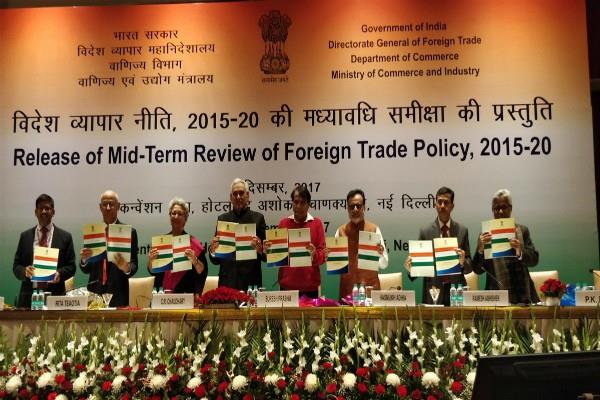
 Export promotion being a constant endeavour of the government, export performance is constantly monitored and export strategy and export policies are formulated. In the Foreign Trade Policy for the years 2015-20 announced in April 2015, the Government spelt out a framework for increasing exports of goods and services as well as generation of employment and increasing value addition in the country, in line with the ‘Make in India’ and “Digital India” program.
Objective
The policy seeks to make India a bigger player in global trade by doubling the overseas sales to $900 billion by 2019-20, while integrating the foreign trade with “Make in India” and “Digital India Programme”.
MEIS and SEIS schemes
Five existing schemes to promote merchandize exports have been merged into a single Merchandise Exports from India Scheme (MEIS). In this scheme, the incentives are to be provided in the form of duty scrips as % of FOB {free on board} value of exports. One scheme for services exports called Served from India Scheme (SFIS) have been replaced in one scheme called Service Exports from India Scheme (SEIS). The benefits of this scheme will be only for India based service providers and will be based on net foreign exchange earned. The benefits of MEIS and SEIS have been extended to the SEZ units also.
Merchandise Exports from India Scheme (MEIS)
Earlier there were 5 different schemes ( Scheme, Market Linked Focus Product Scheme, Focus Market Scheme, Agri. Infrastructure Incentive Scrip, VKGUY) for rewarding merchandise exports with different kinds of duty scrips with varying conditions (secr specific or actual user only) attached to their use. Now all these have been merged into a single scheme, namely Merchandise Export from India Scheme (MEIS) and there would be no conditionality attached to the scrips issued under the scheme.
Rewards for export of notified goods to notified markets under ‘Merchandise Exports from India Scheme (MEIS) shall be payable as percentage of realized FOB value (in free foreign exchange). The debits towards basic customs duty in the transferable reward duty credit scrips would also be allowed adjustment as duty drawback. At present, only the additional duty of customs / excise duty / service tax is allowed adjustment as CENVAT credit or drawback, as per Department of Revenue rules.
Country Groups:
Category A: Traditional Markets (30) -European Union (28), USA, Canada.
Category B: Emerging & Focus Markets (139), Africa (55), Latin America and Mexico (45), CIS countries (12), Turkey and West Asian countries (13), ASEAN countries (10), Japan, South Korea, China, Taiwan
Category C: Other Markets (70).
Products supported under MEIS
Level of Support: Higher rewards have been granted for the following category of products:
- Agricultural and Village industry products, presently covered under VKGUY.
- Value added and packaged products.
- Eco-friendly and green products that create wealth out of waste from agricultural and other waste products that generate additional income for the farmers, while improving the environment.
- Labour intensive Products with large employment potential and Products with large number of producers and /or exporters.
- Industrial Products from potential winning sectors.
- Hi-tech products with high export earning potential.
Markets Supported
- Most Agricultural products supported across the Globe.
- Industrial and other products supported in Traditional and/or Emerging markets only.
High potential products not supported earlier:
Support to 852 Tariff lines that fit in the product criteria but not provided support in the earlier FTP. Includes lines from Fruit Vegetables, Dairy products, Oils meals, Ayush & Herbal Products, Paper, Paper Board Products.
Global support has been granted to the following category:
- Fruits, Flowers, vegetables
- Tea Coffee, Spices
- Cereals preparation, shellac, Essential oils
- Processed foods,
- Eco Friendly products that add value to waste
- Marine Products
- Handloom, Coir, Jute, products and Technical Textiles, Carpets Handmade. Other Textile and Readymade garments have been supported for European Union, USA, Canada and Japan.
- Handicraft, Sports Goods
- Furniture, wood articles
Support to major markets have been given to the following product categories
- Pharmaceuticals, Herbals, Surgicals
- Industrial Machinery, IC Engine, Machine tools, Parts, Auto Components/Parts
- Hand Tools, Pumps of All Types
- Automobiles, Two wheelers, Bicycles, Ships,
- Planes
- Chemicals, Plastics
- Rubber, Ceramic and Glass
- Leather garments, saddlery ims, footwear
- Steel furniture, Prefabs, Lighters
- Wood , Paper, Stationary
- iron, steel, and base metals, products
Other sectors supported under MEIS
- 352 Defence related Product with export of US$ 17.7B consisting of Core Products (20), Dual Use products (60) ,General Purpose products (272).
- 283 Pharmaceutical products of Bulk Drug & Drug Intermediates, Drug Formulations Biologicals, Herbal, Surgicals, and Vaccines.
- 96 lines of Environment related Goods, Machinery, Equipment’s.
- 49 lines where mandatory BIS standards are prescribed.
- 7 lines of Technical Textiles.
Participation in global value chain of the items falling under the scheme:
- 1725 lines of Intermediate Goods – These goods become inputs in the manufacturing of other countries and will strengthen backward manufacturing linkages which is vital for India’s participation in Global Value Chains.
- 1109 lines of Capital Goods sector- will also strengthen Manufacturing Base in India.
- 1730 lines of Consumer Goods sector- We hope a quantum jump in export from this sector with strengthening of Make in India Brand in near future.
Technology based analysis:
- 572 lines-Low skill Technology-intensive manufacturing.
- 1010 lines-Medium skill Technology-intensive manufacturing.
- 1309 lines-High Skill Technology-intensive manufacturing.
Women Centric Products supported under MEIS
Women workers constitute 52% of plantation workers-203 lines of Tea Coffee, Spices, Cashew.
69% of the aggregate female employment is concentrated in the following sectors:
(i) Manufacture of other food products – Jelly Confectionery, tomato ketchup, cooked stuffed pasta, pawa, mudi and the like, gingerbread , papad, pastries and cakes.
(ii) Manufacture of wearing apparel-396 lines of Readymade Garments
Sectors that have a significant proportion of female employment (more than 25%):
(i) Agricultural and animal husband service activities, except veterinary activities– 263 lines of basic Agriculture products.
(ii) Manufacture of footwear – 28 Footwear and Leather products.
(iii) Consumer Electronics and Electronic Components, watches and clocks -483 lines.
Service Exports from India Scheme (SEIS)
Served From India Scheme (SFIS) has been replaced with Service Exports from India Scheme (SEIS). SEIS shall apply to ‘Service Providers located in India’ instead of ‘Indian Service Providers’. Thus SEIS provides for rewards to all Service providers of notified services, who are providing services from India, regardless of the constitution or profile of the service provider.
The rate of reward under SEIS would b based on net foreign exchange earned. The reward issued as duty credit scrip, would no longer be with actual user condition and will no longer be restricted to usage for specifie types of goods but be freely transferable and usable for all types of goods and service tax debits on procurement of services / goods. Debits would be eligible for CENVAT credit or drawback.
The present rates of reward are 3% and 5%. The list of services and the rates of rewards would be reviewed after 30.9.2015.
SECTORS |
Admissible rate |
| BUSINESS SERVICES- Professional services – Legal services, Accounting, auditing and bookkeeping services, Taxation services, Architectural services , Engineering services, Integrated engineering services, Urban planning and landscape architectural Medical and dental services, Veterinary services, Services provided by midwives, nurses, physiotherapists and paramedical personnel | 5% |
| Research and development services – services on natural sciences, R&D services on social sciences and humanities, Interdisciplinary R&D services | 5% |
| Rental/Leasing services without operators to ships, Relating to aircraft, Relating to other transport equipment, Relating to other machinery and equipment | 5% |
| Other business services – Advertising services, Market research and public opinion polling services Management consulting service, Services related to management consulting, Technical testing and analysis services, Services incidental to agricultural, hunting and forestry, Services incidental to fishing, incidental to mining, Services to manufacturing, Services incidental to energy distribution, Placement and supply services of personnel, Investigation and security, Related scientific and technical | |
| consulting services, Maintenance and repair of equipment (noincluding maritime vessels, aircraft or other transport equipment), Building-cleaning services, Photographic services, Packaging services, Printing, publishing and Convention services | 3% |
| COMMUNICATION SERVICES – Audvisual services – Motion picture and video tape production and distributio Motn picture projection service, Radio and television services, Radio and television transmission services, Sound recording | 5% |
| CONSTRUCTION AND RELATED ENGINEERING SERVICES – General Construction work for building, General Construction work for Civil Engineering, Installation and assembly work , Building completion and finishing work | 5% |
| EDUCATIONAL SERVICES (Please refer Note 1) – Primary education services, Secondary education services, Higher education services, Adult education | 5% |
| ENVIRONMENTAL SERVICES – Sewage services, Refuse disposal, Sanitation and similar services | 5% |
| HEALTH-RELATED AND SOCIAL SERVICES – Hospital services | 5% |
| TOURISM AND TRAVEL-RELATED SERVICES – Hotels and Restaurants (including catering), Hotel, Restaurants (including catering) | 3% |
| Travel agencies and tour operators services C. Tourist guides services | 5% |
| RECREATIONAL, CULTURAL AND SPORTING SERVICES (other than audiovisual services) – Entertainment services (including theatre, live bands and circus services) News agency services, Libraries, archives, museums cultural services, Sporting and other recreational services | 5% |
| TRANSPORT SERVICES (Please refer Note 2) – Maritime Transport Services, Passenger transportation*, Freight transportation* , Rental of vessels with crew *, Maintenance and repair of vessels, Pushing and towing services, Supporting services for maritime transport, Air transport services, Rental of aircraft with crew Maintenance and repair of aircraft, Airport Operations and ground handling, Road Transport Services, Passenger transportation, Freight transportation, Rental of Commercial vehicles with operator, Maintenance and repair of road transport equipment, Supporting services for road transport services, Services Auxiliary To All Modes Of Transport, Cargo-handling services, Storage and warehouse services, Freight transport agency services | 5% |
Note:
(1) Under education services, SEIS shall not be available on Capitation fee.
(2) *Operations from India by Indian Flag Carriers only is allowed under Maritime transport services.
Transferable Duty Scrips
A scrip literally means a “chit” and refers to a form of credit. The Duty free scrips are provided to the exporters under various export promotion schemes of the government s. Under these schemes, the exporters get incentives at a certain percentage of the export value and these incentives can also be used to reimburse duties on imported inputs. The scrips may be transferable or non-transferable. If they are transferable the holder of these scrips can sell them in market at discount. If the scrips are non-transferable, they come with actual user condition and the holder can use it to import inputs or capital goods duty free. The foreign Trade Policy 2015 makes all duty free scrips freely transferable. These scrips can be used for payment of custom duty, excise duty and service tax also.
Status Holders
Merchant as well as Manufacturer Exporters, Service Providers, Export Oriented Units (EOUs) and Units located in Special Economic Zones (SEZs), Agri. Export Zones (AEZs), Electronic Hardware Technology Parks (EHTPs), Software Technology Parks (STPs) and Bio-Technology Parks (BTPs) are recognized as various status holders as follows:
Status |
Business in million US dollars |
| One Star Export House | 3 |
| Two Star Export House | 25 |
| Three Star Export House | 100 |
| Four Star Export House | 500 |
| Five Star Export House | 2000 |
A status holder is eligible for many benefits such as self declaration during custom clearances; exception from some documents and receipts various incentives. In the foreign Trade Policy 2015-20, the government says promises to reduce transaction costs of the status holders.
Make in India
To integrate the FTP with Make in India, the government has reduced export obligation for capital goods purchased from Indian suppliers under the EPCG {Export Promotion of Capital Goods} scheme. The exporters who export with high level of domestic content get higher level rewards.
Trade facilitation and ease of doing business
The policy calls for online filing of documents/ applications and paperless trade in 24×7 environments; online inter-ministerial consultations and simplification of procedures/processes, digitisation and e-governance. Henceforth, hardcopies of applications an specified documents would not be required to be submitted to RA, saving paper as well as cost and time for the exporters. To start with, applications under Chapter 3 & 4 of FTP are being covered (which account for nearly 70% of total applications in DGFT). Applications under Chapter-5 would be taken up in the next phase. As a measure of ease of doing business, landing documents of export consignment as proofs for notified market can be digitally uploaded in the following manner:-
- Any exporter may upload the scanned copy of Bill of Entry under his digital signature.
- Status holders falling in the category of Three Star, Four Star or Five Star Export House may upload scanned copies of documents.
It is proposed to have Online inter-ministerial consultations for approval of export of SCOMET items, Norms fixation, Import Authorisations, Export Authorisation, in a phased manner, with the objective to reduce time for approval. As a result, there would not be any need to submit hard copies of documents for these purposes by the exporters.
Under EPCG scheme, obtaining and submitting a certificate from an independent Chartered Engineer, confirming the use of spares, tools, refractory and catalysts imported for final redemption of EPCG authorizations has been dispensed with.
Certain information, like mobile number, e-mail address etc. has been added a mandatory fields, in IEC data base. This information once provided by exporters, would help in better communication with . SMS/ email would be sent to exporters to inform them about issuance of authorisations or status of their applications.
It has been decided to have on line message exchange with CBDT fr PAN data and with Ministry of Corporate Affairs for CIN and DIN data. This integration would obviate the need seeking information from IEC holders for subsequent amendments/ updation of data in IEC data base.
Other measures include
- Measures to facilitate & encourage export of defence goods
- e-Commerce Exports: Benefits of foreign trade policy to export of items up to Rs. 25,000 per consignment
- Benefit available to handloom products, books / periodicals, leather footwear, toys and customized fashion garments
- New initiatives for EOUs {Export Oriented Units}, EHTPs {Electronic Hardware Technology Parks} and STPs {Software Technology Parks}. They can share infrastructure & inter-unit transfer of goods allowed.
Prohibited Items
- India’s Foreign Trade Policy prohibits the following:
- Import & Exports trade in “arms and related material ” with Iraq
- Any defense related equipment from North Korea
- Any content which might enhance the nuclear energy adventures of Iran
- Import of Charcoal from Somalia. We note here that UNSC Resolution 2036 had banned all exports from Somalia and India honours this resolution. Charcoal exports from Somalia are a significant revenue source for Al-Shabaab.
EOUs, EHTPs and STPs
EOUs, EHTPs, STPs have been allowed to share infrastructural facilitie among themselves. This will enable units to utilize their infrastructural facilities in an optimum way and avoid duplication of efforts and cost to create separate infrastructural facilities in different units.
Inter unit transfer of goods and services have been allowed among EOUs, EHTPs, STPs, and BTPs. This will facilitate group of those units which source inputs centrally in order to obtain bulk discount. This will reduce cost of transportation, other logistic costs and result in maintaining effective supply chain.
EOUs have been allowed facility to set up Warehouses near the port of export. This will help in reducing the time for delivery of goods and will also address the issue of unpredictability of supply orders.
STP units, EHTP units, software EOUs hav been allowed the facility to use all duty free equipment/goods for training purposes. This will help these units in developing skills of their employees. 100% EOU units have been allowed facility supply of spares/ components up to 2% of
the value of the manufactured articles to a buyer in domestic market for the purpose of after sale services.
At present, in a period of 5 years EOU units have to achieve Positive Net Foreign Exchange Earning (NEE) cumulatively. Because of adverse market condition or any ground of genuine hardship, then such period of 5 years for NFE completion can be extended by one year.
Time period for validity of Letter of Permission (LOP) for EOUs/EHTP/ STPI/BTP Units has been revised for faster implementation and monitoring of projects. Now, LOP will have an initial validity of 2 years to enable the unit to construct the plant and install the machinery. Further extension can be granted by the Development Commissioner up to one year. Extension beyond 3 years of the validity of LOP, can be granted, in case unit has completed 2/3rd of activities, including the construction activities.
At present, EOUs/EHTP/STPI units are permitted to transfer capital goods to other EOUs, EHTPs, STPs, SEZ units. Now a facility has been provided that if such transferred capital goods are rejected by the recipient, then the same can be returned to the supplying unit, without payment of duty. A simplified procedure will be provided to fast track the de-bonding / exit of the STP/ EHTP units. This will save time for these units and help in reduction of transaction cost.
EOUs having physical export turnover of Rs.10 crore and above, have been allowed the facility of fast track clearances of import and domestic procurement. They will be allowed fast tract clearances of goods, for export production, on the basis of pre-authenticated procurement certificate, issued by customs / central excise authorities. They will not have to seek procurement permission for every import consignment.
Merchandise Export from India
Scheme The six different schemes of the earlier FTP (Focus Product Scheme, Market Linked Focus Product Scheme, Focus Market Scheme, Agriculture Infrastructure Incentive Scrip, Vishesh Krishi and Gram Udyog Yojana and Incremental Export Incentive Scheme) which had varying sector-specific or actual user only conditions attached to their use have been merged into a single scheme, namely the Merchandise Export from India Scheme (MEIS). Notified goods exported to notified markets will be incentivized on realized FOB value of exports. For the purpose of granting incentibes, the countries have been grouped into three categories as follows:
- Category A: traditional markets
- Category B: emerging & focus markets
- Category C: other markets
Government has expanded the coverage of the MEIS on 29 October 2015 by adding 110 new items. The incentive rate/country coverage of 2228 items has been enhanced.
Comment on FTP-2015-20
The new foreign trade policy aims to double India’s exports to $900 billion by 2020. To achieve this target, the exports need to grow at about 14% every year. This growth is a function of global recovery, which seems to be distant at present. However, the policy must be lauded for its recognition that exports cannot be made competitive just by throwing sops for exporters. The government has made the duty free scrips freely transferable as per the global norms. This would be used by exporters to pay indirect taxes and duties and will be available to SEZs too. Further, the Export obligation under the Export Promotion Capital Goods Scheme has also been reduced, ostensibly to give a boost to “Make in India”. All these are efforts towards making exports more competitive. What India needs to do is to raise the share of manufacturing in its economy and promote exports of manufactured goods. Towards this direction, the government needs to slash and rationalize import duties further.
 Directorate General Of Foreign Trade | Ministry Of Commerce And Industry | Government Of India,Trade