Introduce Yourself (Example Post)

This is an example post, originally published as part of Blogging University. Enroll in one of our ten programs, and start your blog right.

You’re going to publish a post today. Don’t worry about how your blog looks. Don’t worry if you haven’t given it a name yet, or you’re feeling overwhelmed. Just click the “New Post” button, and tell us why you’re here.

Why do this?

  • Because it gives new readers context. What are you about? Why should they read your blog?
  • Because it will help you focus you own ideas about your blog and what you’d like to do with it.

The post can be short or long, a personal intro to your life or a bloggy mission statement, a manifesto for the future or a simple outline of your the types of things you hope to publish.

To help you get started, here are a few questions:

  • Why are you blogging publicly, rather than keeping a personal journal?
  • What topics do you think you’ll write about?
  • Who would you love to connect with via your blog?
  • If you blog successfully throughout the next year, what would you hope to have accomplished?

You’re not locked into any of this; one of the wonderful things about blogs is how they constantly evolve as we learn, grow, and interact with one another — but it’s good to know where and why you started, and articulating your goals may just give you a few other post ideas.

Can’t think how to get started? Just write the first thing that pops into your head. Anne Lamott, author of a book on writing we love, says that you need to give yourself permission to write a “crappy first draft”. Anne makes a great point — just start writing, and worry about editing it later.

When you’re ready to publish, give your post three to five tags that describe your blog’s focus — writing, photography, fiction, parenting, food, cars, movies, sports, whatever. These tags will help others who care about your topics find you in the Reader. Make sure one of the tags is “zerotohero,” so other new bloggers can find you, too.

Spanish language for Exporter Importer

Spanish language for Exporter Importer

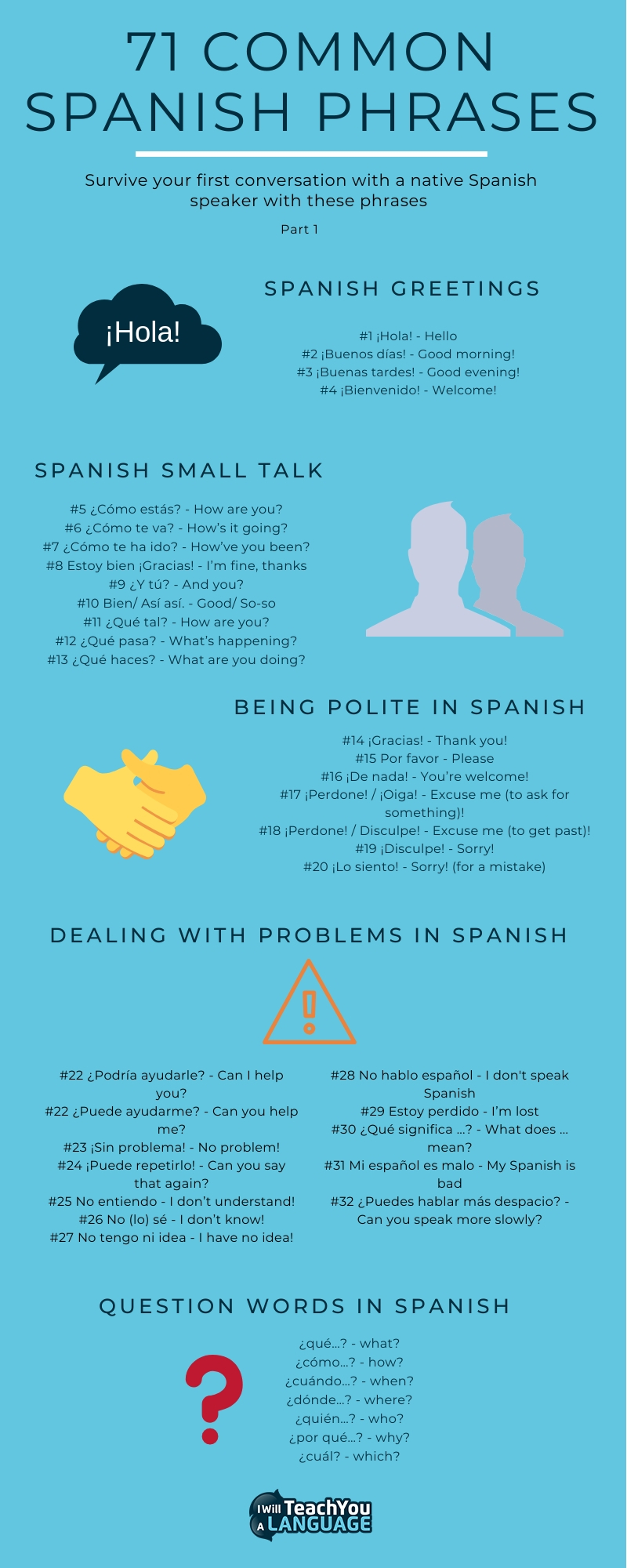
71 common Spanish phrases part 1

Spanish Greetings

spanish greetings barcelona
Understanding what you should say when you meet and greet people is the least you can do if you want to make a good impression.
After all, you’re going to be using greetings every time you have a conversation in Spanish!
These phrases are simple, easy to remember and will go a long way to help you make friends and have your first conversations in the language.
  • #1 ¡Hola! – Hello
    • (O-la)
  • #2 ¡Buenos días! – Good morning!
    • (BWAY-nos DEE-as)
  • #3 ¡Buenas tardes! – Good evening!
    • (BWAY-nas TAR-des)
  • #4 ¡Bienvenido! – Welcome!
    • (Bee-en-ven-EE-doh)
I’ve included tips for pronouncing each phrase in brackets, but it’s always best to listen to how native speakers talk if you really want to master pronunciation.
If you’re confused about how to pronounce any of these phrases, you can look them up on Forvo (an online pronunciation dictionary) and hear them spoken by native speakers.

Keeping The Conversation Going: Small Talk In Spanish

barcelona spanish people conversation
Making small talk is something you’re going to do a lot of. So there’s every reason to know how to do it properly.
Besides, small talk is the gateway to real communication; you need to be able to do it in order to really speak to a person.
Making small talk is not something most of us enjoy in our own language, so doing it in a foreign language can be a bit daunting. But trust me, being able to engage in small talk will allow you to get a conversation started.
Making conversation in whatever way you can as a beginner will allow you to grow in confidence and figure out what you need to learn next in Spanish.
Here are some phrases you can use to get the conversation going:
  • #5 ¿Cómo estás? – How are you?
    • (KOH-moh eh-STAHS)
  • #6 ¿Cómo te va? – How’s it going?
    • (KOH-moh te BAH)
  • #7 ¿Cómo te ha ido? – How’ve you been?
    • (KOH-moh te ha EE-doh)
  • #8 Estoy bien ¡Gracias! – I’m fine, thanks
    • (eh-STOY bee-en GRA-thee-as/GRA-see-as)
  • #9 ¿Y tú? – And you?
    • (ee too)
  • #10 Bien/ Así así. – Good/ So-so
    • (bee-en / a-SEE a-SEE)
  • #11 ¿Qué tal? – How are you?
    • (kay tal)
  • #12 ¿Qué pasa? – What’s happening?
    • (kay PA-sa)
  • #13 ¿Qué haces? – What are you doing?
    • (kay AH-says)
Did you notice anything strange about the pronunciation of the phrase ¿Cómo te va?
The ‘v’ in va is pronounced almost like a ‘b’.
In English, the letter’s ‘b’ and ‘v’ represent different sounds, but in Spanish, they represent the same sound.
This sound is different from anything we have in English. It’s like a B, but softer. Listen to how I pronounce the word ¡Vale! (‘ok’) in this recording to see how it sounds:

To find out more, check out my complete guide to the difference between ‘b’ and ‘v’ in Spanish. 

Being Polite In Spanish

polite spanish restaurant córdoba
Of course, no matter what language you’re speaking, politeness goes a long way. Whether you need to make an apology or just want to thank someone, you’re going to use these phrases a lot!:
  • #14 ¡Gracias! – Thank you!
    • (GRA-thee-as/GRA-see-as)
  • #15 Por favor – Please
    • (por FAH-vor) 
  • #16 ¡De nada! – You’re welcome!
    • (de NA-da)
  • #17 ¡Perdone! / ¡Oiga! – Excuse me (to ask for something)!
    • (per-DON-ay/ OY-ga)
  • #18 ¡Perdone! / Disculpe! – Excuse me (to get past)!
    • (per-DON-ay/ dis-KUL-pay)
  • #19 ¡Disculpe! – Sorry!
    • (if you didn’t hear something) (dis-KUL-pay)
  • #20 ¡Lo siento! – Sorry! (for a mistake)
    • (lo see-EN-to)

Dealing With Problems In Spanish

travel map directions
Of course, not every conversation or language exchange will go smoothly.
What should you do when you don’t understand something? Or if you need to ask someone for help?
It’s important to know some basic Spanish phrases you can use for dealing with problems when they arise. If you need someone to speak more slowly or to repeat something, the best thing to do is just ask them!
  • #22 ¿Podría ayudarle? – Can I help you?
    • (poh-DREE-a ay-oo-DAR-le)
  • #22 ¿Puede ayudarme? – Can you help me?
    • (PWE-day ay-oo-DAR-may)
  • #23 ¡Sin problema! – No problem!
    • (sin prob-LAME-ah)
  • #24 ¡Puede repetirlo! – Can you say that again?
    • (PWE-day re-pet-EER-lo)
  • #25 No entiendo – I don’t understand!
    • (no en-tee-EN-do)
  • #26 No (lo) sé – I don’t know!
    • (no lo say)
  • #27 No tengo ni idea – I have no idea!
    • (no TEN-go nee ee-DAY-ah)
  • #28 No hablo español – I don’t speak Spanish
    • (no AB-lo es-pan-YOL)
  • #29 Estoy perdido – I’m lost
    • (eh-STOY per-DEE-do)
  • #30 ¿Qué significa …? – What does … mean?
    • (kay sig-nif-EE-ka)
  • #31 Mi español es malo – My Spanish is bad
    • (mi es-pan-yol es MA-lo)
  • #32 ¿Puedes hablar más despacio? – Can you speak more slowly?
    • (PWE-des ab-LAR mas des-PATH-ee-o)
The word despacio in the last phrase is interesting.Notice that the ‘c’ is pronounced like ‘th’ in this context.
This is the traditional Spanish pronunciation used in Spain. However, in Latin America, people pronounced the ‘c’ as an ‘s’ sound (e.g. des-PAS-ee-o).
Curious about this and other variations in Spanish in the world? This guide explains the 3 key differences in Spanish varieties that you’ll hear in different countries and regions.

Question Words In Spanish

barcelona spain
Conversation is a two-way street. So if you want to really connect with people, you need to be able to ask questions. Here are the Spanish question words you need to know:
  • ¿qué…? – what?
    • (kay)
  • ¿cómo…? – how?
    • (KOH-moh)
  • ¿cuándo…? – when?
    • (KWAN-doh)
  • ¿dónde…? – where?
    • (DON-day)
  • ¿quién…? – who?
    • (KEE-en)
  • ¿por qué…? – why?
    • (por KAY)
  • ¿cuál? – which?
    • (kwal)
It’s a good idea to just memorise these words right away. You’re going to come across them again and again so it’s important you’re comfortable with them.
Pro tip: Question words are always written with an accent and with opening/closing question marks.
There are lots of questions which we use regularly in everyday conversation but we often don’t realise how important they are.
Not having them in your repertoire will leave you tongue-tied and at a loss in many situations.
Here are some examples of questions that are useful to know:
  • #33 ¿Como te llamas? – What is your name?
    • (KOH-moh teh yah-mas)
  • #34 ¿Qué hora tienes? – What time is it?
    • (kay OH-ra tee-EN-es)
  • #35 ¿Dónde puedo comprar…? – Where can I buy…?
    • (DON-day pway-DO kom-PRAR)
  • #36 ¿Cuántos años tienes? – How old are you?
    • (KWAN-tos AN-yos tee-EN-es)
  • #37 ¿De dónde viene? – Where are you from?
    • (de DON-day vee-EN-ay)
  • #38 ¿Dónde vives? – Where do you live?
    • (DON-day VEE-ves)
  • #39 ¿Tienes hermanos o hermanas? – Do you have brothers or sisters?
    • (tee-EN-es er-MA-nos o er-MA-nas)
  • #40 ¿Cuánto cuesta eso? – How much is that?
    • (KWAN-to KWES-ta eso)
  • #41 ¿Qué es esto? – What is this?
    • (kay es ES-to)
  • #42 ¿Entiende? – Do you understand?
    • (en-tee-EN-day)
  • #43 ¿Comprende? – Do you understand?
    • (com-prEN-day)
  • #44 ¿Hablas inglés? – Do you speak English?
    • (AB-las in-glAYs)
  • #45 ¿Dónde está el baño? – Where is the bathroom?
    • (DON-day es-TAH el BAN-yo)

Talking About Yourself & Answering Questions In Spanish

71 common Spanish phrases
Learning how to ask questions in Spanish is all good and well. But if you’re dealing with questions, you need to be able to deal with answers too!
Here’s how you can respond to some of the questions above:
  • #46 Me llamo… – My name is…
    • (me YA-mo …)
  • #47 Mi nombre es… – My name is
    • (mi NOM-bray es …)
  • #48 (Yo) tengo … años – I am … years old.
    • (yo TEN-go … AN-yos)
  • #49 (Yo) soy de… – I come from ….
    • (yo soy de …)
  • #50 Sí – Yes
    • (see)
  • #51 No – No
    • (no)
  • #52 Tal vez – Maybe
    • (tal ves)
  • #53 Siempre – Always
    • (see-EM-pray)
  • #54 Nunca – Never
    • (NUN-kah)
  • #55 A veces – Sometimes
    • (A VE-says)
  • #56 Claro – Of course
    • (KLA-ro)

Spanish Expressions For Special Occasions

spanish seaside
There are a number of common expressions that are used regularly to denote special circumstances or for special occasions.
These phrases are ideal for events like birthdays, meals with friends or even for ending the conversation:
  • #57 ¡Diviértete! – Have fun!
    • (di-vi-EHR-te-te)
  • #58 ¡Buen viaje! – Have a good trip!
    • (bwu-en vi-AH-kay)
  • #59 ¡Buen provecho! – Bon appetit!
    • (bwu-en pro-VE-choh)
  • #60 ¡Muy bien! – Well done!
    • (mwee bee-en)
  • #61 ¡Cuídate! – Take care!
    • (kw-EE-dah-tay)
  • #62 ¡Felicitaciones! – Congratulations!
    • (fe-lis-i-ta-see-ON-es)
  • #63 ¡Bienvenidos! / ¡Bienvenidas! – Welcome!
    • (bee-en-ven-EE-dos / bee-en-ven-EE-das)
  • #64 ¡Feliz Cumpleaños! – Happy Birthday!
    • (fe-LEES kump-lay-AN-yos)
  • #65 Salud! – Cheers!
    • (Sa-LOOD)

Saying Goodbye In Spanish

asturias spain evening
Saying goodbye is never easy, especially in a foreign language when you don’t know how to do it!
Whether you are bidding farewell to friends you’re going to see later or to somebody you’ll never see again, make sure you know how to say your goodbyes appropriately.
In any case, Spanish has lots of different options:
  • #66 Adiós – Goodbye
    • (ah-dee-OS)
  • #67 ¡Buenas noches! – Goodnight!
    • (bway-nas no-ches)
  • #68 ¡Hasta luego! – See you later
    • (AS-ta loo-AY-go)
  • #69 ¡Hasta pronto! – See you soon
    • (AS-ta PRON-to)
  • #70 ¡Hasta mañana! – See you tomorrow
    • (AS-ta man-YAN-a)
  • #71 Nos vemos – See you
    • (nos VAY-mos)

NEWS FOR EXPORTERS IMPORTERS – GOOGLE MY BUSINESS

Google My Business is also known as GMB. It is an essential factor to get your business you on Google Search Engine.
 GMB helps the users to get all the relevant data at one place through which the users get satisfied. GMB is a free tool which help the business to appear on Google search as well as on Google Map. Through GMB the users get information like company details, location, number, website, working hours, customers review, etc.

 Important Factors required to publish your business on GMB is

: 1. Company Name: The company is can registered by providing all the details and the Google will mail you to get live on Google Search Engine.

 2. E-Mail Id: Google send email on the registered email id. Google send the password link of password which is used to make the GMB live on Google Search Engine & the Password is generated in 7 to 15 working days.
 3. Phone No: The phone needs to be registered which will help the users/ customers to co-ordinate and get all the relevant details they require.

 4. Website URL: In website URL we can upload the website link, blog, etc. where we generate backlinking. The website URL the business can generate more traffic on the link provided

. 5. Business Address: Business address is very important factor is GMB. It is verified when the Google generates the password on the email id. Other Factors which are required to publish your business on GMB is: 1. Images/ videos: The business can upload images of the office, logo, templates, etc. or a short video of 30 seconds 2. Business hours: The business hour help the user/ customers to know the business time of the company. 3. Rating & Reviews: Review and rating helps the user to build trust and satisfaction towards a particular business they are looking for. 4. Web Reviews: It means the business can linked other website reviews with Google My Business to make their users/ customers aware about their business. Web reviews example is JustDail, Sulekha, etc. Details Reviewed in insight report: 1. No of visitors visited their GMB 2. Percentage of viewers Viewing their business 3. How many times the views have visited? 4. Reviews & ratings done by their customers.

Trade Trend Analysis in Europe 2019

Trade Trend Analysis in Europe 2019

On the basis of the export data of April, 2019, the top 6 European nations which had the highest demand for Indian engineering products are- Cyprus, Germany, U K, Italy, France and Belgium with their respective trade values are shown in Table 1.  trade trend analysis Cyprus being a surprise entry this month, thus top six nations have been considered instead of five.

As As demonstrated by the table above, only Cyprus and France exhibited the positive growth rate for exports of engineering products from India in April, 2019 when compared to April, 2018. The growth was monumental in case of Cyprus, approx. 37680.56% followed by France at 6.50%

Considering   the trend analysis   top 6 export destinations of India in Europe namely Cyprus, Germany, U K, Italy, France and Belgium, and then analyzing the top panels exported from India to these destinations for April, 2019, we observe that Iron and Steel, Products of Iron & Steel, Auto Components/Parts, Motor Vehicle/cars, Industrial machinery and Electric machinery are the most traded panels across all countries except Cyprus. In the case of Cyprus, the share of the Ships, Boats and Floating Structures was almost 100%.

The link for the website is: http://trade.ec.europa.eu/tradehelp/

HOW TO FIND INDIAN MARKET FOR FOR YOUR PRODUCT

HOW TO FIND INDIAN  MARKET FOR FOR YOUR PRODUCT 

Export of Top 5 Categories of Organic Products under National Programme of Organic Production during 2016-17

May 20, 2019Author : OGD PMU Team

Annual growth of 17.48% has been observed in total Export of Organic Products under National Programme of Organic Production (NPOP) during 2016-17 in comparison to de-growth of -7.68% during 2015-16. Total Export of Organic Products under NPOP was 285607.81 MT, 263687.011 MT and 309766.94 MT from 2014-15 to 2016-17 respectively. The Top 5 Categories in terms of Export of Organic Products under NPOP during 2016-17 were Oil Seeds & Crops, Processed Foods, Cereals & Millets, Sugar Crops and Pulses.
Export of Oil Seeds & Crops under NPOP was 132503.93 MT during 2016-17, up by 40 basis points versus 131981.589 MT during 2015-16. It accounted 42.78% of the total Export of Organic Products under NPOP during 2016-17. We have seen annual growth of 92.07% in Export of Processed Foods under NPOP from 38453.878 MT during 2015-16 to 73859.65 MT during 2016-17. It accounted 23.84% of the total Export of Organic Products under NPOP during 2016-17. Export of Cereals & Millets under NPOP was 44113.941 MT during 2015-16. It has decreased by -19.85% to 35356.76 MT during 2016-17 above 2015-16. It accounted 11.41% of the total Export of Organic Products under NPOP during 2016-17.
Annual growth of 9.57% has been seen in Export of Sugar Crops under NPOP during 2016-17 against 47.32% during 2015-16. Export of Sugar Crops under NPOP was 28654.361 MT and 31396.4 MT during 2015-16 and 2016-17 respectively. Annual growth of 179.56% has been found in Export of Pulses under NPOP during 2016-17 in comparison to 89.15% during 2015-16. Export of Pulses under NPOP was 4817.645 MT during 2015-16 and 13468.09 MT during 2016-17. Export of Sugar Crops and Pulses accounted for 10.14% and 4.35% respectively of the total Export of Organic Products under NPOP during 2016-17.
Note: Source: RAJYA SABHA SESSION – 245 UNSTARRED QUESTION NO. 4495; NA: Not Available; Source: Data provided by the accredited Certification Bodies under NPOP on tracenet.
Resource Title: Category-wise Export of Organic Products under National Programme of Organic Production (NPOP) from 2014-15 to 2016-17 (From: Ministry of Agriculture and Farmers Welfare)
View in Visualization Tool 

Source: Rajya Sabha

The scheme of Remission of Duties or Taxes on Export Products (RoDTEP) will replace MEIS SCHEME by 2020

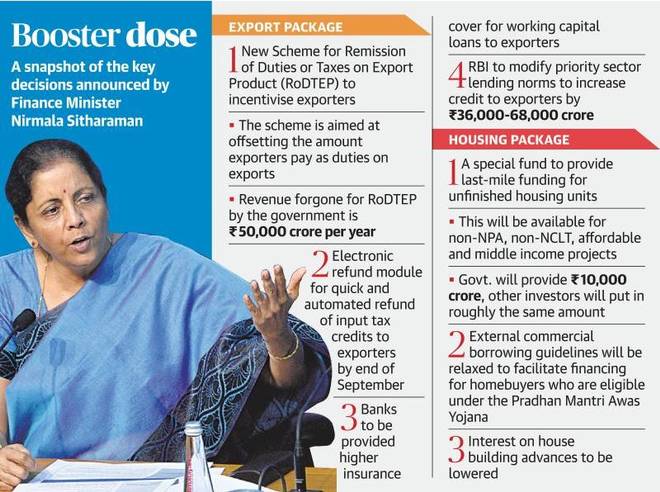
India’s exports in August dropped by 6.05 per cent in comparison to the August 2018 mark, Finance Minister Nirmala Sitharaman on Saturday announced the Remission of Duties or Taxes on Export Product (RoDTEP) scheme to boost the exports. The minister said the revenue foregone towards the scheme is projected at Rs 50,000 crore.
The announcement comes in the backdrop of India’s merchandise exports declining by 6.05 per cent to USD 26.13 billion in August compared to the year-ago month.
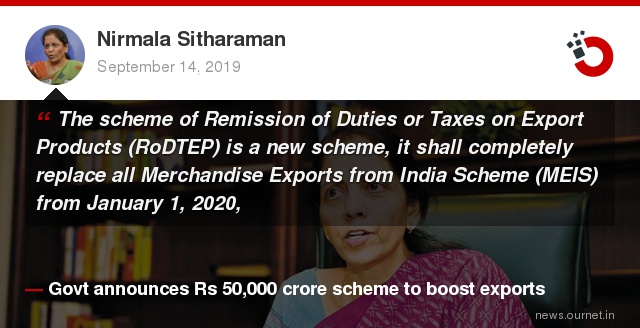
“The scheme of Remission of Duties or Taxes on Export Products (RoDTEP) is a new scheme, it shall completely replace all Merchandise Exports from India Scheme (MEIS) from January 1, 2020,” Nirmala Sitharaman said.
Addressing a press conference, Nirmala Sitharaman also announced that there will be a fully automated electronic refund route for input tax credits (ITC) in the Goods and Services Tax (GST). This, she said, will be implemented by September end.The move, Nirmala Sitharaman said, is aimed at quick and automated refunds of ITC.
To further boost exports, Nirmala Sitharaman said, “Textiles and sectors which currently enjoy incentives upto 2 per cent over MEIS will transit into RoDTEP from January 1.” In effect, she said, the RoDTEP will more than adequately incentivize exporters than existing schemes put together.
Sitharaman also said that the government will offer a higher insurance cover to banks working lending capital for exports.
“Export Credit Guarantee Corporation (ECGC) will expand scope of ECIS and offer higher insurance cover to banks lending working capital for exports in a move which will cost Rs 1,700 crores per annum to the government,” the finance minister announced.
Design a site like this with WordPress.com
Get started