Ways to overcome Negative thoughts in export business

Basically export means shipping of goods and services out of the legal jurisdiction of a country. International trade business is mostly assumed to be highly complicated and full of risk.  Many times, business people hold back from investing in international trade due to a negative perception. In order to overcome such negative thoughts, it would be wise to conduct a proper assessment of the risks involved in this form of trade and weigh them against anticipated benefits. You can learn the whole export procedure from some educational institutes.
Exports business forms a major part of a country’s GDP and has a number of benefits in store for the businesses that do international trade. However, due to the risks and complications associated with trading in countries with different financial, cultural and legal systems, many businesses have negative thoughts on undertaking export business.
Following are the negative thoughts that one comes across during an export business –
  1. Complications –
Fear of extra formalities than the regular domestic business, exporting is complicated in form of mental stress, time, legal formalities, etc.
  1. Completion –
Every business begins with a very small margin and order and nothing comes in bulk. One needs to expand its horizons slowly and steady studying all the factors and environment.
  1. High Risk –
Business is all about overcoming hindrances. Risk can be of any type – selling techniques, production technique, the cost of production, labor hired, production of goods, promoting methods, etc. To do business one should have the capability to take the risk.
  1. Affordability –
All beginnings are small. It is not compulsory to invest a huge amount of money for starting an export business.
Instead of letting the negative thoughts hamper the business, one should weigh these thoughts down against the anticipated benefits of exporting. This is just one of the various ways you can overcome negative thoughts in your export business.
Below mentioned are the ways to overcome negative thoughts in export business –
  1. Understand & Identify The Risk –
Every line of trade has some specific risks associated with it. There is always a proven way to mitigate any risk associated with your export business and with prior research and analysis, you can do the same. It is important that you identify the risks in your line of trade and find out effective solutions to avoid any negative results.
  1. Analyze Cultural, Legal & Financial Barriers –
While trading with a foreign country, there are numerous legal, financial and cultural barriers that you may have to overcome to become successful.  To overcome the negative thoughts it is important to assess and study all these barriers before making any trade decision.
  1. Make Forward Exchange Contracts –
Currency fluctuation is one of the most common reasons for negative thoughts. Currency tends to fluctuate every day and so making foreign exchange contracts with the importing business would be advisable.
  1. Imagine about the brighter prospects –
Fears such as fear of failure, fear of risks, fear of extra formalities give rise to negativity. To avoid the same you should focus more on the brighter prospects.

Looking For Distributer/Dealer for our products

Title
Looking For Distributer/Dealer for our products  
Company Namehttp://www.projectexports.com/
capious roadtech pvt ltd  
Description
We would like to introduce ourselves as one of the leading manufacturer of Road Construction equipments in India with ISO 9001:2008 .Having strong presence in India and world like U.S.A,Europe, Latin America, Gulf, Middle East& African Countries. Our Product Range include:- *Automatic Asphalt Drum Mix Plant up to 250 TPH capacity. *Automatic Counter Flow Asphalt Drum Mix Plant with Bag House Filter. *Mechanical Paver with Hydraulically Extendable Screed. *Wet Mix Plants up to 300 TPH Capacity. *Concrete Batching Plant. *Bitumen/Emulsion Sprayer Distributors. *Road Broomer. *Chips/Metal Spreader. *Kerb Paver. In short span of time we have cliental base of more than 300 units, with repeat orders and from users of others brands switching over to us, Is the testimony of our quality and customer satisfaction. While designing our equipments, we have not only taken care of its reliability and smooth operation but have also ensured low operating cost and easy serviceability. The Insulated Thermodrum ensure lower fuel consumption and in turn saves substantial amount of money in year’s time. The paver offers largest capacity conveyor system throughout the paving system and is available with extendable screed and the Wet Mix Macadam Plant provides homogeneous mix material to prepare sub base in Road construction. You can login to our website http://www.capious.com for detail information. Please feel free to write or call to us for any detail, clarification

Export Promotion Councils of India

Apparel Export Promotion Council
Apparel House, Institutional Area Sector-44,
Gurgaon-122003, Haryana
Phone: 0124-2708000-3
Fax : 0124-2708004
Basic Chemicals, Pharmaceuticals and Cosmetics
Export Promotion Council (CHEMEXCIL)     
Jhansi Castle, 4th floor,
7-Cooperage Road, Mumbai – 400039
Tel. : (91)22-2021288/2021330/2026549
Fax : (91)22-2026684
Carpet Export Promotion Council
Niryat Bhawan, 3rd Floor, Rao Tula Ram Marg,
Opp: R.R. Army Hospital, New Delhi -110057
Tele: 91-11-2615 3466, 91-11-2615 3467
Fax: 91-11-2615 3465
Email: cepc.nd@gmail.com
Cashew Export Promotion Council
Cashew Bhavan, Mundakkal, Kollam – 691001, Kerala, India
Tel.: 0474 2742704/2761003
Fax: 0474 2742704
Email: cepc@cashewìndia.org, cchi.kollam@cashewìndìa.org
Chemicals and Allied Products Export Promotion
Council (CAPEXIL)
Vanijya Bhavan”, International Trade Facilitation Center,
3rd Floor, 1/1 Wood Street, Kolkata-700016
Tel. : (91)-33-22890524/0525
Fax : (91)33-22891724
E-mail: capexil@capexil.in
Council for Leather Exports
3rd floor, CMDA Tower-2 Gandhi Irwin Bridge Road,
Egmore, Chennai – 600008
Tel. : (91)44-28594367-71(5 lines)
Fax : (91)44-28594363/64
E-Mail : cle@vsnl.com
Electronics and Computer Software 
Export Promotion Council

3rd Floor, PHD House 
Opp. Asiad Village 
New Delhi 110016 
Tel:+ 91 11 26965103    26964463  47480000
Fax: +91 11 26853412
Email : info@escindia.com
Engineering Export Promotion Council,
India (EEPC India)  
                                                                                        
Vanijya Bhawan, 1st Floor, International Trade Facilitation Centre,
1/1, Wood Street, Kolkata – 700016
Tel. : 91-33-22890651/52
Fax : 91-33-22890654

E-mail : eepcho@eepcindia.net 
Export Promotion Council for EOUs & SEZ Units
8G,8th Floor, Hansalaya Bldg.,
15, Barakhamba Road,
New Delhi – 110001
Tel. : (91)11-23329766-69
Fax : (91)11-23329770
E-Mail : epces@vsnl.netepcesho@hotmail.com , epcesho@gmail.com
Export Promotion Council for Handicrafts
EPCH House, Pocket 6&7, Sector ‘C’,
LSC, Vasant Kunj, New Delhi-110070
Tel: +91-11+26135256 
Fax: +91-11-26135518 & 19 
Email: mails@epch.com
Gem and Jewellery Export Promotion Council
Office No. AW 1010, Tower A, G Block, 
Bharat Diamond Bourse, Next to ICICI Bank,
Bandra-Kurla Complex, Bandra – East,
Mumbai – 400 051, India 
Tel :91-22-26544600
Fax :91-22-26524764
Email :ho@gjepcindia.com
Indian Oil Seeds & Produce Export Promotion Council
78-79, Baja] Bhavan, Nariman Point,
Mumbai- 400 021
Tel.: (91) 22 22023225/22029295
Fax: (91) 22 22029236
Email: info@iopepc.org
Jute Products Development & Export Promotion Council
Chatterjee International, 5th Floor, Flat No, 8, 33A, J.N.Road
Kolkata, West Bengal, 700071, India
Email: jute.jpdepc@hotmail.com
Phone: 033 65006816
Fax: 033-22884418
Mobile: 09230616887 (O)
Pharmaceutical Export Promotion Council
101, Aditya Trade Center,
Ameerpet, Hyderabad – 500038
Tel : (91)40-23735462/66
Fax : (91)40-23735464
E-Mail : info@pharmexcil.com
Powerloom Development & Export Promotion Council
GC-2, Ground Floor, Gundecha Onclave,
Kherani Road, Saki Naka, Andheri (East),
Mumbai – 400 072 (INDIA)
Tel. +91 (22) 67254510 / 67254497 / 67254498
Fax +91 (22) 67254526
Email : pdexcilmumbai@gmail.com
Project Exports Promotion Council of India (PEPC)
1112, Arunachal Building(11th Floor)
19, Barakhamba Road
New Delhi – 110001
TEL. : 91-11-41514673, 41514284

E-Mail : info@projectexports.com
Services Export Promotion Council
509-518, 5th Floor, APPAREL House, Sector-44,
Institutional Area, Gurgaon-122003 
Tel. : (91)124-2587666 to 68
Fax : (91)124-2587666
E-Mail : services.epc@gmail.com
Shellac Export Promotion Council
“Vanijya Bhawan” International Trade Facilitation Centre,
1/1 Wood Street, 2nd Floor, Kolkata – 700016
Tel. : (91)33-22834417,22834697, 22834698
Fax : (91)33-22834699
Sports Goods Export Promotion Council
1-E/6, Swami Ram Tirth Nagar,
Jhandewalan Extn. New Delhi – 100055
Tel. : (91)11-23525695-23516183
Fax : (91)11-23632147
E-Mail : sgepc@vsnl.com
The Cotton Textiles Export Promotion Council of India

Engineering Centre, 5th Floor
9 Mathew Road, Mumbai 400004
Telephone : (022) 2363 2910 to 13
Fax : (022) 2363 2914
Email : info@texprocil.org
The Handloom Export Promotion Council

34, Cathedral Garden Road,
Nungambakkam, Chennai –600034.
Tel : +91 44 28278879 / 6043
Fax : +91 44 28271761
E-Mail : hepc@hepcindia.com
The Indian Silk Export Promotion Council
B-1, Extn/A-39,
Mohan Cooperative industrial Estate,
Mathura Road, New Delhi-110044
Email: isepc@theindiansilkexportpromotioncouncil.com
Telefax: 011-40571366
The Plastics Export Promotion Council
Crystal Tower, Gundivali Road No. 3, Opp Sir M.V.Road,
Andheri(East), Mumbai-400 069
Tel. : (91)22-26833951/52
Fax : (91)22-26833953/4057
E-Mail : 
plexconcil@vsnl.com
The Synthetic & Rayon Textiles Export Promotion Council 
Resham Bhavan, 78,
Veer Nariman Road,
Mumbai-400020
Phone: (+91-22) 22048797, 22048690
Fax: (+91-22) 2204 8358 / 2281 0091
Email: srtepc@vsnl.com; srtepc@srtepc.org
Wool & Woollens Export Promotion Council
Flat No. 614, Indra Prakash Building,
21, Barakhamba Road , New Delhi -110001
Tel: 011-23315512, 23315205
Fax: 011-23730182
Email: wwepc@bol.net.in
Wool Industry Export Promotion Council
Churchgate Chambers, 7th Floor, 5,
New Marine Lines, Mumbai – 400020
Tel.No.0091 22-22624372
Fax No.0091 22 22624675
E-mail:mail@wooltexpro.com

3 Mandatory documents required to import goods to India

Three Mandatory documents required to import goods to India ?

1 Bill of Lading/Airway Bill:
Bill of Lading/ Airway Bill issued by carrier of goods is one of the three mandatory documents required to import goods to India. I have written in detail about Bill of Lading and some of them are given below for your further read to know more about Bill of Lading and Airway bill.


2 Commercial Invoice cum Packing List
Another mandatory document for import goods to India is Commercial Invoice cum Packing List. The exporter can either prepare Commercial Invoice cum packing list by including specified information or arrange separate document as Commercial Invoice and Packing list. You may refer my related posts about Commercial Invoice and Packing List here:
Why, best attention while preparing Export Invoice? Difference between Purchase Order and Commercial Invoice.How to prepare an Export Invoice.Contents of Export commercial Invoice.Difference between Pro forma Invoice and Commercial Invoice.Difference between Purchase Order and Pro forma Invoice.How to prepare an Export Packing list. Contents of Export Packing list


3 Bill of Entry
Bill of Entry is one of the three mandatory documents required to import goods from foreign countries to India. Bill of Entry is filed either by importer or his customs broker at destination customs location of India to complete import customs clearance procedures and formalities. The detailed articles about Bill of entry is given here for further read –

EXIM BANK FINANCING INITIATIVES AND ACTIVITES IN AFRICA

Exim Bank’s Financing Initiatives and Activities in Africa
Mr. Debasish Mallick, Deputy Managing Director, Export-Import Bank of India
Africa is positioning itself as a key partner in the global arena, with a collective GDP of around USD 2 trillion and a population base of more than 1 billion, offering a great market potential. Africa is estimated to present business opportunities worth USD 2.6 trillion per year by 2020 and consumer spending amounting to USD 1.4 trillion.
While Africa witnessed an annual GDP growth rates in excess of 5% over the last decade, economic growth of the region, however, has not been fully translated into shared prosperity and better livelihoods for the majority.
India-Africa trade has grown by almost 1.6 times in the last 10 years. India’s exports have grown from USD 146 bn in 2007 to USD 260 bn in 2016. Imports on the other hand has increased from USD 218 bn to USD 356 bn during the same period.
Exim Bank’s financing initiatives and activities in Africa
Countries in the African region constitute as a focus region for Exim Bank and are a critical component of the Bank’s strategy is to promote and support two-way trade and investment flows. Exim Bank has representative offices in Johannesburg (South Africa), Addis Ababa (Ethiopia) and Abidjan (Cote d’Ivoire), which play an important role in facilitating economic cooperation with the African region. The representative offices interface with various institutions, as well as Indian missions in the region. Exim Bank plays the role of coordinator and facilitator for the promotion of Project Exports covering overseas industrial turnkey projects, civil construction contracts, supplies as well as technical and consultancy service contracts. Exim Bank through its number of financing, advisory and support programmes has been striving to facilitate and promote India’s trade and investment relations with the African region, in line with Government of India’s (GOI) initiatives.
Lines of Credit (LOCs) to Africa
Exim Bank’s LOCs extended to Africa supplement the “Focus Africa” programme of the GOI that focus on priority sectors, helps in building mutual cooperation and benefit. Besides these operating LOC extended at the behest of Government of India, Exim Bank also extends its own commercial Lines of Credits to various financial institutions and other entities in Africa. As on March 31, 2017, the total number of operative LOCs to Africa stood at 153 extended to 44 countries and amounting to USD 7.63 billion. These LOCs have been utilized for priority sectors in Africa, such as railway rehabilitation, setting up of industrial & IT parks, cement factories, vocational training centres, irrigation projects, cotton processing plants, sugarcane crushing plants, fertilizer plants, rural electrification projects, hydro-power projects, exports of tractors and agricultural equipment, and power transmission. Institutions in Africa benefitting from Exim Bank’s LOCs include Afrexim Bank, ECOWAS Bank for Investment & Development (EBID), PTA Bank, West African Development Bank (BOAD), Nigerian Export Import Bank and Indo-Zambia Bank.
Buyer’s Credit under National Export Insurance Account (BC-NEIA) to Africa
To boost large scale project exports from India viz. turnkey, construction & consultancy projects, sovereign governments and government-owned overseas entities can avail the Buyer’s Credit facility for financing import of projects from India on deferred payment terms. Under the BC-NEIA programme, till May 15, 2017, Exim Bank has sanctioned loans aggregating USD 2.84 bn for 23 projects valued at USD 3.07 bn. Out of the above, loans aggregating USD 1.80 bn for 15 projects valued at USD 1.90 bn have been sanctioned to African countries with projects including power transmission and distribution network in Cameroon, Ethiopia, Senegal and Zambia; integrated LPG facility at bitumen storage facility in Mozambique; supply of vehicles and spares to Cote d’Ivoire, Senegal, Tanzania and Zimbabwe; construction of railway line in Ghana; supply of blast hole drill and mining equipment to Zimbabwe and city de-congestion project in Zambia. The Bank has also given in-principle commitments for supporting 31 projects aggregating USD 4 bn under BC-NEIA to African nations.
Buyer’s Credit-Commercial
Exim Bank also extends Buyer’s Credit-Commercial to overseas Borrowers, under which Exim Bank facilitates Indian exports by way of extending credit facility to the overseas buyers (other than sovereign government and parastatal entities) for financing their imports from India, based on available securities. The facilities are generally extended for long term. As on May 15, 2017, the Bank has sanctioned loans for an aggregate amount of USD 310 mn for 10 projects, in sectors including oil & gas, fertilizer, cement, steel, hydro, wind and peat-based power. Out of the above, loans aggregating USD 216 mn for 5 projects have been sanctioned to African countries, with projects including petrochemical and fertilizer complex in Nigeria, cement plants in Ghana and Cote d’Ivoire, wind power in Mauritius and peat-based power in Rwanda.
Non-funded facilities
Exim Bank further provides assistance by way of non-funded facilities including Bank guarantees such as Bid Bond Guarantee (BBG), Advance Payment Guarantee (APG), Performance Guarantee (PG) and Retention Money Guarantee (RMG) to Indian project exporters to secure and facilitate execution of export contracts or deemed export contracts. As on May 15, 2017, out of the total guarantee facilities of USD 1,236 mn, Exim Bank has provided guarantees to the tune of USD 231 mn for project exports in Africa.
Finance for Joint Ventures Overseas
Exim Bank supports Indian companies in their endeavour to globalise their operations, through joint ventures (JVs) and wholly owned subsidiaries (WOS). Such support includes loans and guarantees, equity finance and in select cases direct participation in equity along with Indian promoter to set up such ventures overseas. In the African region, the Bank has supported several such ventures in countries such as South Africa, Kenya, Mauritius, Nigeria, Zambia, Morocco, Uganda and Tanzania, in areas such as pharmaceuticals, chemicals, fertilizers, textiles, agro-based products, plastics & rubber products, electronics, engineering goods, cycles and telecom systems. These ventures serves to promote value addition, as also contribute to capacity building and capacity creation in host countries.
Program for Financing Creative Industry
India is the 8th largest exporter of creative goods in the world and the growth rate in 2010 was the highest among the top 10 exporters. However, India’s share in export of creative goods was USD 13.8 billion as against China’s exports of USD 97.8 billion. Creative industries include Arts, Crafts, Design, Film & Video, Music, Publishing, Interactive leisure software, Architectural services, Advertising, Video games, Animation, etc. Nigerian Export-Import Bank (NEXIM Bank) had commissioned Exim Bank to undertake an assignment to design, develop, and implement a programme on Film Financing for expanding its exposure in financing films, especially those having potential to earn foreign exchange. Exim Bank has also facilitated capacity building training programmes for select officials of NEXIM Bank, and organized study visits to major film production house/facilities/ studios in India. NEXIM Bank has launched a film financing programme based on Exim Bank’s consultancy.
Association with African Development Bank (AfDB)
India is a member of the African Development Bank (AfDB) Group. Exim Bank works very closely with AfDB and has an active programme which offers a range of information, advisory and support services to Indian companies to enable more effective participation in projects funded by multilateral funding agencies, including AfDB. Exim Bank assists Indian companies in projects supported by AfDB by not only fund and non-fund based assistance, but also by providing advance alerts on upcoming opportunities. With support from Exim Bank, Indian project exporters have secured a number of overseas contracts in Africa in sectors such as power, telecommunications, transport, water supply & sanitation. Exim Bank and AfDB have also signed an agreement for co-financing projects in Africa. The agreement envisages joint financing of projects (priority being given to support projects of small and medium enterprises) in regional member countries of AfDB. Exim Bank also organizes Business Opportunities seminars in Projects funded by AfDB across various centres in India.
Kukuza Project Development Company (KPDC) in Africa
Africa is a region of opportunities, as the continent is receiving plenty of investments in the infrastructure space. The PPP structure is slowly getting popularised by the national governments, increasing the interest of the private sector in infrastructure development. Exim Bank has been playing a pivotal role in various initiatives in Africa such as KPDC, which will encourage in building Indian project exports while simultaneously aiding the furtherance of economic and political ties between India and Africa. ‘Kukuza’ has been incorporated in Mauritius in July 2015. ‘Kukuza’ in Swahili means ‘a cause to growth’. Reflecting the name, KPDC is expected to provide specialist project development expertise to take the infrastructure project from concept to commissioning in the African Continent.
Exim Bank’s Engagements in ITC’s ‘Supporting India’s Trade and Investment Preferences for Africa’ (SITA) Project
On March 09, 2014, Department for International Development (DFID) mandated the International Trade Centre (ITC), United Kingdom, to design and implement a project, called ‘Supporting India’s Trade Preferences for Africa’ now called ‘Supporting Indian Trade and Investment for Africa’ (SITA). SITA is a six-year (2014-2020) project that aims at promoting exports from five East African countries – Ethiopia, Kenya, Rwanda, the United Republic of Tanzania and Uganda – to India through investment and skills transfer from the Indian side. Exim India had entered into an MOU with ITC in Geneva on March 26, 2014, under which it was associated with ITC’s SITA initiative.
In Sum, the various financing mechanisms and advisory and consultancy services that Exim Bank extends serve to promote value addition, technology transfer, generate local employment as also contribute to capacity building and capacity creation in host countries.

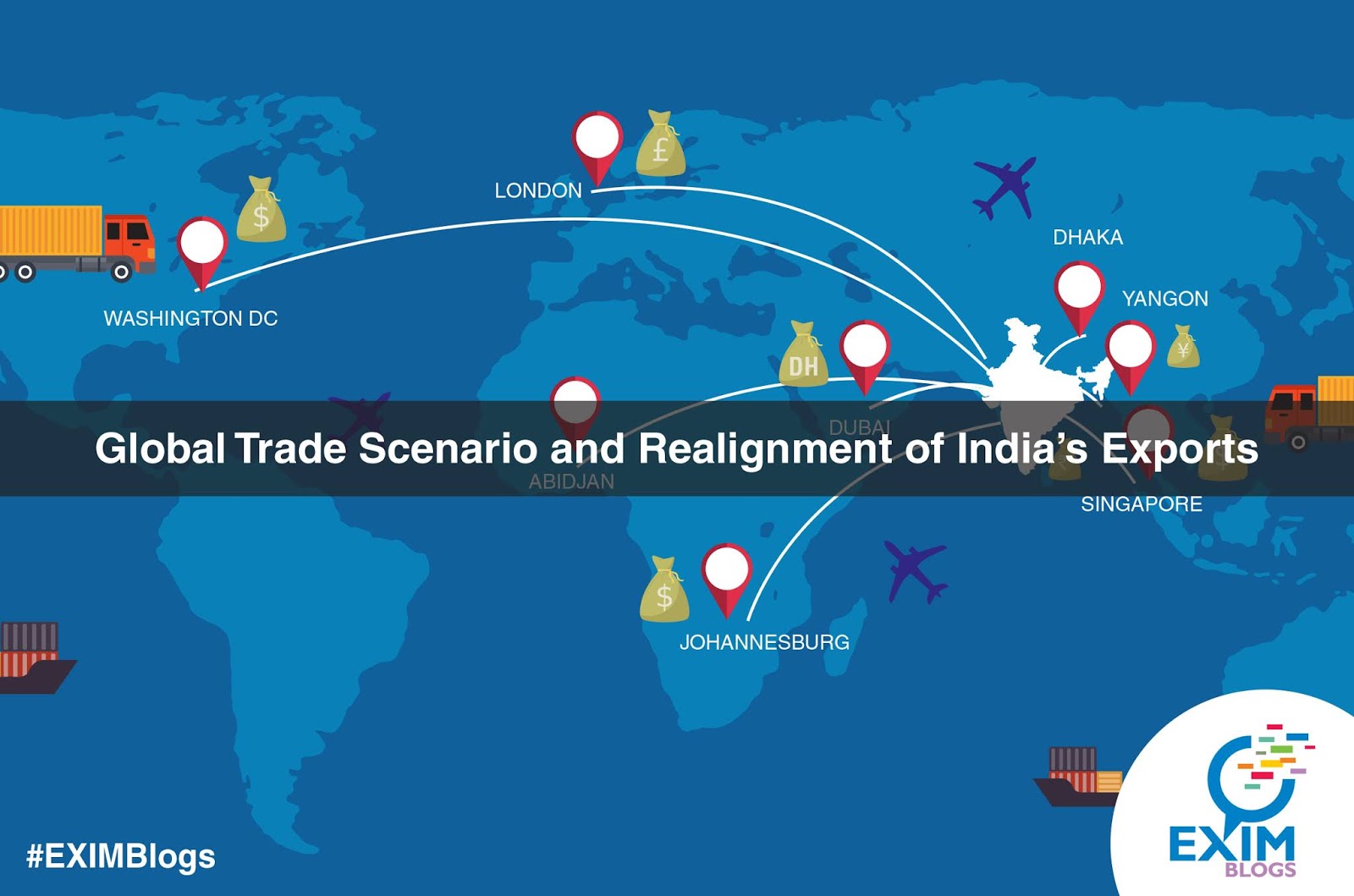
Global Trade Scenario and Realignment of India’s Exports

Global Trade Scenario and Realignment of India’s Exports
David Rasquinha, Managing Director, Export-Import Bank of India
The global economy has been on a subdued growth path since the advent of ‘Financial Crisis’ of 2008, and has now started to show signs of global recovery. In October 2017, the IMF projected world GDP growth to pick up from 3.2% in 2016 to 3.6% in 2017, and further to 3.7% in 2018. Economic activity has also picked up in developed market economies such as the US, UK, and Europe. There is a rise in global demand, which is expected to remain buoyant. The developing and emerging market economies have seen mixed economic performance. The pickup in momentum of global demand has been led by investment demand. More specifically, production of both consumer durables and capital goods have rebounded since the second half of 2016. Some factors that have contributed to these developments include global recovery in investments, led by infrastructure and real estate investment in China; firming global commodity prices; and end of an inventory cycle in US.
On the back of this global recovery, the world is witnessing a pickup in global trade. The Asian Development Bank, in its recent update1, noted that most of the emerging economies (excluding China) are witnessing a rebound in manufacturing exports, “particularly in electronics, where foreign direct investment has been strengthening”. The economies of south-east Asia are also gaining from increased activity along cross-border manufacturing supply chains. The World Trade Organisation (WTO), has recently in its September 2017 press release upgraded the growth forecast for global trade in the year 2017, from 2.4% to 3.6%. Particularly, in the first half of 2017, world trade rose by a robust 4.2% (year on year), driven by exports of developing economies which grew by 5.9 percent as compared to a growth of 3.1 percent witnessed in exports of developed economies. Imports by developed and developing economies also increased by 2.1% and 6.9%, respectively. Moreover, the ratio of trade growth to world GDP growth is also set to recover and reach around 1.3, which will be at a highest level in last 5 years.
This pickup in global growth which has boosted demand for imports, spurred intra-Asia-trade as demand was transmitted through global value chains. In this current scenario, even though India is witnessing a mild rebound in its exports, there are concerns that merchandise exports in Asia’s second largest economy are lagging behind other major Asian economies. Today global attention is riveted on emerging and developing economies and especially Asia, driven by the continent’s growing appetite for industrial investment, burgeoning infrastructural requirements and its quest for expanding trade.
Indian economy and its trade scenario
India’s growth story, especially since the start of the 21st century has been remarkable. The Indian economy has come a long way since its economic liberalisation, and is amongst the fastest growing major economies of the world today. While India witnessed a relatively moderate growth during the period 2011-12 to 2013-14, on account of the global economic slowdown, the economy recorded a robust growth averaging 7.5 percent during the period 2014-15 to 2016-17, much above the growth rate of other emerging and developing economies. In the last one year, it has seen major economic policy developments with the introduction of Goods and Services Tax (GST) and demonetisation of higher currency notes.
Even though the GDP growth in the first quarter of current fiscal has fallen down to a low of 5.7%, its lowest since March 2014, it is widely believed that the economy has bottomed out and it can only rise from here. According to the IMF, India is expected to grow at 7.2% in this fiscal year, aided by higher government spending and a pickup in the service sector performance.
Fueling India’s growth through international trade
In recent years, India’s robust growth has been driven by the dynamic private sector. An encouraging phenomenon that has been witnessed has been the emergence of a large number of investment driven small and medium enterprises with immense potential for growth. A large number of such enterprises have also endeavoured to expand their business operations overseas. The Indian economy is more globalised than we could imagine. As a result, India’s foreign trade has seen a multi-fold increase, since liberalisation of the economy.
Accordingly, there have been significant structural shifts not only in the product basket, but also in the geographical composition of India’s foreign trade. The opening up of Indian economy led to a massive increase in the foreign trade, which aided in sustained GDP growth over last two decades. During the last 25 years Indian exports have increased by 17 times and imports by 19 times. India’s share in global merchandise exports has risen from 0.6 percent in early 1990s to 1.7 percent in 2016, and similarly the share of imports has risen from 0.6 percent to 2.4 percent during the same period. India’s trade to GDP ratio, a measure of an economy’s openness and integration into the global economy, has witnessed a phenomenal increase over the last few decades. Foreign trade which constituted around 13-15 percent of India’s GDP in the early nineties, peaked at 55 percent in 2012- 13 and today accounts for around 40 percent in 2016-17. India also, ranked as the 20th largest exporter and 14th largest importer in the world in 2016.
Concomitantly, India’s engagement with Global Value Chains (GVCs), which have become dominant feature of world trade, has increased significantly since 1990s. In manufacturing sector, especially for electrical and optical equipment, India is more integrated with the south east Asian region, while for services the integration in GVCs is with western countries like the US and UK. According to an OECD estimate, developing economies with fastest growing GVC participation have experienced a GDP per capita growth rate percent above average.
India has set an ambitious target of achieving exports worth US $ 900 billion by 2020, while accounting for a share of 3.5 percent of global exports4. In the current global macroeconomic scenario, while it seems like a challenging task, concerted efforts would need to be made for India to be able to achieve its trade target and realign its foreign trade policy with the new global trading system.
While the global economic scenario is crucial, the domestic factors are no less important, when it comes to trade. India’s overall trade policy faces certain challenges viz. inadequate export diversification in terms of products and geographical distribution; insignificant involvement of a majority of states in exports; rationalisation of the tariff regime and export promotion schemes; and factor market reforms which are critically linked with export performance. These challenges not only affect the productivity and competitiveness of domestic firms but also restrict them from participating in global production networks.
What needs to be done?
Integrating into and moving up the value chain
Most manufactured products, often high technology manufactured products, that are part of GVCs are infrastructure critical products whose parts are manufactured in several countries. A robust transport and connectivity network supported by fast entry/exit through port/customs is a precondition to making such products as delay may disrupt the entire value chain. There is a need for India to focus on expanding production capacity along with value addition, and moving up the value chain,while creating an enabling environment to account for a sizeable share in major leading global exports. This gain seven more significance given that India’s labour force is projected to swell by about 110 mn by 2020. The biggest challenge is to employ the surplus labour coming out of agriculture into industry and services.
Upscaling Manufacturing
The Make in India initiative is an important initiative of the Government of India, which envisages to promote India as a manufacturing hub and investment destination. There is need for highlighting the potential and stimulating the manufacturing sector through supporting mechanisms and conducive policy measures, including support for R&D, technology orientation and investment incentives. A Higher expenditure on R&D generally correlates with increase in high-technology exports, and increased local value addition. R&D expenditure as a percentage share of GDP in India has remained extremely low at less than1 percent, much lower even in comparison to other developing economies. Also, while we lay emphasis on the manufacturing sector and thereby on manufactured exports, it is also important to ensure an enabling environment and improving our competitiveness by investing in infrastructure such as better connectivity through roads and ports, coal availability, labour reforms and flexibility in factor markets.
Aligning India’s Export Capability in-Line with Global Import Demand
With regard to India’s exports, while merchandise exports have more than doubled over the period 2006-07 to 2016-17 from US$ 126 billion to more than US$276 billion, there remains huge potential for exports of select products to select countries in line with India’s export capability and import demand. There is need for identifying and aligning India’s export capability vis-à-vis global import demand. Such in-depth analysis has been the focus of research studies in Exim Bank. Comparative analyses of global trends in trade, undertaken in such studies have yielded interesting results.
To Sum Up
All in all, a pick-up in global growth is expected to contribute to the revival of international trade, but the downside risks such as the possible adoption of protectionist trade policies by especially developed market economies, around the world weigh on the recovery of trade. As a result, there is an increasing need for India and other emerging market economies, relying on export led economic growth, to take a proactive stand for globalisation and international trade.
There is a need to shift our focus from exporting what we can (or supply based), to items that are globally demanded. A demand-based export basket diversification approach could give a big push to exports. While India has made remarkable progress in the recent past, it facesan even more challenging global environment today. Itis certainly a daunting, yet possible, task to ensure that India repositions itself as an important driver of global economic growth.
1. Asian Development Bank Outlook 2017, September 2017
2. World Bank Data
3. WTO- World Trade Statistical Review, 2017
4. Foreign Trade Policy 2015-20
20
Leave a Comment

Active buyers’ data

Active buyers’ data can help you in business development across the globe. It’s not just an ordinary data contained in buyers and suppliers directories which are available in the market.
Derived from genuine and current sources of the respective countries, this data is a very powerful tool for business development in your target countries. It covers both Air and Sea shipments moving from various Indian ports.
1.)    Product:  Readymade Garments. 
HS Code: From Chapter heading 62.Buyer:
Adrianna papell evening LLC.
512 7th avenue new York 10018 U.S.A
U.S.A.
Phone: 2126955244
Email: customerservice@adriannapapell.com
  
2.)    Product: Readymade Garments. 
HS Code: From Chapter 62.Buyer: 
Fleur Wood Fabrics & Designs Pty Ltd.
Suite 301, 11 Randle Street Surry Hills Nsw 2010 Sydney.
Australia.
Phone: 61-29829511
Fax: 61-2 9282 9522.
Email: info@fleurwood.com
3.)    Product: Home Textile. 
HS Code: From chapter heading 63.Buyer: 
M/s Oka direct limited.
Unit 11, the coach works. 80 parsons green lane.
Phone: 0870 160 6002.
Web: www.okadirect.com
  
4.)    Product: Leather garments. 
HS Code: From chapter heading 42.Buyer: 
Koenig Leatherwear Gmbh
Bierstadter Str. 1 65189 Wiesbaden
Germany.
Phone: +49 611 33 34-0
Fax: +49 611 33 34-444

Active suppliers’ data helps you to find authentic suppliers for your products from various countries. It covers both Sea and Air shipments.
Ideal tool for developing cheaper source of supply from your target country. Not just an ordinary data contained in buyers and suppliers directories which are available in the market, it is derived from the current shipping transactions of the various countries.
1.)    Product:  RD – St Spherical conditioned cut wire shot grain size 0 6MM G D
HS Code: From chapter heading 84Supplier:
Frohn GMBH
Nettestr. 83-87 D-58762, Altena
Germany.
Tel: +49 2352 92 81-0
Fax: +49 2352 92 81-30
  
2.)    Product: Used Daewoo lathe machine 
HS Code: From chapter heading 84Supplier:
Eurolat Machines.
Industrieweg 29 7418 CD Deventer,
The Netherlands.
Tel: +31 (0) 570-629676, + 31 (0) 6 – 20854452
Fax: +31 (0) 570 – 67 70 71.
Web: info@eurolatmachines.nl
3.)    Product: Key cutting Machine A – 11. 
HS Code: From chapter heading 84Supplier:
Qingdao everise int`l co.,ltd.
Qingdao Shangdong road no.9 Shenye Mansion A22E.
Tel: 86-0532-86063283.
Fax: 86-0532-85826625
  
4.)    Product: Toyo ST50 Discpro- S Moulding Machine Serial No.1365894
HS Code: From chapter heading 84Supplier:
Toyo machinery & metal co. ltd.
523-1 fukusato, futami-cho akashi hyugo,
Japan 674-0091.
Tel: +81-78-942-2345 

Fax: +81-78-943-7275https://www.eximbankindia.in/

India’S Import Tariff Very Low, Not So For Us, China

https://www.eximbankindia.in/

Date : 13-May-2019
Subject : India’s import tariff very low, not so for US, China
US President Donald Trump may call India the “tariff king”, but data show New Delhi has exercised “maximum self-restraint” in taxing imports. While India’s average bound rate — or the maximum duty it is allowed to charge under the World Trade Organization (WTO) framework — is as much as 48.5%, its actual applied tariff is as low as 13.8%, according to the WTO data. On a trade-weightage basis, the tariff is even lower — just 7.5%.
In contrast, China’s applied tariff of 9.8% is almost as high as its permissible limit (bound rate) of 10%, while South Korea’s is 13.7% against 16.5%. Importantly, at an average of 3.4%, the actual US tariff is as much as it is allowed to slap.

In other words, the US hasn’t shown any restraint and hit the maximum ceiling of tariff barriers it’s entitled to impose under the WTO rules, say analysts. The bound rates for countries are determined after serious negotiations at the WTO on a range of issues and indicators, including the stage of the development of an economy. Brazil, a member of the so-called BRICS grouping like China, charges as much as 13.4%, compared with its bound rate of 31.4%. Importantly, on a trade weightage basis, the tariff levels of both South Korea (9%) and Brazil (10.3%) are higher than India’s (7.5%), while Beijing’s (5.2%) is closer to New Delhi’s. The tariff rates are based on the WTO’s World Tariff Profile 2018.
While US commerce secretary Wilbur Ross on May 7 flayed India for imposing “not justified” tariff on ICT products (20%), motorcycles (50%) automobiles (60%) and alcoholic beverages (150%), the US charges 350% on tobacco (350%), 163.8% on peanuts, 48% on footwear, 38% on glassware for toilet and 32% on shoes. In fact, analysts say in some cases, duties are very difficult to calculate or implement. For instance, for every wristwatch, the tariff is 93 cents plus 4.8% on the value of the case plus 2.2% on the value of strap, band, and bracelet, they added. This means one needs to know the value of each component separately.

Basmati Prices Fall 5% As India Awaits Clarity On Iran Export Payment Mode

https://www.eximbankindia.in/

Date : 13-May-2019
Subject : Basmati prices fall 5% as India awaits clarity on Iran export payment mode
New Delhi: Basmati paddy is being sold at Rs 4,700 per 100 kg –– which is around 5 per cent lower compared to a fortnight ago –– as traders and companies await government clarity on the export payment mechanism to Iran.

The industry has requested the government to issue guidelines to ensure that payments against rice exports to Iran will be guaranteed in view of the US doing away with waivers for import of crude oil from Iran by India.

Iran has remained the largest importer of basmati rice from India in recent years, by buying over 30 per cent of the total basmati rice exported from India. Traders said there was volatility in the market as things were unclear.

“Market has shown a fall of 5 per cent since April 22 till date, although exporters have stock. Prices can further fall in the coming days if we don’t get clarity on Iran demand,” said Rajesh Paharia, a Delhi-based grain trader.

Prices of different varieties of basmati paddy have seen a fall in Haryana mandi, he said.

“The 1121 steamed basmati paddy prices fell by 2.4 per cent to Rs 8,100 per 100 kg while the traditional basmati paddy has fallen 7.8 per cent to Rs 4,700 per 100 kg in the past 15-18 days,” said Paharia.

Companies said that if Iran is unable to import Indian basmati rice because of the nonexistence of an export payment mechanism, then rice prices would go down in India in the coming paddy season. This could impact basmati planting in Haryana, Punjab, Uttar Pradesh, Himachal Pradesh and Jammu and Kashmir. Paharia said Indian companies have started talks with Saudi Arabia and traders in the UAE to offload the huge stocks they are holding now.

“Now that the US has abolished the waiver for import of crude oil from Iran by India, there is uncertainty among exporters whether or not to accept fresh orders since they are worried about receipt of payments against such supplies,” said Vinod Kumar Kaul, executive director, All India Rice Exporters Association. Basmati rice is a major commodity in the agricultural export basket of India fetching close to Rs 30,000 crore in foreign exchange, said Kaul. An agreement had been signed by the Indian and Iranian government on November 2, 2018, that India will import crude oil from Iran using a rupee-based payment mechanism through UCO Bank. Under this bilateral mechanism, UCO Bank remits payment to Indian exporters against exports to Iran.

In 2011-12, basmati rice exports from India to Iran was only 6.18 lakh tonnes. After setting up this bilateral payment mechanism through UCO Bank, exports from India to Iran grew substantially to 14.80 lakh tonne in 2018-19.

Design a site like this with WordPress.com
Get started