Export and Import

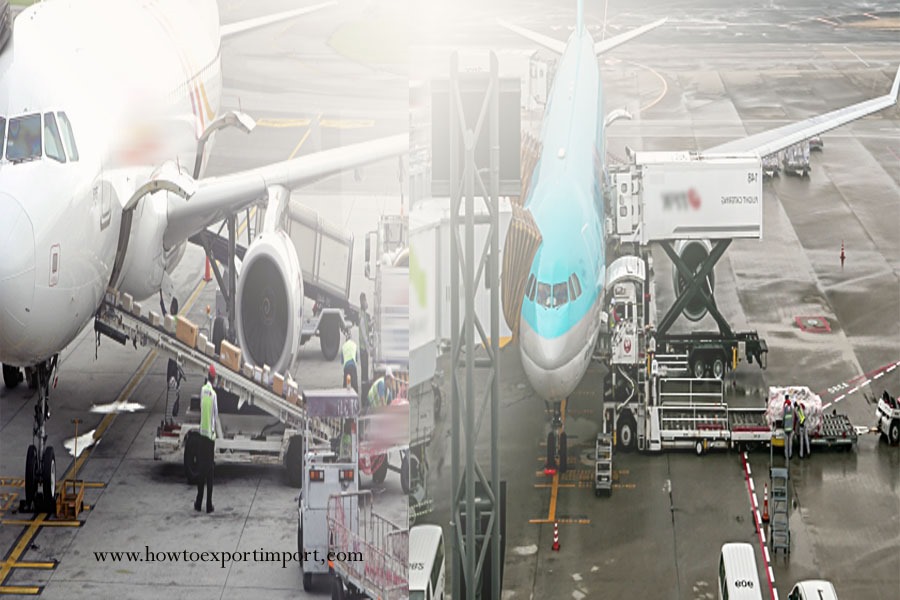
The term export is derived from the conceptual meaning as to ship the goods and services out of the port of a country. The seller of such goods and services is referred to as an “exporter” who is based in the country of export whereas the overseas based buyer is referred to as an “importer”. In International Trade, “exports” refers to selling goods and services produced in home country to other
The term export is derived from the conceptual meaning as to ship the goods and services out of the port of a country. The seller of such goods and services is referred to as an “exporter” who is based in the country of export whereas the overseas based buyer is referred to as an “importer”. In International Trade, “exports” refers to selling goods and services produced in home country to other markets.
In National Accounts, exports consist of transactions in goods and services (sales, barter, gifts or grants) from residents to non-residents.  The exact definition of exports includes and excludes specific “borderline” cases.
Export of commercial quantities of goods normally requires involvement of the customs authorities in both the country of export and the country of import. The advent of small trades over the internet such as through Amazon and e-Bay has largely bypassed the involvement of Customs in many countries because of the low individual values of these trades. Nonetheless, these small exports are still subject to legal restrictions applied by the country of export.

Difference between EP copy and EC copy of shipping bill

The exporter or their customs house agent files necessary export documents with customs location where the cargo is moved to be exported. After completion of necessary export customs formalities at customs, Exporter copy and Exchange control copy are given back to exporter. Exporter retains export copy of shipping bill and submits exchange control copy with their authorized bank. The said exchange control copy is sent to Reserve Bank by authorized dealer bank to control foreign inward and outward remittance.
Submission of exchange control copy of shipping bill with exporter’s authorized bank is required at the location where no EDI facility is available where in exporter or his customs house agent files export documents manually. In a customs location where EDI is available, such exchange control copy of shipping bill is electronically transferred to Reserve Bank from respective Customs location immediately up on release of exchange control copy of shipping bill.
What is EP copy of shipping bill? How does Export Promotion copy of Shipping Bill work?
Exporter gets all benefits under exports from different government export promotion agencies only on the basis of export promotion shipping bills and other proof of export. In other words, among shipping bills, Government agencies accept only EP copy of shipping bill  as a proof of export. Why?
Difference between EP copy and EC copy of shipping bill 2Immediately up on completion of export customs procedures exporter can obtain exporter copy and exchange control copy of shipping bill. However, export promotion copy of shipment is issued by customs only after ‘export’ takes place. Means, EP copy of Shipping bill is issued only after goods moved out of country.
After movement of goods out of country by shipping carrier either by air or sea, the carrier files EGM (export general manifest) with customs mentioning details of goods moved as per specified format. EGM filing is a legal and mandatory requirement as per customs rules. The details of vessel or aircraft in which the cargo moved, Shipping bill number and other details of goods are mentioned in the EGM. Once after filing EGM by shipping carrier who carried goods, the exporter or his customs house agent approaches concerned customs officials to release EP copy of shipping bill. Once after satisfying on the ‘export’ of goods mentioned in shipping bill after verifying with Export General Manifest (EGM), the customs official approves and confirms ‘export’ by releasing EP copy of shipping bill. This export promotion copy of shipping bill is used by exporters to produce at different government agencies for claiming export benefits along with other export document like BL/AWB etc.

Electronic Bank Realization Certificate

Electronic Bank Realization Certificate

Electronic Bank Realization Certificate (BRC) or eBRC is issued by banks to the exporter for the purpose of claiming benefits under the various schemes of the Foreign Trade Policy. eBRC is initiative to promote paperless trade and the DGFT has created an electronic platform for Bank Realization Certificate. Using the eBRC platform, banks can electronically transmit foreign exchange realization from banks to the DGFT server. This process is secured by the use of a digital certificate. In this article, we look at the Electronic Bank Realization Certificate (BRC) or eBRC in detail.

Responsibilities of the Bank

The bank is responsible to perform the following functions:
  • Generate e-BRC.
  • Generate XML file.
  • Upload the file on DGFT Server.
  • Transmit foreign exchange realized value without converting it into INR to the DGFT server.
  • Upload the INR of the realized foreign exchange value. The conversion should be performed in accordance with the notified RBI rates.
  • If the rate of exchange is not available from RBI, banks may pursue the conversion of currency as per its standard practice.

Responsibilities of an Exporter

The exporter is required to:
  • Login to the e-BRC application by logging into the portal.
  • Use the option of uploading BRC.
  • Select file from file system and upload the same.
  • The server will verify the user, authenticate data, and provide the result of the process in XML or tabular format, as chosen by the user.

How Does the Server Work?

It is implicit that the process of uploading certificates is done through the DGFT server. Let us have an in-depth understanding on what the server offers:
  • Facilitate the uploading of file generated by the bank.
  • Process the file and store e-BRC.
  • Generate acknowledgement XML.
  • Enable e-BRC to the applicant.
  • Providing the facility of viewing the status of e-BRC.
  • Sharing of e-BRC information with Government or Dept/Agencies.
  • Provide banks with the facility of updating the database of its branch.
  • Assist the bank officer to further delegate power to subordinate staff for uploading the file.

Requisites of the Certificate

The digital certificate must comprise of 2048 characters. It must be in accordance with SHA-2 standard, and approved by the Controller of Certifying Authorities (CCA). Certificates of Class 2 and 3 are accepted. The authorized signatory will be specified by the DGFT.

Repository of Shipping Bills

DGFT maintains a Repository of Shipping Bills which facilitates the exporters to capture and link the e-shipping bill and e-BRC data in an automated manner. Shipping bills from the repository may be utilized in any pertinent schemes.

Revenue Authority

Earlier, exporters were required to submit physical copies of BRC to the Revenue Authority. This requirement has been annulled with effect from 17.08.2012. It was decided in this manner considering that the inward remittance is linked with DGFT’s software system, wherein the details are electronically transferred.

Offices to apply for Certificate of origin GSP

The following are the list of offices in India authorized to issue GSP Certificate of origin to exporters. The details of authorized offices to issue GSP against specified export products are also given for your easy reference.
1. Export Inspection Council through their field offices known as Export Inspection Agencies with their offices all over India. All products
2. Marine Products Export Development Authority through their regional offices all over India. Marine products
3. Development Commissioner through their regional offices all over India. Handicraft
4. Spices Board, Ministry Of Commerce & Industry Sugandha Bhavan, NH-Bye-Pass, P.B No.2277,
Palarivatom P.O. Cochin- 682025 (Ernakulam District) Spices and Cashewnuts
5.Coir Board,P.B No.1752, M.G.Road,Ernakulam, Cochin-16. Coir and Coir products
6.Textile Committee through their regional offices all over India. Textiles and madeups
7.Central Silk Board through their regional offices all over India.Silk products
export import tutorial online
MEPZ Special Economic Zones
MEPZ special Economic Zone,Administrative office building,National highway 45,Tambaram, All products manufactured by Units in Madras SEZ and EOUs located within the respective jurisdiction of the Development Commissioner ,31 ,Chennai -600 045. In addition, the Development Commissioner shall also issue the certificate for the trading units, provided they meet the conditions of GSP.
Kandla Special Economic zone, Gandhidham, Kutch, Gujarat-370230, All products manufactured by Units in Kandla and Surat SEZs and EOUs located within the respective jurisdiction of the Development Commissioner. In addition, the Development Commissioner shall also issue the certificate for trading units, provided they meet the conditions of GSP
All products manufactured by Units in SEEPZ SEZ and EOUs located within the respective jurisdiction of the Development Commissioner. In addition, the Development Commissioner shall also issue the certificate for the trading units, provided they meet the conditions of GSP.
Cochin Special Economic Zone, Kakkanad, Cochin – 682030, Kerala
All products manufactured by Units in CochinSEZ and EOUs located within the respective jurisdiction of the Development Commissioner. In addition, the Development Commissioner shall also issue the certificate for the trading units, provided they meet the conditions of GSP.
NOIDA Export Processing Zone, Noida-DadriRoad,Phase-II, Noida,201305 (UP), Distt.Gautambudh Nagar.
All products manufactured by Units in Noida SEZ and EOUs located within the respective jurisdiction of the Development Commissioner. In addition, the Development Commissioner shall also issue the certificate for the trading units, provided they meet the conditions of GSP. 32
Vishakhapatnam SEZ, Administrative Building, Duvvada, Visakhapatnam 530 046
All products manufactured by Units in Vishakhapatnam SEZ and EOUs located within the respective jurisdiction of the Development Commissioner. In addition,the Development Commissioner shall also issue the certificate for the trading units, provided they meet the conditions of GSP.
Falta SEZ, 2nd MSO Building, 4th Floor,Room No.4,Nizam Place, 234/4, AJC Bose Road, Kolkata-700 020,West Bengal.
All products manufactured by Units in Falta SEZ and EOUs located within the respective jurisdiction of the Development Commissioner. In addition, the Development Commissioner shall also issue the certificate for the trading units, provided they meet the conditions of GSP.
Directorate General of Foreign Trade & its regional offices

Types of Export Containers

This post helps you to get information about different cargo container types used for transport of goods.
Different types of containers are used in domestic and international trade to move cargo from one location to another. Some types of containers are Standard Dry Containers, Open Top Containers, High cube Containers, Refrigerated Containers (Reefer Containers), GOH Containers (Garments on hanger containers), Open Side Containers, Tank Containers , Half height Containers, Ventilated Containers, Car Carrier Containers, Hard top Containers, Insulated Containers, Tunnel Containers, Platform Containers, Flat rack Containers etc. These containers are used to transport different types of goods as per convenience, coastwise and time saving parameters. For example, Standard dry containers are used to move general dry cargo, temperature sensitive cargo is moved with refrigerated containers, liquid and powder type goods are moved with tank container so on. So each type of container is manufactured as per customer’s requirements.

How to send export samples to foreign buyer? Tips to send samples to foreign buyer

How to send export samples to foreign buyer?
Some of you may need a support on procedures to send export samples to your buyer at foreign country. Sending export samples is a simple procedure under export and import.
Can I get cost of export sample from foreign buyer, if value of product is high? Can we get reimbursed on the cost of courier to send export samples?
Based on your communication with the buyer, you are asked to send sample of your product. If value of your product sample is high, you can request buyer to make payment on the same. The buyer remits the amount to your bank. If value is nominal and you can afford the cost, you can supply free of cost. There are government financial assistances to send sample products to foreign countries. You can contact your export promotion council or commodity board for further information. While sending samples, do not forget to retain a set of same sample with you as you have to meet the specification of product as per the said sample. If you do not keep a copy of sample, you can not claim with your buyer against any disputes on the quality specification of product.
You can send export sample by courier if the value is below a certain amount. Contact your service provider for latest value limit that government of your country allowed on export sample that you can send by courier without any specific regulations.
The cost of courier charges can be paid by you or the buyer as per your understanding with the buyer on mutually agreed terms of communication.

How to get RCMC from Export Promotion Councils

Registration Cum Membership Certificate- RCMC. What is RCMC? Why do you require an RCMC?
I have written a separate article about the importance of obtaining Registration Cum Membership Certificate in this web blog. Please read the said article to know more about RCMC – Registration cum Membership Certificate.
Here, we discuss about the name of departments who issues Registration Cum Membership Certificate – RCMC.
This information helps exporters in handling various products to approach authorities who promote exports on the respective fields. If you are a new exporter, select your Export promotion council and approach them to get necessary assistance.
Agricultural and Processed Food Products Export Development Authority (APEDA) Animal Products, Cereals, Floriculture and Seeds, Fruits and Vegetables, Processed Fruits and Vegetables, Other Processed Food

Apparel Export Promotion Council:
Readymade Garment excluding Woolen knitwear and of leather, silk, jute hemp.
Chemicals Pharmaceuticals & Cosmetics Export Promotion Council, (CHEMEXCIL) Basic chemicals namely drugs and Fine chemical Dyes Intermediate, Alcohol and coal Tar Chemicals, Organic chemicals, Agro-chemicals, Glycerin, Soaps, Detergents Cosmetics & Toiletries, Processed Talc. Agarbathi, Essential Oils, Dehydrated Culture Meida and crude.
Carpet Export Promotion Council: Handmade/Woolen Carpets, Rugs, Durries, Druggets and Namdhas including handmade Silk carpets.
Cashew Export Promotion Council of India: Cashew, Kernels.
Chemical & Allied Products Export Promotion Council: Chemicals and Allied Products namely, Glass and Ceramics Paints, Rubber products including Tyres and Tubes, Paper and Paper Products including Books , Journals, Periodicals, Safety Matches, Fire Works and Explosives, cement Products Marble, chips Adhesive Shellac-compound Photo-typeset Films and micro films, Wood Products.
Cotton Textile Export Promotion Council: Cotton Textiles
Coffee Board: Coffee
Coir Board: coir and coir products
Electronic & Computer Software Export Promotion Council:Electronic, goods, Computer Software and related services.
Engineering Export Promotion Council:Engineering Goods, Stainless Steel Products Fabricated Mica, Mica based Engineering products and Construction Services.
Gems & Jewellery Export Promotion Council:Gems and Jewellery
Export Promotion Council for Handicrafts:Handicrafts
Handloom Export Promotion Council:Handloom Products
Handicrafts & Handloom Export Corporation:Handicrafts & Handlooms
Office of the Development Commissioner for Handlooms : Promotion of Handlooms Export abroad.
Development Commissioner for Iron Steel:Promotion of Iron & Steel Exports abroad.
Indian Silk Export Promotion Council:All Natural silk fabrics made ups, garments machine made carpets
Council for Leather Export:Finished Leather, Lexprocil Leather goods, Chrome tanned hides and skins, Chrome tanned crust leather, E.I. tanned hides and skins and E.I. crust Leather
Marine Products Exports Development Authority (MPEDA):Sea Food
Overseas Construction Council of India:Overseas Project Construction and civil Projects Engineering.
Power loom Development and Export Promotion Council:Plastics, toys, Polyester Film and Allied Products, Human Hair and Human Hair Products.
Rubber Board:Rubber and rubber products
Shellac Export Promotion Council:Shexprocil Lac in all its forms.
Sports Goods Export Promotion Council:Sports Goods
Spices Board:spices
Central Silk Board:silk and silk products
Synthetic & Rayon Textiles Export Promotion Council:Silk rayon Cellulosic and Non, cellulosic Products, Blended Products from Mixtures of cotton/cellulosic and Nylon/Polyester fiber or yarn, and Acrylic knitwear.
Tea Board:Tea and Tea products
Tobacco Board:Tobacco and Tobacco products 
Wool & Woolens Export Promotion Council : 
Warmth Woolen Textiles, Hosiery Knitwear, Mixed Fabrics and Machine made Woolen Carpets and Rugs and Druggets Flex Yarn and Flex Products Acrylic, Knitwear.
If your product or service has not been included in the above, you can approach Regional Licensing Authority to get Registration Cum Membership Certificate (RCMC) for your firm.
Federation of Indian Export Organizations (FIEO), Indian Trade Promotion Organization, National Agricultural Cooperative Federation of India Ltd. (NAFED) and other agencies also supports exporters and importers in India.

How to obtain GSP – Certificate of Origin?

ow to obtain GSP – Certificate of Origin?
There are two types of certificates of origin in India – Certificate of origin issued by Chamber of commerce and Certificate of origin issued by Export Inspection Agency. Customs of some importing countries insist either of them to certify the country of origin of goods.
What is GSP? How can an exporter get GSP – Certificate of origin – in India?
GSP means, Generalized System of Preference, which is issued by Export Inspection Agency. Export Inspection Agency has offices in all major cities to serve exporters in maintaining best quality to meet the specification of buyer to have best quality management system for exporters. In order to get certificate of origin (GSP), before physical movement of goods, you need to apply with export inspection agency as per their specified request form along with copy of commercial invoice duly signed by the authorized signatory. After verifying properly and collecting necessary charges, export inspection agency certifies the document and issues GSP Certificate of origin along with attested copy of commercial invoices.
GSP can be obtained by filing online. You may find the procedures to file electronically. Once after filing electronically, the required hard copies of documents can be submitted with respective offices of export inspection council and obtain GSP certificate after paying necessary charges.
Can an exporter obtain GSP after shipment of goods?
Normally GSP certificate of origin issued by export inspection council is obtained before export. However, GSP certificate of origin can be obtained after shipment date with necessary procedures and formalities insisted by the issuing authority. Such GSP certificate reflects as ‘Issued retrospectively

Export Financial benefits, Export incentives and supports

Export Benefits and Incentives in India 

How does exports benefit to exporters in India? What are the financial assistance to exporters? Advantages of Exports in India? What are the different government schemes to exporters? How does bank help exporters financiallyFinancial assistance,benefits and supports to Exporters in India? Different financial schemes and other supports of Export Promotion Councils. Who are the organizations and agencies supporting exporters in India and how?

The below mentioned export benefits, schemes, financial assistance and other support to exporters in India by government and other different agencies could be withdrawn or modified. The actual beneficiaries may reconfirm with the concerned authorities whether such export benefits are valid.

EXPORT FROM INDIA SCHEME

MEIS (
Merchandise Exports from India Scheme)
MEIS scheme for exporters was introduced in recent Foreign Trade Policy of India 2015-20 by consolidating previous different schemes such as Vishesh Krishi Gram Udyog Yojana (VKGUY), Focus Product Scheme (FPS), Agri-Infrastructure Incentive Scrip), Market Linked Focus Product Scheme (MLFPS) etc with modification. MEIS scheme extends benefits to more than 5000 export items and the duty credit scrips helps exporters in payment of Customs Duties for import of inputs or goods, payment of excise duties on domestic procurement of inputs or goods, payment of service tax on procurement of services, payment of Customs Duty and fee etc. I have written detailed articles about MEIS scheme in this web blog and you may read in detail here.
SEIS (Service Exports from India Scheme)
The foreign Trade Policy of India 2015-20 introduced SEIS (Service Exports from India Scheme) for service exporters by modifying SFIS scheme of previous years by benefiting all service providers of India including foreign brand of Indian Companies. Detailed articles about SEIS have been written in this web blog, you may click here to read.
ASSISTANCE FROM TRADE PROMOTION COUNCILS AND COMMODITY BOARDS
You may  also contact concerned trade promotion council and commodity board for more details.

DUTY EXEMPTION AND REMISSION SCHEME FOR EXPORTERS:
Advance Authorization Scheme (AA scheme): 
As per foreign trade policy of India, inputs are allowed to import without duty payment for export purpose. The licensing authority fixes value addition on export products not below 15%. A stipulated period to import is allowed and validity for export obligation. For more details, contact nearest DGFT office (Director General of Foreign Trade, Government of India). I have mentioned a short note on Advance Authorization Scheme in this web blog separately, you can click here to read. Advance Authorization for annual requirement is also issued for items having standard input output norms those exporters having past export performance, minimum preceding two financial years.

Export Duty Drawback of Customs, Central Excise and Service Tax
Duty paid inputs against exported products is refunded to exporters in the form of Duty Drawback. If the rates of such items are scheduled under Drawback schedule, the amount of drawback is refunded accordingly. If not scheduled, a separate application has to be filed to fix Brand Rate. Detailed articles on Duty Drawback and Brand rate are available in this web blog with method of claim. Procedures to claim duty drawback

Brand rate under Duty Drawback for Exporters
If Duty Drawback rate has not been mentioned in schedule, exporters can approach concerned authority for Brand rate. The detailed article is available in this website, click here to read : What is Brand rate?Procedures to claim Brand rate

Rebate of Service Tax through all industry rates for Exporters
Service tax refund paid is reimbursable on specified output services used for export of goods at specified all industry rates fixed time to time by the authority.

EXPORT BENEFIT OF DUTY FREE IMPORT AUTHORIZATION
DFIA (Duty Free Import Authorization) scheme is the export scheme introduced by DGFT by clubbing DEEC (Advance License) and DFRC to support exporters for free import of inputs. I have written a separate updated article in detail about Duty Free Import Authorization (DFIA). You may click here to read.

DEPB, ANOTHER ADVANTAGE TO EXPORTER
DEPB (Duty Entitlement Pass Book) scheme is another export incentive scheme in India. At present, DEPB can be claimed post export. Import customs duty credit is allowed to exporters to neutralize the customs import duty against export of goods. Also read Can DEPB/DEEC bill can be converted to Drawback

EPCG SCHEME TO PROMOTE EXPORTS
Export Promotion Capital Goods (EPCG) scheme helps exporters to import capital goods with zero import duty for the purpose of production of export products with a commitment of export obligation period with licensing authority. Certain rate of relaxation is allowed to sell in local market after fulfilling export obligation. A detailed article about EPCG (Export Promotion Capital Goods) can be read in this website. How does EPCG work? EPCG under new Foreign Trade Policy 2015-20 Difference between EPCG and ECGC

CENTRAL EXCISE REBATE OF DUTY FOR EXPORTERS
Rebate of duty paid on excisable goods exported or duty paid on the material used in manufacture of such export goods may be claimed. Also read: Procedure for Central Excise Clearance Under Claim of Rebate

CENTRAL EXCISE DUTY EXEMPTION ON EXPORTS
Excisable goods are exempted to pay export excise duty with simple procedures with central excise department. Necessary registration of premise, factory or warehouse is required to be completed with concerned central excise department by executing bond. Click here to read Central Excise clearance procedures

DEEMED EXPORT BENEFITS
Deemed Export transactions are those transactions in which the goods supplied do not leave the country and the payment for such supplies is received either in Indian rupees or in free foreign exchange. You may go through this link to know in detail about Deemed Exports. Deemed exporters get benefit of refund of excise duty paid on final products, Duty drawback, imports under DEEC scheme, Special import licenses based on value of deemed exports etc. Click here to learn more about Deemed Exports

INCOME TAX BENEFITS FOR EXPORTERS
Income tax exemption to exporters are allowed by government in different categories. You may contact your nearest Income Tax Department to know latest updated information on income tax exemptions to exporters in India.
SALES TAX / VAT EXEMPTION TO EXPORTERS
No sales tax is required to pay for exports. The facility is extended to the suppliers of goods for export also. Value Added Tax (VAT) is also exempted for export goods. The details of such exemption of sales tax / VAT is available with the concerned Sales Tax Department. Read more How to get exemption of Sales Tax under exports     Is sales tax applicable on shipments effected under high sea sales   How does CENVAT Credit work?
BILATERAL TRADE AGREEMENTS BENEFITS TO EXPORTERS
Trade Agreement between countries promote exports each other by providing different special schemes to exporters. Click here to read about Bilateral Trade Agreements Difference between Multilateral Trade Agreements and Bilateral Agreements

POST OFFICE CLEARANCE FACILITY TO EXPORTERS
Post office clearance facility is also available for exporters who would like to export/import clear the goods in India. Read more: Procedures to claim under MEIS scheme under Export of goods through courier or foreign post offices

BANK ASSISTANCE FOR EXPORTERS
Many financial assistances with different schemes are given to exporters to boost exports in India. Pre Shipment Credit in Foreign Currency (PCFC) and in INR, Packing Credit loans, Supplier’s credit, Buyer’s credit, Post shipment Finance, short term and long term finance, Finance for special export projects, Working capital finance, Capital Equipment Finance, Fund for export consultancy and technological services, different guarantees for exports like Advance Payment Guarantee, Performance Guarantee, Retention Money Guarantee, Guarantee for customs, central excise and other government and private agencies etc. Banks also provide financial assistance to Export Oriented Units (EOU), Special Economic Zones (SEZs), Corporates, STPs, EHTPs, FTZs, MSMEs etc. Bank also provides Line of Credit mechanism for export of projects, equipment, goods and services from India.
Authorized banks also provide exporters to open Foreign currency account in the form of EEFC (Exchange Earners Foreign Currency) to help them in handling foreign currency easily without local currency fluctuation and to eliminate currency conversion charges. Many other services are also provided to exporters in India by authorized banks to boost exports for favourable balance of payments.
ECGC (EXPORT CREDIT GUARANTEE CORPORATION)
Export Credit Guarantee Corporation (ECGC) protects exporters in covering credit risk of overseas buyers. Click here to read more.

FEDERATION OF INDIAN EXPORTERS ORGANISATION
FIEO also plays a major role in promoting exports in India by assisting exporters in various ways.

EXPORT SUPPORT FROM CHAMBERS OF COMMERCE 
Chamber of Commerce at different parts of the country and Federation of Indian Chamber of Commerce and Industry (FICCI) help exporters in various ways to promote exporters in earning foreign currency to strengthen economy.

EXPORT ASSISTANCE FROM INDUSTRIES’ ASSOCIATIONS
The support from Exporters Organization formed privately also plays a major role in sharing practical problems facing by industry and helps to find solutions. Such exporter’s association takes up their issues with government time to time, so as to enable the government to introduce new policy or to amend existing one.

CENTRAL ASSISTANCE TO STATES FOR EXPORTS (ASIDE)
Assistance to States for Infrastructural Development for Exports (ASIDE) has been introduced by Central Government with an objective to involve States / Under Takings in export effort by providing assistance to the State Governments or State Under Takings Administrations for creating appropriate infrastructure for development and growth of exports.
TOWNS OF EXPORT EXCELLENCE (TEE)
India government declared a list of towns of export excellence where specialized export products are promoted. Click here to know towns of export excellence

BENEFITS TO SPECIAL GROUP OF EXPORTERS

BENEFITS FOR EXPORTERS FROM CERTAIN REGIONS
Exporters and manufacturers from special region such as Sikkim, Jammu and Kashmir etc. are given specific benefits by government. The exporters can contact the related government agencies for more details.
Export benefits to units having ISO 9000 (series) / ISO 14000 (series) / WHOGMP / HACCP / SEI CMM level-II and above status
Export units holding special status are also eligible for different exports benefits from government modifying time to time.

SSI/MSME BENEFITS
There are many schemes available for Micro Small and Medium Enterprises (MSME) and SSI (Small Scale Industries) including scheme to promote exports. You may approach concerned office. Benefits to MSME

Export benefits to Free Trade Zones (FTZ)
Export Units in Free Trade Zones can enjoy zero excise duty on goods manufactured for export purpose. Import customs duty is exempted for import of components used for manufacturing export goods. Domestic Tariff Area (DTA) sales up to certain rate is allowed.
Advantages like Single point contact service, income tax benefits, DTA sales up to certain limit and many other export benefits can be enjoyed for units of Electronic Hardware Technology Park (EHTP)

Export benefits for 
Software Technology Parks
Many advantages like Foreign equity permission, income tax benefits, DTA sales up to certain limit and many other supports can be enjoyed for the units under STP.

Advantages to 100% Export Oriented Units (EOUs)
Import of second hand capital goods, re export of capital goods, income tax benefits, DTA sales up to certain limit and many other government assistances can be enjoyed by Export Oriented Units.

Export benefits to Bio Technology Park (BTP)
income tax benefits, re export of capital goods, DTA sales up to certain limit and many other conveniences can be enjoyed from different government and non-government agencies to BTP.

Export merits for Agri Export Zone(AEZs)
income tax benefits, re export of capital goods, DTA sales up to certain limit and many other export advantages can be availed for Agri Export Zone (AEZs)

Advantages of Electronic Hardware Technology Parks(EHTPs)
income tax benefits, re export of capital goods, DTA sales up to certain limit and may other export supports can be enjoyed by Electronic Hardware Technology Parks (EHTPs).

Export supports to Special Economic Zones
Government provides many benefits to Special Economic Zones in India to create an internationally competitive and smooth working environment for exports and thereby economic development of the country. Some of the advantages enjoyed by SEZ are single window clearance, free import of goods, exemption of customs duty for import of capital goods, consumables, raw materials, spares etc, reimbursement of CST, 0% income tax for 5 years, Foreign Direct Investment, exemption on MAT, Service Tax, DDT, CST, Service Tax, External commercial borrowing facility etc. and many more.

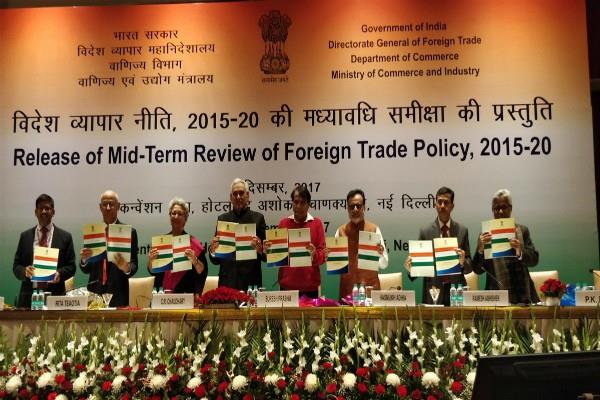
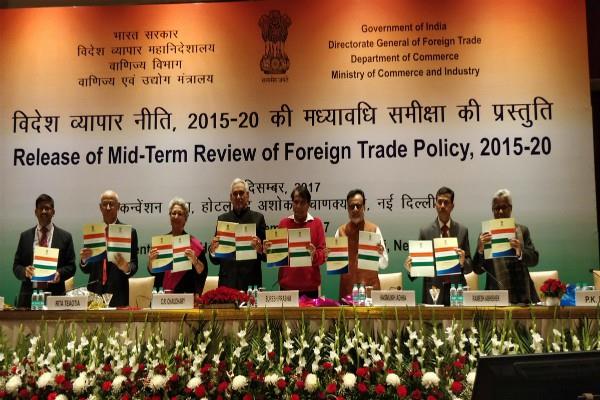
FOREIGN TRADE POLICY 2015-2020

Export promotion being a constant endeavour of the government, export performance is constantly monitored and export strategy and export policies are formulated. In the Foreign Trade Policy for the years 2015-20 announced in April 2015, the Government spelt out a framework for increasing exports of goods and services as well as generation of employment and increasing value addition in the country, in line with the ‘Make in India’ and “Digital India” program.

Objective
The policy seeks to make India a bigger player in global trade by doubling the overseas sales to $900 billion by 2019-20, while integrating the foreign trade with “Make in India” and “Digital India Programme”.

MEIS and SEIS schemes
Five existing schemes to promote merchandize exports have been merged into a single Merchandise Exports from India Scheme (MEIS). In this scheme, the incentives are to be provided in the form of duty scrips as % of FOB {free on board} value of exports. One scheme for services exports called Served from India Scheme (SFIS) have been replaced in one scheme called Service Exports from India Scheme (SEIS). The benefits of this scheme will be only for India based service providers and will be based on net foreign exchange earned. The benefits of MEIS and SEIS have been extended to the SEZ units also.

Merchandise Exports from India Scheme (MEIS)
Earlier there were 5 different schemes ( Scheme, Market Linked Focus Product Scheme, Focus Market Scheme, Agri. Infrastructure Incentive Scrip, VKGUY) for rewarding merchandise exports with different kinds of duty scrips with varying conditions (secr specific or actual user only) attached to their use. Now all these have been merged into a single scheme, namely Merchandise Export from India Scheme (MEIS) and there would be no conditionality attached to the scrips issued under the scheme.
Rewards for export of notified goods to notified markets under ‘Merchandise Exports from India Scheme (MEIS) shall be payable as percentage of realized FOB value (in free foreign exchange). The debits towards basic customs duty in the transferable reward duty credit scrips would also be allowed adjustment as duty drawback. At present, only the additional duty of customs / excise duty / service tax is allowed adjustment as CENVAT credit or drawback, as per Department of Revenue rules.
Country Groups:
Category A: Traditional Markets (30) -European Union (28), USA, Canada.
Category B: Emerging & Focus Markets (139), Africa (55), Latin America and Mexico (45), CIS countries (12), Turkey and West Asian countries (13), ASEAN countries (10), Japan, South Korea, China, Taiwan
Category C: Other Markets (70).
Products supported under MEIS
Level of Support: Higher rewards have been granted for the following category of products:
  • Agricultural and Village industry products, presently covered under VKGUY.
  • Value added and packaged products.
  • Eco-friendly and green products that create wealth out of waste from agricultural and other waste products that generate additional income for the farmers, while improving the environment.
  • Labour intensive Products with large employment potential and Products with large number of producers and /or exporters.
  • Industrial Products from potential winning sectors.
  • Hi-tech products with high export earning potential.
Markets Supported
  • Most Agricultural products supported across the Globe.
  • Industrial and other products supported in Traditional and/or Emerging markets only.
High potential products not supported earlier:
Support to 852 Tariff lines that fit in the product criteria but not provided support in the earlier FTP. Includes lines from Fruit Vegetables, Dairy products, Oils meals, Ayush & Herbal Products, Paper, Paper Board Products.
Global support has been granted to the following category:
  • Fruits, Flowers, vegetables
  • Tea Coffee, Spices
  • Cereals preparation, shellac, Essential oils
  • Processed foods,
  • Eco Friendly products that add value to waste
  • Marine Products
  • Handloom, Coir, Jute, products and Technical Textiles, Carpets Handmade. Other Textile and Readymade garments have been supported for European Union, USA, Canada and Japan.
  • Handicraft, Sports Goods
  • Furniture, wood articles
Support to major markets have been given to the following product categories
  • Pharmaceuticals, Herbals, Surgicals
  • Industrial Machinery, IC Engine, Machine tools, Parts, Auto Components/Parts
  • Hand Tools, Pumps of All Types
  • Automobiles, Two wheelers, Bicycles, Ships,
  • Planes
  • Chemicals, Plastics
  • Rubber, Ceramic and Glass
  • Leather garments, saddlery ims, footwear
  • Steel furniture, Prefabs, Lighters
  • Wood , Paper, Stationary
  • iron, steel, and base metals, products
Other sectors supported under MEIS
  • 352 Defence related Product with export of US$ 17.7B consisting of Core Products (20), Dual Use products (60) ,General Purpose products (272).
  • 283 Pharmaceutical products of Bulk Drug & Drug Intermediates, Drug Formulations Biologicals, Herbal, Surgicals, and Vaccines.
  • 96 lines of Environment related Goods, Machinery, Equipment’s.
  • 49 lines where mandatory BIS standards are prescribed.
  • 7 lines of Technical Textiles.
Participation in global value chain of the items falling under the scheme:
  • 1725 lines of Intermediate Goods – These goods become inputs in the manufacturing of other countries and will strengthen backward manufacturing linkages which is vital for India’s participation in Global Value Chains.
  • 1109 lines of Capital Goods sector- will also strengthen Manufacturing Base in India.
  • 1730 lines of Consumer Goods sector- We hope a quantum jump in export from this sector with strengthening of Make in India Brand in near future.
Technology based analysis:
  • 572 lines-Low skill Technology-intensive manufacturing.
  • 1010 lines-Medium skill Technology-intensive manufacturing.
  • 1309 lines-High Skill Technology-intensive manufacturing.
Women Centric Products supported under MEIS
Women workers constitute 52% of plantation workers-203 lines of Tea Coffee, Spices, Cashew.
69% of the aggregate female employment is concentrated in the following sectors:
(i) Manufacture of other food products – Jelly Confectionery, tomato ketchup, cooked stuffed pasta, pawa, mudi and the like, gingerbread , papad, pastries and cakes.
(ii) Manufacture of wearing apparel-396 lines of Readymade Garments
Sectors that have a significant proportion of female employment (more than 25%):
(i) Agricultural and animal husband service activities, except veterinary activities– 263 lines of basic Agriculture products.
(ii) Manufacture of footwear – 28 Footwear and Leather products.
(iii) Consumer Electronics and Electronic Components, watches and clocks -483 lines.

Service Exports from India Scheme (SEIS)
Served From India Scheme (SFIS) has been replaced with Service Exports from India Scheme (SEIS). SEIS shall apply to ‘Service Providers located in India’ instead of ‘Indian Service Providers’. Thus SEIS provides for rewards to all Service providers of notified services, who are providing services from India, regardless of the constitution or profile of the service provider.
The rate of reward under SEIS would b based on net foreign exchange earned. The reward issued as duty credit scrip, would no longer be with actual user condition and will no longer be restricted to usage for specifie types of goods but be freely transferable and usable for all types of goods and service tax debits on procurement of services / goods. Debits would be eligible for CENVAT credit or drawback.
The present rates of reward are 3% and 5%. The list of services and the rates of rewards would be reviewed after 30.9.2015.

SECTORS

Admissible rate
BUSINESS SERVICES- Professional services – Legal services, Accounting, auditing and bookkeeping services, Taxation services, Architectural services , Engineering services, Integrated engineering services, Urban planning and landscape architectural Medical and dental services, Veterinary services, Services provided by midwives, nurses, physiotherapists and paramedical personnel 5%
Research and development services – services on natural sciences, R&D services on social sciences and humanities, Interdisciplinary R&D services 5%
Rental/Leasing services without operators to ships, Relating to aircraft, Relating to other transport equipment, Relating to other machinery and equipment 5%
Other business services – Advertising services, Market research and public opinion polling services Management consulting service, Services related to management consulting, Technical testing and analysis services, Services incidental to agricultural, hunting and forestry, Services incidental to fishing, incidental to mining, Services to manufacturing, Services incidental to energy distribution, Placement and supply services of personnel, Investigation and security, Related scientific and technical
consulting services, Maintenance and repair of equipment (noincluding maritime vessels, aircraft or other transport equipment), Building-cleaning services, Photographic services, Packaging services, Printing, publishing and Convention services 3%
COMMUNICATION SERVICES – Audvisual services – Motion picture and video tape production and distributio Motn picture projection service, Radio and television services, Radio and television transmission services, Sound recording 5%
CONSTRUCTION AND RELATED ENGINEERING SERVICES – General Construction work for building, General Construction work for Civil Engineering, Installation and assembly work , Building completion and finishing work 5%
EDUCATIONAL SERVICES (Please refer Note 1) – Primary education services, Secondary education services, Higher education services, Adult education 5%
ENVIRONMENTAL SERVICES – Sewage services, Refuse disposal, Sanitation and similar services 5%
HEALTH-RELATED AND SOCIAL SERVICES – Hospital services 5%
TOURISM AND TRAVEL-RELATED SERVICES – Hotels and Restaurants (including catering), Hotel, Restaurants (including catering) 3%
Travel agencies and tour operators services C. Tourist guides services 5%
RECREATIONAL, CULTURAL AND SPORTING SERVICES (other than audiovisual services) – Entertainment services (including theatre, live bands and circus services) News agency services, Libraries, archives, museums cultural services, Sporting and other recreational services 5%
TRANSPORT SERVICES (Please refer Note 2) – Maritime Transport Services, Passenger transportation*, Freight transportation* , Rental of vessels with crew *, Maintenance and repair of vessels, Pushing and towing services, Supporting services for maritime transport, Air transport services, Rental of aircraft with crew Maintenance and repair of aircraft, Airport Operations and ground handling, Road Transport Services, Passenger transportation, Freight transportation, Rental of Commercial vehicles with operator, Maintenance and repair of road transport equipment, Supporting services for road transport services, Services Auxiliary To All Modes Of Transport, Cargo-handling services, Storage and warehouse services, Freight transport agency services 5%
Note:
(1) Under education services, SEIS shall not be available on Capitation fee.
(2) *Operations from India by Indian Flag Carriers only is allowed under Maritime transport services.

Transferable Duty Scrips
A scrip literally means a “chit” and refers to a form of credit. The Duty free scrips are provided to the exporters under various export promotion schemes of the government s. Under these schemes, the exporters get incentives at a certain percentage of the export value and these incentives can also be used to reimburse duties on imported inputs. The scrips may be transferable or non-transferable. If they are transferable the holder of these scrips can sell them in market at discount. If the scrips are non-transferable, they come with actual user condition and the holder can use it to import inputs or capital goods duty free. The foreign Trade Policy 2015 makes all duty free scrips freely transferable. These scrips can be used for payment of custom duty, excise duty and service tax also.

Status Holders
Merchant as well as Manufacturer Exporters, Service Providers, Export Oriented Units (EOUs) and Units located in Special Economic Zones (SEZs), Agri. Export Zones (AEZs), Electronic Hardware Technology Parks (EHTPs), Software Technology Parks (STPs) and Bio-Technology Parks (BTPs) are recognized as various status holders as follows:

Status

Business in million US dollars
One Star Export House 3
Two Star Export House 25
Three Star Export House 100
Four Star Export House 500
Five Star Export House 2000
A status holder is eligible for many benefits such as self declaration during custom clearances; exception from some documents and receipts various incentives. In the foreign Trade Policy 2015-20, the government says promises to reduce transaction costs of the status holders.

Make in India
To integrate the FTP with Make in India, the government has reduced export obligation for capital goods purchased from Indian suppliers under the EPCG {Export Promotion of Capital Goods} scheme. The exporters who export with high level of domestic content get higher level rewards.

Trade facilitation and ease of doing business
The policy calls for online filing of documents/ applications and paperless trade in 24×7 environments; online inter-ministerial consultations and simplification of procedures/processes, digitisation and e-governance. Henceforth, hardcopies of applications an specified documents would not be required to be submitted to RA, saving paper as well as cost and time for the exporters. To start with, applications under Chapter 3 & 4 of FTP are being covered (which account for nearly 70% of total applications in DGFT). Applications under Chapter-5 would be taken up in the next phase. As a measure of ease of doing business, landing documents of export consignment as proofs for notified market can be digitally uploaded in the following manner:-
  • Any exporter may upload the scanned copy of Bill of Entry under his digital signature.
  • Status holders falling in the category of Three Star, Four Star or Five Star Export House may upload scanned copies of documents.
It is proposed to have Online inter-ministerial consultations for approval of export of SCOMET items, Norms fixation, Import Authorisations, Export Authorisation, in a phased manner, with the objective to reduce time for approval. As a result, there would not be any need to submit hard copies of documents for these purposes by the exporters.
Under EPCG scheme, obtaining and submitting a certificate from an independent Chartered Engineer, confirming the use of spares, tools, refractory and catalysts imported for final redemption of EPCG authorizations has been dispensed with.
Certain information, like mobile number, e-mail address etc. has been added a mandatory fields, in IEC data base. This information once provided by exporters, would help in better communication with . SMS/ email would be sent to exporters to inform them about issuance of authorisations or status of their applications.
It has been decided to have on line message exchange with CBDT fr PAN data and with Ministry of Corporate Affairs for CIN and DIN data. This integration would obviate the need seeking information from IEC holders for subsequent amendments/ updation of data in IEC data base.

Other measures include
  • Measures to facilitate & encourage export of defence goods
  • e-Commerce Exports: Benefits of foreign trade policy to export of items up to Rs. 25,000 per consignment
  • Benefit available to handloom products, books / periodicals, leather footwear, toys and customized fashion garments
  • New initiatives for EOUs {Export Oriented Units}, EHTPs {Electronic Hardware Technology Parks} and STPs {Software Technology Parks}. They can share infrastructure & inter-unit transfer of goods allowed.

Prohibited Items
  • India’s Foreign Trade Policy prohibits the following:
  • Import & Exports trade in “arms and related material ” with Iraq
  • Any defense related equipment from North Korea
  • Any content which might enhance the nuclear energy adventures of Iran
  • Import of Charcoal from Somalia. We note here that UNSC Resolution 2036 had banned all exports from Somalia and India honours this resolution. Charcoal exports from Somalia are a significant revenue source for Al-Shabaab.

EOUs, EHTPs and STPs
EOUs, EHTPs, STPs have been allowed to share infrastructural facilitie among themselves. This will enable units to utilize their infrastructural facilities in an optimum way and avoid duplication of efforts and cost to create separate infrastructural facilities in different units.
Inter unit transfer of goods and services have been allowed among EOUs, EHTPs, STPs, and BTPs. This will facilitate group of those units which source inputs centrally in order to obtain bulk discount. This will reduce cost of transportation, other logistic costs and result in maintaining effective supply chain.
EOUs have been allowed facility to set up Warehouses near the port of export. This will help in reducing the time for delivery of goods and will also address the issue of unpredictability of supply orders.
STP units, EHTP units, software EOUs hav been allowed the facility to use all duty free equipment/goods for training purposes. This will help these units in developing skills of their employees. 100% EOU units have been allowed facility supply of spares/ components up to 2% of
the value of the manufactured articles to a buyer in domestic market for the purpose of after sale services.
At present, in a period of 5 years EOU units have to achieve Positive Net Foreign Exchange Earning (NEE) cumulatively. Because of adverse market condition or any ground of genuine hardship, then such period of 5 years for NFE completion can be extended by one year.
Time period for validity of Letter of Permission (LOP) for EOUs/EHTP/ STPI/BTP Units has been revised for faster implementation and monitoring of projects. Now, LOP will have an initial validity of 2 years to enable the unit to construct the plant and install the machinery. Further extension can be granted by the Development Commissioner up to one year. Extension beyond 3 years of the validity of LOP, can be granted, in case unit has completed 2/3rd of activities, including the construction activities.
At present, EOUs/EHTP/STPI units are permitted to transfer capital goods to other EOUs, EHTPs, STPs, SEZ units. Now a facility has been provided that if such transferred capital goods are rejected by the recipient, then the same can be returned to the supplying unit, without payment of duty. A simplified procedure will be provided to fast track the de-bonding / exit of the STP/ EHTP units. This will save time for these units and help in reduction of transaction cost.
EOUs having physical export turnover of Rs.10 crore and above, have been allowed the facility of fast track clearances of import and domestic procurement. They will be allowed fast tract clearances of goods, for export production, on the basis of pre-authenticated procurement certificate, issued by customs / central excise authorities. They will not have to seek procurement permission for every import consignment.

Merchandise Export from India
Scheme The six different schemes of the earlier FTP (Focus Product Scheme, Market Linked Focus Product Scheme, Focus Market Scheme, Agriculture Infrastructure Incentive Scrip, Vishesh Krishi and Gram Udyog Yojana and Incremental Export Incentive Scheme) which had varying sector-specific or actual user only conditions attached to their use have been merged into a single scheme, namely the Merchandise Export from India Scheme (MEIS). Notified goods exported to notified markets will be incentivized on realized FOB value of exports. For the purpose of granting incentibes, the countries have been grouped into three categories as follows:
  • Category A: traditional markets
  • Category B: emerging & focus markets
  • Category C: other markets
Government has expanded the coverage of the MEIS on 29 October 2015 by adding 110 new items. The incentive rate/country coverage of 2228 items has been enhanced.

Comment on FTP-2015-20
The new foreign trade policy aims to double India’s exports to $900 billion by 2020. To achieve this target, the exports need to grow at about 14% every year. This growth is a function of global recovery, which seems to be distant at present. However, the policy must be lauded for its recognition that exports cannot be made competitive just by throwing sops for exporters. The government has made the duty free scrips freely transferable as per the global norms. This would be used by exporters to pay indirect taxes and duties and will be available to SEZs too. Further, the Export obligation under the Export Promotion Capital Goods Scheme has also been reduced, ostensibly to give a boost to “Make in India”. All these are efforts towards making exports more competitive. What India needs to do is to raise the share of manufacturing in its economy and promote exports of manufactured goods. Towards this direction, the government needs to slash and rationalize import duties further.
Design a site like this with WordPress.com
Get started