Export procedures and documentation

Export Documentation and processes
In this post, a basic idea about export procedures and formalities are explained. This export process is same in almost all countries with slight variation. I hope this post helps you in getting a basic training on how to export various products.
Export procedures and formalitiesIn almost all countries, a onetime licensing procedure to act as an Exporter/Importer is required to be completed. In India, IEC number (Import Export Code number) is required to act as an Importer or Exporter.

If you are an exporter, you would have already set up an Export company by following necessary government rules and regulations. By choosing your export product, you would have sent export samples to your international buyer if required and got approved. After necessary communication with your overseas buyer on terms of payment and terms of delivery, you arrange to issue proforma invoice, in turn you receive export order followed by purchase order from your overseas buyer. The terms of payment for your export contract could be advance paymentDocuments against Acceptance DADocuments against Payments DAP, or under Letter of Credit LC. If you as overseas seller require to cover credit risk against your overseas buyer, you can approach concerned authorities to cover insurance. In India, ECGC is the authorized agency who covers such credit risks for Indian exporters. Being an exporter, you will have an idea about other risks involved in export. The terms of delivery could be EX-WorksFOBCFRCIFDAPDDP or any other Inco terms. If you would like to arrange finance against export , you can approach your bank for preshipmentor post shipment finance against export orders obtained by you.
If any international quality check agencies like SGS,BVQI etc. are involved as per the terms and conditions between you and your overseas buyer, such inspection is arranged. After completing necessary quality check (QC) formalities, the goods for export are arranged for proper packing to meet export quality. Palletization or Crating is arranged for safety of cargo. If your export goods are shipped by sea mode of transport, you decide whether the export shipment is by LCL or FCL. Necessary information about shipping of LCL may be collected if sent as LCLType of container is decided based on your nature of export goods.

Ok, now the shipment is ready for export. The documentation department prepares export invoiceexport packing list etc. based on the purchased order or LC. Application for certificate of origin(GSP – Generalized System of Preference) and other required documents required for importer are also prepared. Necessary documents required for export customs clearance purpose are forwarded to Customs broker. The export process at customs completes either by customs broker or your representative directly. You as an exporter decide whether your export shipment is FCL or LCL. Pre shipment inspections like Phyto sanitaryFumigation etc. if required have to be completed before export of goods.

Bill of Lading or AWB is issued by carrier of goods. If consolidator involved, HAWB or HBL is issued accordingly. If On Board Bill of Lading required as per buyer’s requirement, you have to wait to get the export shipment go ‘onboard’ the vessel. If you export your goods from a dry portyou have to wait till the cargo to go onboard the vessel, if you need On board bill of lading from shipping carrier.

After completion of export customs clearance procedures and collection of AWB or Bill of Lading, necessary documents for bank and overseas buyer are prepared. The export bill can be disounted, arrange for collection of payment if on credit basis or negotiated if export shipment is on Letter of Credit basis. If you have availed packing credit from bank, the amount of discounted/negotiatedexport bill amount will be adjusted once bank receives export proceeds from your overseas buyer. If bank does not receive such export proceeds from your overseas buyer, your bank may crystalize such export bills, you/bank can approach credit insurance company (like ECGC in India) for claim, if such cover done by you or your bank.
Export Schemes from Trade Promotion Council

Assistance for exports from Trade Promotion Council
Export Schemes from Trade Promotion Council

Difference between mother vessel and feeder vessel

MOTHER VESSEL Vs. FEEDER VESSEL

What is Feeder Vessel? What is the size of a Feeder Vessel? How does Feeder Vessel serve?  How to differentiate Mother Vessel between Feeder Vessel? What is the capacity of a Mother Vessel? How does Mother Vessel serve? 


Feeder vessel and Mother vessels are part of vessel carrying network

FEEDER VESSEL


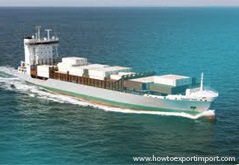
Difference between mother vessel and feeder vesselFeeder vessel is normally small in size compared to Mother vessel. Feeder vessels serves between smaller ports and major ports. In other words, feeder vessels feeds cargo to mother vessel from smaller ports to large ports for exports and from major main ports to smaller ports for imports. Compared to mother vessel, feeder vessel is slow.
What is the capacity of Feeder vessel?.
Average capacity of a feeder vessel is 300 to 500 TEUs (20’ containers). Feeder vessel serves short distance, either between  smaller ports, or between smaller ports  and major ports.

MOTHER VESSEL


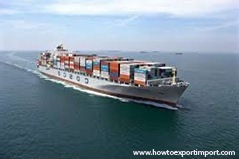
Mother vessel is big in size compared to feeder vessel. Mother vessels only serveDifference between mother vessel and feeder vessel 1 between major big ports. Mother vessels have the capacity to carry thousands of containers. Mother vessel calls only main ports. The mother vessel covers large distance compared to feeder vessel.
What is the capacity of mother vessel?
Average capacity of a Mother Vessel is 10000 TEUs (Twenty foot Equipment Units).   In 1960s,  vessel capacity was maximum of  500 – 800 TEUs.  Mother vessel with a capacity of  15000 TEUs are available now. We can expect mother vessels with a capacity of 20000 TEUs by the year 2015.   Read – Difference between Vessel arriving and Vessel berthing 

Documents required for import customs clearance

http://www.cybex.in/indian-custom-duty

This is one of the important articles in export and import trade –What are the documents required for Import clearance? One of frequently asked questions is ‘documents required for import clearance’

Unlike other articles, I can not provide a ‘capsule’ solution on this article about documents required for import customs clearance. I will explain reason behind it. First of all, let me clarify: the documents required for import clearance under all products are not same. However, we can discuss about the common documents required for import customs clearance in importing countries. I will provide you a some general information on documentation of import customs clearance from which you can have a common idea on the subject. I hope, this information helps you a lot to know about documents required for import clearance generally.
Since various types of commodities are imported from different countries, a complete list of documents for import customs clearance procedures can not be provided. More over, different countries have their own policies in turn different procedures and formalities for import clearance. Each product under import and export  is classified under a code number accepted globally which is called ITC number.
There may have bilateral import export agreements between governments of different countries. Imports and exports from such countries may have exemptions on documentation for export and import clearance.
However there are legal documents, common documents and specific documents on commodity basis required to complete import customs procedures. 
Let us discuss some of the common documents required for import customs clearance procedures and formalities in some of the importing countries.
Bill of Entry:
Bill of entry is one of the major import document for import customs clearance. As explained previously, Bill of Entry is the legal document to be filed by CHA or Importer duly signed. Bill of Entry is one of the indicators of ‘total outward remittance of country’ regulated by Reserve Bank and Customs department. Bill of entry must be filed within thirty days of arrival of goods at a customs location.
Once after filing bill of entry along with necessary import customs clearance documents, assessment and examination of goods are carried out by concerned customs official. After completion of import customs formalities, a ‘pass out order’ is issued under such bill of entry. Once an importer or his authorized customs house agent obtains ‘pass out order’ from concerned customs official, the imported goods can be moved out of customs. After paying necessary import charges if any to carrier Documents required for import customs clearanceof goods and custodian of cargo, the goods can be taken out of customs area to importer’s place. For further read:  How to file Bill of Entry online?  How to file Bill of Entry manually?  Can Bill of Entry be filed before arrival of goods at destination?
Commercial Invoice.
Invoice is the prime document in any business transactions. Invoice is one of the documents required for import customs clearance for value appraisal by concerned customs official. Assessable value is calculated on the basis of terms of delivery of goods mentioned in commercial invoice produced by importer at customs location. I have explained about the method of calculation of assessable value in another article in same web blog. The concerned appraising officer verifies the value mentioned in commercial invoice matches with the actual market value of same goods. This method of inspection by appraising officer of customs prevents fraudulent activities of importer or exporter by over invoicing or under invoicing. So Invoice plays a pivotal role in value assessment in import customs clearance procedures.  Read more: How to prepare Commercial Invoice? Contents of Commercial Invoice.    Difference between proforma Invoice and Commercial Invoice.  Howmany types of Bills of Entry in India?
Bill of Lading / Airway bill :
BL/AWB is one of the documents required for import customs clearance.
Bill of lading under sea shipment or Airway bill under air shipment is carrier’s document required to be submitted with customs for import customs clearance purpose. Bill of lading or Airway bill issued by carrier provides the details of cargo with terms of delivery. I have discussed in detail about Bill of Lading and Airway bill separately in this website. You can go through those articles to have a deep knowledge about documents required for import customs clearance.  Read more about: Different types of Bill of Lading   When to release Bill of Lading?  Importance of Bill of Lading
Import License
As I have mentioned above, import license may be required as one of the documents for import customs clearance procedures and formalities under specific products. This license may be mandatory for importing specific goods as per guide lines provided by government. Import of such specific products may have been being regulated by government time to time. So government insist an import license as one of the documents required for import customs clearance to bring those materials from foreign countries.
Insurance certificate
Insurance certificate is one of the documents required for import customs clearance procedures. Insurance certificate is a supporting document against importer’s declaration on terms of delivery. Insurance certificate under import shipment helps customs authorities to verify, whether selling price includes insurance or not. This is required to find assessable value which determines import duty amount. 
 
Purchase order/Letter of Credit
Purchase order is one of the documents required for import customs clearance. A purchase order reflects almost all terms and conditions of sale contract which enables the customs official to confirm on value assessment. If an import consignment is under letter of credit basis, the importer can submit a copy of Letter of Credit along with the documents for import clearance. Also read How does Letter of Credit work?
Technical write up, literature etc. for specific goods if any
Technical write up, literature of imported goods or any other similar documents may be required as one of the documents for import clearance under some specific goods. For example, if a machinery is imported, a technical write up or literature explaining it’s function can be attached along with importing documents. This document helps customs official to derive exact market value of such imported machinery in turn helps for value assessment.
Industrial License if any
An industrial license copy may be required under specific goods importing. If Importer claims any import benefit as per guidelines of government, such Industrial License can be produced to avail the benefit. In such case, Industrial license copy can be submitted with customs authorities as one of the import clearance documents.
RCMC. Registration cum Membership Certificate if any
For the purpose of availing import duty exemption from government agencies under specific goods, production of RCMC with customs authorities is one of the requirements for import clearance. In such cases importer needs to submit Registration Cum Membership Certificate along with import customs clearance documents.
Test report if any
The customs officials may not be able to identify the quality of goods imported. In order to assess the value of such goods, customs official may draw sample of such imported goods and arranges to send for testing to government authorized laboratories. The concerned customs officer can complete appraisement of such goods only after obtaining such test report. So test report is one of the documents under import customs clearance and formalities under some of specific goods.
DEEC/DEPB /ECGC or any other documents for duty benefits
If importer avails any duty exemptions against imported goods under different schemes like DEEC/DEPB/ECGC etc., such license is produced along with other import clearance documents.
 documents required for import clearance
Central excise document if any
If importer avails any central excise benefit under imported goods, the documents pertaining to the same need to be produced along with other import customs clearance documents.
GATT/DGFT declaration.
As per the guidelines of Government of India, every importer needs to file GATT declaration and DGFT declaration along with other import customs clearance documents with customs. GATT declaration has to be filed by Importer as per the terms of General Agreement on Tariff and Trade.

TYPES OF EXPORT CONTAINER

Types of Export Containers
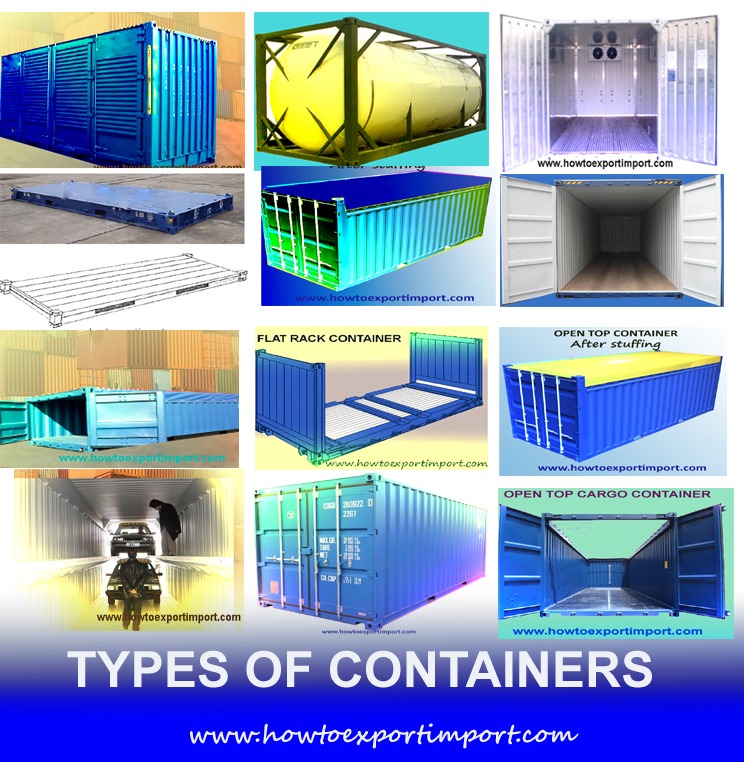
types of containersThis post helps you to get information about different cargo container types used for transport of goods.
Different types of containers are used in domestic and international trade to move cargo from one location to another. Some types of containers are Standard Dry Containers, Open Top Containers, High cube Containers, Refrigerated Containers (Reefer Containers), GOH Containers (Garments on hanger containers), Open Side Containers, Tank Containers , Half height Containers, Ventilated Containers, Car Carrier Containers, Hard top Containers, Insulated Containers, Tunnel Containers, Platform Containers, Flat rack Containers etc. These containers are used to transport different types of goods as per convenience, coastwise and time saving parameters. For example, Standard dry containers are used to move general dry cargo, temperature sensitive cargo is moved with refrigerated containers, liquid and powder type goods are moved with tank container so on. So each type of container is manufactured as per customer’s requirements.
Detailed article about each type of container has been described in separate post in this website to make you easily understand about each container. You can click below links to learn more about types of containers.
You can click below links to learn more about types of containers:

How to settle dispute in International Business of Import and Export

DISPUTE SETTLEMENT IN EXPORTS AND IMPORTS BUSINESS
How to settle dispute in International Business of Import and Export copyLitigations and Arbitration in Export and Import Business. 
I hope this article helps all traders in a business especially those who are in to Import Export business – how to handle disputes in import and export trade?
I sell goods to you, you buy them, you pay bill, you use my goods. Simple. Both are happy. Right? But is it that much simple in an international trade? I will say ‘YES’ depends up on how fast you are untying the knot. In other words, I will say, ‘Removing hindrances with least time and least money is business’ . Am I right?
Let me discuss firstly about causes for disputes under export import business. What are the reasons for Disputes in international business?
Reasons for disputes in international trade between exporter and importer can be many. 
 
As per my experience in import export trade for the past 25 years, the primary reason for disputes is quality of the goods exported. Under contractual terms in many export contracts, importer gets the opportunity to inspect the quality of goods only when the consignment reaches him. In many cases, by that time, the exporter would have got money. Even if the consignment is sent on collection basis, importer can check the quality only after retiring the documents. Other reasons for the disputes can be delayed shipment or non-shipment due to change in government regulations or market conditions, restricting exports, etc.
What are the methods of settling dispute? 
In any business there are two basic methods for dispute settlement – Litigation and arbitration. 
 
Litigation is highly suitable due to the proverbial delayed process, prohibition costs and uncertainty of decision. 
 
But what are the basic Limitations of Litigation? How fast a litigation can be in export import business? Is it easy to educate and convince on judgments with proper documentary proof? How convenient to both exporter and importer under Litigation in international business? Will it effect both importer and exporter on their business due to bad image among public? How to effect trade relationship for both seller and buyer under litigation? Are international laws and procedures simple to handle?  Let me discuss these area also here:
Slow Process: As you know, almost all civil process of litigation is slow. Court process proverbially takes huge time consuming and formalistic.
Avoidable Necessity of Export Witness and other Evidence: In international contracts, practices, procedures and customs are different. A judge however well versed may be, in law, can not be expected to know all these intricate matters. So, in courts, to educate the judge about these practices, witnesses who are experts and having knowledge in the field have to be produced to prove the practices, even before the evidence is established.
disputes in international businessInconvenience to the Parties: Court timing and date of hearings may not be convenient to litigants. Most of the time, cases are postponed and in that process months drag on even for completion of one witness. Even after day’s long waiting for hearing, one may know, at the end of the day, that the case is adjourned for two months due to non availability of the other advocate!
Adverse Public Image: Court proceedings are never secret. Media always covers the developments in important cases. Even the superior court judgments are published. Matters, which have been confidential till the case is brought to a court of law, become topics for public discussion that may bring notoriety, loss of goodwill and long-standing reputation.
Bitterness and Disruption of Trade Relationships: When a matter goes to a court of law, it is immaterial which party may win as the age old established relationship, after the case is brought to litigation in a court, comes to an end with only acrimony ad bitterness.
Different Laws and Procedures: International trade laws and procedures are more complicated. Litigation in foreign courts is more expensive and difficult in comparison to the domestic courts.
OK, Now let us discuss about Arbitration under Imports and Exports. How does arbitration helps exporters and importers if dispute arises? How fast arbitration can take place under a dispute between buyer and seller in export import business? How expensive compared to litigation under export import dispute between seller and buyer? How does an arbitration under international business effect Goodwill of both exporter and importer? What about the confidentiality about the dispute between importer and exporter in an international trade?
What are the basic Advantages of Arbitration under a dispute between seller and buyer in export import business of international trade? 
Let me explain basic advantages of arbitration in Export Import dispute compared to Litigation:
Quickness: Definitely, arbitration is quicker than litigation. Process of arbitration can be completed as fast as the concerned parties desire. Under Arbitration Act, the arbitrators have to make the award within four months from the date of completion of all proceedings. Usually, arbitration is settled within a period of four months to one year.
Inexpensiveness: Total incidental expenditure in arbitration is always much lower than litigation. Arbitration fees is around 2% of the claim value or less in institutional arbitration.
Promotes Goodwill: As the arbitrator is chosen by both the parties, based on their faith and his competence, arbitration becomes a normal process of goodwill. Arbitration proceedings and its outcome do not disturb the existing friendly relations between the exporter and importer.
Choice of Appropriate Arbitrator: As the arbitrator is chosen by both the parties and name incorporated in contract, who has the knowledge of customs and procedures of international trade, so separate expert witness for educating the judge does not arise.
Privacy: Arbitration proceedings are not open to public. Arbitrator’s award is not published in any newspapers. This preserves privacy of the parties. So, trade secrets as well as disputes arising from the contracts do not become public.
dispute in exports and importsIn this article, I have explained about Litigation and Arbitration under dispute between Exporter and Importer in an International Business. Had you experienced Litigation and Arbitration under dispute between you and your customer? Would you like to add more information about dispute between importer and exporter in International Business? Share below your experience in handling dispute between you and your customer in Export Import Business. 

Comment below your thoughts about this article – Dispute settlement in Imports and Export business, Litigation and Arbitration.

What are the legal documents in exports

Are there any documents to be filed legally under export from India? If yes, what are those legal documents under exports? Why legal documents for exports? How do those legal documents work?
What are the legal documents in exports
As you are aware, export means taking goods outside territory border of a country and imports means bringing in to the territory border of a country.
For each exports, foreign currencies flows into a country . As well as there should be proper record of details of description goods, value of goods and other details are to be recorded by the government of each country.
The major legal document for export is GR/PP form/SOFTEX form.
The exporter must file any one of GR,PP form or Softex form depends up on the nature of exports.
What is GR? How does it work?
G.R.forms are issued by Reserved Bank of India to regulate and monitor foreign exchange transactions against export of goods under physical forms. Exporter has to collect blank G.R.forms from RBI. The forms are in duplicate. Exporter had to sign both copies and arranged to deliver to Customs House Agents for filing with customs. While filing shipping documents by customs house agents, a Xerox true copy of shipping bill to be impressed on the G.R.form. Once customs formalities completed, original G.R form is submitted with customs and duplicate copy of G.R. sends back to the exporter. Exporter submits duplicate GR form with their bank along with other shipping documents. Exporter’s bank sends back the said duplicate GR form to RBI for foreign exchange regulations. Customs department also sends back the original GR copy to RBI. PP form is used, if shipment by Post office. After introduction of online filing of shipping bill for export where in electronic filing system is available (EDI) , these procedures have been waived off by Reserve Bank of India as such GR details are electronically transferred from customs department to Reserve bank directly. However, GR forms are mandatory at export customs locations where EDI facility is not available.
What is SOFTEX form? How does SOFTEX form work?
SOFTEX forms are to be filed with STPI to regulate inward outward remittance by Reserve Bank under export of goods in non-physical form, either domestic or offshore. The products includes computer software, export of Video and TV software and all other types of software products and packages which are falling under goods of non physical form.
   
SOFTEX form is issued by Reserve Bank foreign exchange department. All software forms under STP units are eligible to obtain SOFTEX forms from Foreign exchange department of Reserve bank once after submitting self-certified copy of overseas buyer’s contract/purchase order or work order with STPI office as per 7(a) of SOFTEX form for declaration. SOFTEX forms are issued in triplicate. These SOFTEX forms are to be submitted by STP units within 30 days of issue of export invoice or within 30 days of last invoiced released in a month. Once exports effected, after necessary certification by STPI director’s office, the said SOFTEX forms are sent to Reserve bank. SOFTEX blank forms are obtained from foreign exchange department of Reserve bank by the STP units in triplicate. Once after effecting sales, the said SOFTEX forms in triplicate are submitted with STPI for necessary approval / endorsement by director of STPI under the jurisdiction of STP units. After certification of three copies of SOFTEX forms, original and duplicate are returned to STP units and triplicate copy is retained by STPI units. Once after exports effected, the duplicate copy of softex form is submitted with authorized dealer bank along with the necessary supporting documents. Original SOFTEX form is submitted with Reserve Bank’s exchange control department within the jurisdiction of STP unit. Once after receipt of foreign exchange under the said SOFTEX form, authorized bank returns the said duplicate copy of SOFTEX form to Reserve Bank.
What is PP form in Exports? How does PP form work in Exports?
PP forms are used under export through Post office. If you effect shipment through post office, PP form need to be filed up by exporter duly signed and sealed. PP form is a declaration by exporter mentioning the details of goods exporting through post office. These details contains the description of goods, value of goods, term of payment, terms of delivery, port of loading, port of discharge, country of destination, shipper details, consignee details etc.etc.

Export finance – a Key factor in Export trade

As you know finance plays prime role in any business, even in Export also. Each exporter of any country is highly supported by the government in all means to earn foreign exchange, one of the major indicators of wealth of nation.
In this article, let us discuss some of the export financial assistance provided by government agencies to promote export business. These financial assistance to exporters varies from country to country depends up on their policy adopted time to time. However most of countries extend a good financial support to exporters to earn foreign exchange from other countries to strengthen each country’s foreign exchange reserves, in turn financial strength.
Some of the major benefits supported by government are given below. These financial benefits to exporters may vary from country to country. I provide below the following financial benefits in general. You may cross check with your government authorities to get authenticated information. These details of financial assistance to exporters are given to let you know an idea on ‘how government supports exporters in assisting financial support’.
Export Finance a key factor in Export trade
Finance up to 90% of FOB value of exports
Financial support to exporters up to 90% of FOB value of exports are provided by most of the banks based on the instruction of government to boost exports. Some of the banks extend a financial support of 100% export value, with a narrow interest rate fixed by government time to time.
Interest rate as low as below 6% per year.
Most of the banks provide financial assistance to exporters with a low interest rate as 6% per annum. This rate of interest is very nominal which helps exporters to procure materials, packing or for other export related purposes.
Credit period up to 270 days
Extending credit period up to 270 days is one of the supports under financial assistance to exporters by government through authorized bank. A credit of almost 10 months is a good period for an exporter with least rate of interest on financial assistance to help him to utilize this fund for export purpose. During this period of 270 days, an exporter can procure material, export, and collects his amount of sale of exports to repay such loan amount.
Pre shipment finance – Packing credit
Packing credit is one of the other financial assistance to exporters provided by bank. Getting financial assistance before shipment of goods is a great help for any exporter is concerned. Here, an exporter can avail finance before shipment which is called Packing Credit. Packing credit is pre shipment financial assistance to exporters allotted by banks on the basis of export stocks available for exports. The exporter has to produce copy/original of necessary export orders along with the details of stocks available for exports. The bank authorities inspect the exporter’s premises and collect data of such stock ready for export and assess the value. Based on such valuation of stock, the exporter is allotted packing credit loan by banks with a very narrow interest rate.
Short term credits
Exporters are also eligible to avail financial assistance in the form of short term credits from authorized banks. Short term credits are provided by banks on the basis of instructions provided by government time to time to help exporters to meet their financial requirements.
Post shipment finance – Bill discounting/Bill Negotiation etc.
What are the export benefits by government
Financial assistance to exporters after exports in the form of Bill discounting/negotiation is provided by banks with a low interest rate. This financial support also helps exporters to procure/manufacture new products for exports for next export consignment. Once after completing the procedures of an export consignment, the exporter submits all required documents to send to overseas buyer. If the export sale contract between buyer and seller is on credit basis, normally the export bills are sent to buyer for collection of payment on maturity date, mutually agreed. When submitting such documents, if the exporter requires finance for upcoming export consignments, he can apply for post shipment finance by discounting of export bills already exported. In the case of Letter of credit, negotiation procedures are followed to avail post shipment finance.
In short, as per government’s policy, no exporter should suffer for want of funds to export goods. Most of the government supports up to 90% of FOB value of goods with very least rate of interest up to 270 days. This is a great chance for any business man to be attracted to earn foreign exchange.

TYPES OF LETTER OF CREDIT

Letters of Credit (LC) are widely used in international practice for convenience of international trade transactions and elimination of possible risks.
PASHA Bank offers its customers various types of LCs. The Bank issues LC both within its own capabilities and within the cooperation of the world well known 1st class banks. Bank personnel provide complete consulting support in information about LC and selection of LC type depending on the customer needs.
In addition to LC for international trade operations, PASHA Bank also offers Trade financing services.

Main types of LC

Due to frequent usage within the international collaboration, the names of LC types are given in English as well
1. Irrevocable LC. This LC cannot be cancelled or modified without consent of the beneficiary (Seller). This LC reflects absolute liability of the Bank (issuer) to the other party.
2. Revocable LC. This LC type can be cancelled or modified by the Bank (issuer) at the customer’s instructions without prior agreement of the beneficiary (Seller). The Bank will not have any liabilities to the beneficiary after revocation of the LC.
3. Stand-by LC. This LC is closer to the bank guarantee and gives more flexible collaboration opportunity to Seller and Buyer. The Bank will honour the LC when the Buyer fails to fulfill payment liabilities to Seller.
4. Confirmed LC. In addition to the Bank guarantee of the LC issuer, this LC type is confirmed by the Seller’s bank or any other bank. Irrespective to the payment by the Bank issuing the LC (issuer), the Bank confirming the LC is liable for performance of obligations.
5. Unconfirmed LC. Only the Bank issuing the LC will be liable for payment of this LC.
6. Transferable LC. This LC enables the Seller to assign part of the letter of credit to other party(ies). This LC is especially beneficial in those cases when the Seller is not a sole manufacturer of the goods and purchases some parts from other parties, as it eliminates the necessity of opening several LC’s for other parties.
7. Back-to-Back LC. This LC type considers issuing the second LC on the basis of the first letter of credit. LC is opened in favor of intermediary as per the Buyer’s instructions and on the basis of this LC and instructions of the intermediary a new LC is opened in favor of Seller of the goods.
8. Payment at Sight LC. According to this LC, payment is made to the seller immediately (maximum within 7 days) after the required documents have been submitted.
9. Deferred Payment LC. According to this LC the payment to the seller is not made when the documents are submitted, but instead at a later period defined in the letter of credit. In most cases the payment in favor of Seller under this LC is made upon receipt of goods by the Buyer.
10. Red Clause LC. The seller can request an advance for an agreed amount of the LC before shipment of goods and submittal of required documents. This red clause is so termed because it is usually printed in red on the document to draw attention to “advance payment” term of the credit.

WHAT IS MMTC

As the largest trading company of India and a major trading company of Asia, MMTC aims at improving its position further by achieving sustainable and viable growth rate through excellence in all its activities, generating optimum profits through total satisfaction of shareholders, customers, suppliers, employees and society.
CORPORATE OBJECTIVES
1.      To be a leading International Trading House in India operating in the competitive global trading environment, with focus on “bulk” as core competency and to improve returns on capital employed.
2.    To retain the position of single largest trader in the country for product lines like minerals, metals and precious metals. 
3.      To promote development of trade-related infrastructure. 
4.      To provide support services to the medium and small scale sectors.
5.      To render high quality of service to all categories of customers with professionalism and efficiency.
6.      To streamline system within the company for settlement of commercial disputes.
7.      To upgrade employee skills for achieving higher productivity.
Design a site like this with WordPress.com
Get started