Measures to consider while importing samples from foreign country

            Measures to consider while importing samples from foreign country
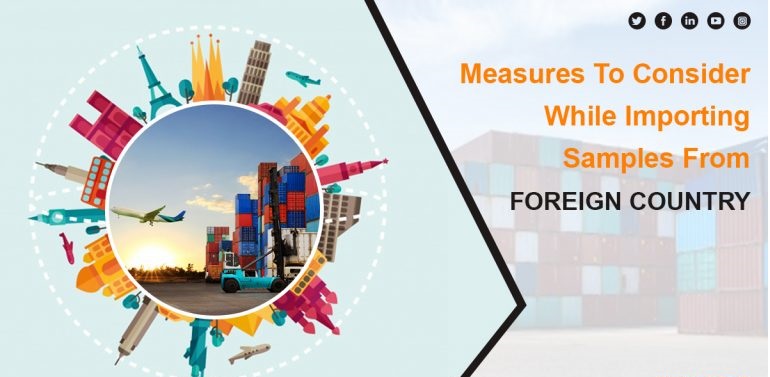
Samples are generally specimens of goods that may be imported by that of the traders or representatives of product manufacturers Abroad in India in order to assess its marketability, know its characteristics and usage in India. Before booking a confirmed order, it is important for the importer to ask for original sample of the manufactured product that can be shown or demonstrated for the purpose of customer appreciation and acceptance.

It includes consumer durables, consumer goods, prototypes of engineering goods, machineries (including agricultural machinery), high value equipment and their accessories. Goods such as wild animals, arms & ammunition, wild birds, ivory, Narcotic drugs etc are prohibited under Foreign Trade Act, 1992 and thus not allowed to be imported as samples.
Limit –
Importing of bonafide trade samples by that of traders and industrialist provided the said goods have been supplied free of charge. For duty free clearance of samples, the value of individual sample should not exceed Rs. 5000 /- and aggregate value should not exceed Rs. 60, 000 /- per year or 15 units of samples in a year. This kind of strategy avoids the risk of non- payment of Customs Duty through repeated imports of samples in smaller lots.
Who can import/ Send –
Samples can be imported by that of the industry, trade, individuals, Research Institutes, Laboratories, Companies or Associations. The representatives of manufacturers abroad can also bring these either through post or courier or as a part of their personal baggage. Samples can also be sent by traders or manufacturers abroad to above Indian parties.
Geneva Convention, 1952 –
As per Geneva Convention that was held on 7th November, 1952, Import of samples of goods is exempt from import duties. India is a signatory to it and thus facilitate the Importation of Commercial Samples and Advertising materials.
Privacy of Import Samples –
In case of high valued machinery the importer can import a sample under privacy. On the request of importer, the Customs authority may seal the machinery during its journey from the port of importation to the place of demonstration and it is unsealed only at the place of operation or place of demonstration.
Machinery import –
Machinery, which are prototypes of engineering goods, imported either for further manufacturing of the said goods or to be used as capital goods for export production or in connection of securing further export orders can also be imported duty-free if the value does not exceed Rs.10000/-.  The goods can be cleared by furnishing a Bank Guarantee (or) deposit of the duty payable and an undertaking from the importer that the said goods would be re- exported within the period of 9 months from the import.
Failure to re-export –
The samples have to be re-exported within 9 months. However, the Assistant Commissioner of Customs can extend the period of 9 months for some further reasonable period under special circumstances.

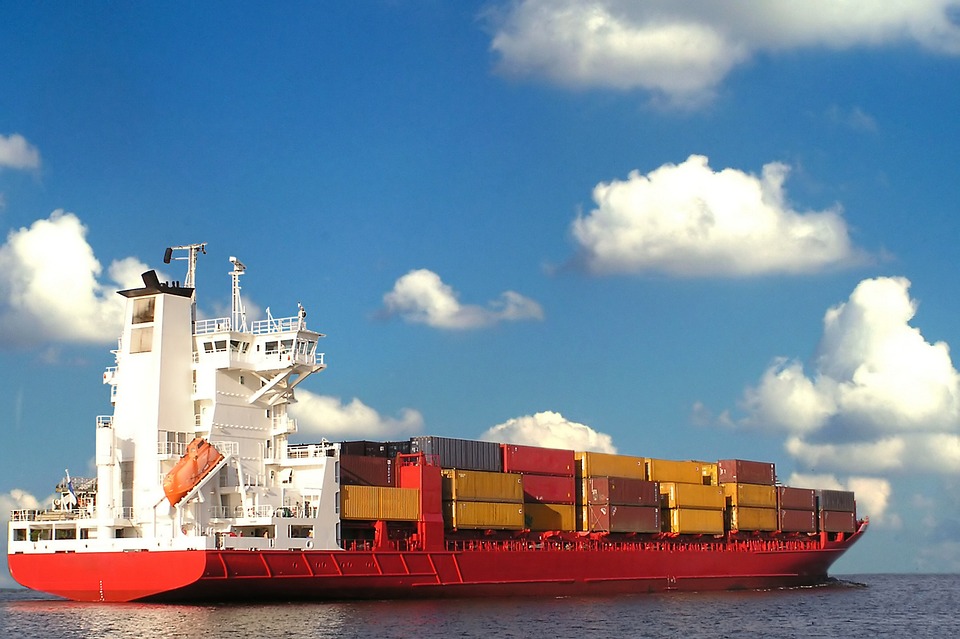
Basic Steps You Should Follow to Export Food From India

Basic Steps You Should Follow to Export Food From India

India is been known as an agrarian country for years as almost 60 percent of the population of India is dependent on agriculture for living. The government of India has over the years taken various steps to boost agriculture and its exports. India exports numerous food/ agricultural products worldwide. Food products can be divided into primary food crops, cash crops and secondary food crops. Primary food crops include vegetables, cereals, spices, meat, oil, fruits etc. India’s foreign trade i.e. imports and exports are been regulated by that of the Foreign Trade policy that is been noticed by Central Government.
A lot needs to be planned and prepared by that of an exporter before starting the business of export. Here are the detailed steps for starting exports –
  1. Establish an organization –
Inorder to start the business of export, a sole Proprietary concern/ Company or a Partnership firm needs to be set up as per prescribed procedure with some attractive name and logo.
  1. Open a Bank account –
Current account needs to be opened with a Bank that is been authorized to deal in Foreign Exchange.
  1. Obtain PAN (Permanent account number) –
It is a compulsory document, which needs to be obtained by every importer and exporter.
  1. Obtain IEC (Import- Export code) –
It is mandatory to obtain a 10-digit IE code number for export/import from India as per Foreign trade policy. Application for the same needs to be done to that of the Regional DGFT authority in form ANF 2A
  1. Registration – Membership certificate –
This certificate is been needed for availing export/ import authorization or benefit or concession under FTP 2015-20.
  1. Selection of product –
Expect the products that appear under restricted or prohibited list, all are freely exportable. One needs to select the product after detailed research.
  1. Selection of market–
An overseas market should be selected after research covering market size, competition, quality requirements, payment terms etc. Indian Missions abroad, Export promotion agencies, friends, relatives and colleagues might be helpful in gathering the information.
  1. Searching buyers –
B2B portals, buyer seller meets, web browsing, participation in trade fairs and exhibitions can be considered as an important tool to find the buyers. Creation of multilingual Website with that of product catalogue, payment terms, price and other related information can be of great help.
  1. Sampling –
Providing customized sample as per the need of the Foreign buyer would help in getting orders.
  1. Price and costing –
Pricing of the product is very much crucial in getting the attention of the buyer along with promoting sales. The price should be worked out keeping into mind all expenses from sampling to realization of export proceeds on the basis of terms of sale i.e. Cost, Cost & Freight (C&F), Free on Board (FOB), Insurance & Freight (CIF) etc.
  1. Negotiation with the buyers –
After determining the buyer’s interest in the product discussion related to the allowance, discount and other aspects can be considered.
  1. Risk covering by way of ECGC –
International trade involves risks related to payment due to buyer/ Country insolvency. These risks need to be covered by an appropriate Policy by Export Credit Guarantee Corporation Ltd (ECGC).

How Can You Prepare an Export Quote?

Generally, an export transaction would begin with buyer requesting for quotation form to the seller.
Quote serves as a promise in form of a formal statement by the seller that he would provide the product at a specified time and price. Seller would be presenting the quotation in proforma invoice form. The seller needs to understand that International market is buyer’s market and thus the price quoted by an exporter should be reasonable as well as final. Government policies, competition, elasticity of demand play a very significant role in determining the price/ quote of the product. Quote is a primary document of price which may be negotiable.
Quote is a crucial document which will benefit the seller as well as the buyer and thus there should be a standard checklist. This checklist should have all the important details such as price, time of delivery, taxes, bank fees if any, transportation mode and price etc.
Below is the checklist for preparing an Export quote –
1. Details of Seller i.e. name, contact information, address, id proof, tax proof
2. Place and time of selling of products
3. Details of Buyer i.e. name, contact information, address, id proof, tax proof
4. Ship to- party’s full details i.e name, contact information, address, id proof, tax proof
5. Detailed description of the product including –
a. Quality and Grade
b. Name by which the product is known locally and in the market of the buyer
c. Harmonized system number
d. Currency
e. Price per unit of the product
f. Country of origin
g. Number of Quantity
h. Symbols, numbers and marks under which the product is sold
6. The details of country in which shipment will be done
7. All kind of goods and services that would be provided by the buyer for the product of the merchandise
8. Some additional information such as,
a. Mode of payment
b. License required if any
c. Any certificates or statements that would be required by the buyer’s country
d. Relevant laws
e. Expiration of the quotation date
f. Where title would be transferred from the seller to that of the buyer
Price is a significant variable as it is the major factor affecting the choice of the consumer. It is very important for a seller to quote the price properly and for this, he should keep following things in mind –
1. Range of products that are been offered.
2. Frequency of purchase
3. Credit offered.
4. Prompt acceptance as well as settlement of the claims.
5. Preference or prejudice for goods originating from that of a particular source.
6. After- sales service in products such as machine tools, consumer durables.
7. Prompt deliveries and continuity in supply.
8. Presumed relationship between price and quality
9. Product differentiation along with brand image
10. Specialty value goods and gift items
11. Unique value goods and gift items
12. Aggressive marketing and sales promotion

10 Common Export Documents You Should Know in exports

10 Common Export Documents You Should Know IN exports

Having a detailed understanding of the below common documents is very crucial for the success of the business –
  1. Bill of Lading (B/L) –
Considered as the initial and most common document that is been used in international shipment. It is a contract cum receipt between the carrier and the owner of the products. It contains basic information such as what goods are been shipped, where they are going etc. Bill of lading is of several types such as – Straight B/L, Air Waybill, Ocean B/L, Truck B/L, and Shipper’s order’s B/L.
  1. Certificate of Origin –
It is a certificate used for the export of goods by the exporter/ manufacturer to certify country of origin. The local Chamber of commerce or government entity legalizes certificate of origin.  It is been used to identify the country of manufacturer where the product is been made.
  1. Certificate of manufacturer –
It is a notarized document which certifies that the goods are been produced by the manufacturer after fulfilling the general requirement of the product and is then ready for shipment.
  1. Commercial Invoice –
Commercial invoice is the key accounting document prepared by the seller of the goods for the buyer. It is used to determine the actual value of the goods for the purpose of assessing the custom duty. The invoice should include the following –
  • Country of origin (manufacture)
  • Gross and net weights
  • Detailed description of the goods
  • Inco- terms rule
  • Total number of packages
  • Invoice quantity
  • Certifications
  • Currency value
  • Authorized exporter signature
  • Destination control statement
  • The following statement along with signature; “I hereby certify that this invoice is true and correct.”
  1. Consular Invoice –
This invoice certifies the shipment of the goods. Not a compulsory document
  1. Dock Receipts –
The reason of this receipt is to provide a proof to the manufacturer/ exporter that the goods are been successfully delivered and are in proper condition.
  1. Inspection certificate –
It certifies the items were received in good condition and that the shipment contained the correct quantity.
  1. Certificate of Insurance –
It certifies you have bought an insurance policy for the cargo.
  1. List of packing –
List of packing is very much similar to that of the shipping list. The list contains details of goods that are to be shipped along with the method of packing, weight/ height dimensions and its numbering methodology. Although it is not a compulsory document in all the cases but it is considered as an significant document that can be used by the freight forwarder in preparing bill of lading.
  1. EEI (Electronic Export Information) –
It is required for all kind of export shipments. This needs to be filled in a Automated export system (AES).

Press Information Bureau
Government of India
Ministry of Commerce & Industry
12-March-2015 18:20 IST
Mandatory Documents Required For Export And Import Reduced To Three Each
India took a leap forward in improving ‘Ease of Doing Business’ today by reducing the mandatory documents required for import and export of goods to three documents each. The Directorate General of Foreign Trade (DGFT) issued a Notification to this effect today (Notification Link below).
The Department of Commerce had set up an Inter Ministerial Committee under the Chairmanship of DGFT in July 2014 to study and recommend ways to reduce the number of mandatory documents required for export and import. The Committee held detailed discussions with all stakeholders and the concerned Departments/ Ministries/Agencies and also visited JNPT to study the ground situation and find ways to minimize the number of documents and reduce transaction costs and time for exports and imports. The Committee submitted its “Trading Across Borders” report to Prime Minister’s Office in December 2014.
Based on the recommendations of the report, the RBI has agreed to do away with the ‘Foreign Exchange Control Form (SDF)’ by incorporating the declaration in the ‘Shipping Bill’ (for exports) and dispensing with the ‘Foreign Exchange Control Form (Form A-1)’ (for imports). Customs have also agreed to merge the ‘Commercial Invoice’ with the ‘Packing List’ and have issued a Circular for accepting ‘Commercial Invoice cum Packing List’ that incorporates the required details of both the documents. The exporters and importers, however, have the option of filing separate ‘Commercial Invoice’ and ‘Packing List’ also, if they so desire. Shipping Ministry has also agreed to do away with the requirement of ‘Terminal Handling Receipt’ and make the process online.
As a consequence, after issue of the DGFT’s Notification dated 12-3-2015, only three documents each would be mandatory documents for export and import.
MANDATORY DOCUMENTS FOR EXPORT & IMPORT
S. No.
EXPORTS
IMPORTS
1
Bill of Lading/ Airway Bill
2
Commercial Invoice cum Packing List
3
Shipping Bill/ Bill of Export
Bill of Entry
It may be recalled that India ranked 126 in ‘Trading Across Borders” component of “Ease of Doing Business”, out of 189 countries ranked by the World Bank, in its 2015 Report. The ranking methodology adopted by the World Bank for ‘Trading Across Border’ takes into account the number of mandatory documents required for export and import and the time and cost of exporting/importing a container out of/into the country. World Bank’s 2015 Report listed 7 and 10 mandatory documents respectively for export and import from/to India.
MANDATORY DOCUMENTS LISTED BY WORLD BANK IN DOING BUSINESS REPORT 2015
S. No.
EXPORTS
IMPORTS
1
Shipping Bill
Bill of Entry
2
Commercial Invoice
Commercial invoice
3
Packing List
 Packing List
4
Bill of Lading
Bill of Lading
5
Foreign Exchange  Control Form (SDF)
Foreign Exchange Control Form (Form A-1)
6
Terminal Handling Receipt
7
Technical Standard Certificate
Certified Engineer’s
 Report
8
Cargo Release Order
9
Product manual
10
Inspection report
As such, after issue of DGFT’s Notification only three documents each would be mandatory for export and import as two documents (Packing List and Commercial Invoice) required by Customs have been merged into one document, whereas one document required by RBI (Foreign Exchange Control Forms – SDF for exports and A-1 for imports) and one document required by Ministry of Shipping (Terminal Handling Receipt) earlier, have now been dispensed with. ‘Cargo Release Order’ is not a mandatory document required by any regulatory agency, but is a commercial document issued by the Shipping line to the concerned importer. As regards, ‘Technical Standard Certificate’/ ‘Certified Engineer’s Report’, ‘Product manual’ and ‘Inspection report’, these documents are required in specific cases/products/tariff lines only and are not mandatory for all products.
The reduction in the number of mandatory documents would also lead to corresponding reduction in Transaction cost and time.  It is expected that this step would not only facilitate the ‘Ease of Doing Business’ in respect of ‘Trading across Borders’ but also improve India’s ranking on this parameter.
To read the Notification on reduction in number of mandatory documents required for export and import, click here.

Online platform for filing and issuance of Preferential Certificate of Origin (CoO)

Online platform for filing and issuance of Preferential Certificate of Origin (CoO)

NO. CLE-HO/POL/CIRCULAR/2019
Oct. 1, 2019
Members of the Council
Online platform for filing and issuance of Preferential Certificate of Origin (CoO)
Dear Member
The DGFT has issued a Trade Notice no. 34 dated 19th September 2019 (copy enclosed)  on the above subject.
The aforementioned Trade Notice states the following
·        A new online platform for issuance of Preferential Certificate of Origin (CoO) has been developed which would be single point access for all Free Trade Agreements / Preferential Trade Agreements (FTAs/PTAs), for all CoO issuing agencies and for all export products.
·        URL to access the platform is http://coo.dgft.gov.in.
·        Exporters who want Certificate of Origin have to register in the aforementioned platform using their digital signature. The digital signature (Class II or Class III with the firm’s IEC embedded) would be the same as used in other DGFT online applications. On registration, a password would be sent to the e-mail linked to the IEC. If the email is to be updated, the same may be done using online IEC application module in the DGFT website.
·        Issue of COO for India – Chile PTA will be started from 25th September 2019. Online issuance of CoO for other countries will start as soon as their acceptance is received.
Members may please note the above and contact the following channels for any further assistance
–          Call the Helpline at the Toll Free Number 1800 111 550
–          Drop an e-email to coo-dgft@gov.in
–          Raise a complaint/suggestion ticket through the Contact@DGFT Service available in the DGFT website www.dgft.gov.in
Thanks and regards

E-SANCHIT FOR EXPORTERS IMPORTERS

E-SANCHIT

No. CLE-HO/POL/DOC/18-19 April 3, 2019
Members of the Council
Sub : E- Sanchit facility for exports and imports
Dear Member
With regard to the above, please note the following.
  • Customs has introduced Single Window Interface for facilitating Trade (SWIFT) as part of ease of doing business initiative to integrate Customs and other Participating Government Agencies (PGAs) for seamless processing of import and export
  • SWIFT allows importers and exporters, the facility to lodge their clearance documents online at a single point only. Required permissions, if any, from other regulatory agencies would be obtained online without the trader having to approach these agencies. Members may find more information on SWIFT in the below weblink
  • One of the component of SWIFT is e-SANCHIT. Under eSANCHIT, the system allows a trader to submit all supporting documents for clearance of consignments electronically with digital signatures. This obviates the need for the trader to approach different regulatory agencies with hardcopies of the documents, thereby making the entire process of consignment clearance faceless and paperless. Exporter/ Importer has to register in ICEGATE website to avail E- Sanchit facility.
  • It has been made mandatory that all the importers are required to upload the documents relating to regulatory compliances electronically from 01 st April, 2018 onwards.
  • Customs Circulars No.35/2018 dated 1.10.2018 and No. 44/2018 dated 13.11.2018 on E-Sanchit are enclosed herewith for your reference.
  • Members may find more information on e-sanchit in the following link (ICEGATE website)
  • The FAQs on E- Sanchit and step by step procedure for electronic document upload hosted in the aforementioned ICEGATE website are also enclosed herewith for ready reference of members.

SINGLE WINDOW INTERFACE FOR FACILITATING TRADE

As part of the “Ease of Doing Business” initiatives, the Central Board of Excise & Customs, Government of India has taken up implementation of the Single Window Project to facilitate the Trading Aross Borders in India. The ‘India Customs Single Window’ would allow importers and exporters, the facility to lodge their clearance documents online at a single point only. Required permissions, if any, from other regulatory agencies would be obtained online without the trader having to approach these agencies. The Single Window Interface for Trade (SWIFT), would reduce interface with Governmental agencies, dwell time and the cost of doing business. CBEC had already executed major projects to automate Customs clearance processes and provide electronic data interchange (EDI) with all agencies. SWIFT was the natural next step. The objectives of SWIFT are in line with key programs of Government namely ‘Make in India’ and ‘Digital India’.
  1. The major import regulatory agencies in India which are involved in issuing clearances or “No Objection Certificates” for live consignments i.e. post import are being brought in under the ambit of a single import declration and the online clearnce facility with effect from 01st April 2016. These 6 agencies namely Food Safety (FSSAI), Drug Controller, Plant Quarantine, Animal Quarantine, Textile Committee and Wild Life Crime Control Bureau are concerned with the vast majority of cases where their NoC is required for Customs clearance.
  2. With the implemnetaion of the single import declaration or the Integrtaed Declaration for all import regulatory information requirements with effect from 01st April 2016, information required for import clearance by government agencies concerned will be integrated at a single entry point, i.e. the Customs Gateway (ICEGATE). Separate application forms required by different agencies would be dispensed with. The information required by Customs and other Participating Government agencies will be automatically routed to concerned agencies for NOC/ clearances without any human intervention.
  3. This will also enable the Customs IT system to automatically identify import goods on the basis of risk criteria require clearance by the Participating Government Agency (PGAs). The system would also automatically direct the taking of samples, inspection, delegation to Customs etc. whenever required thereby dispensing with manual directions.
  4. The Single Window system is a crucial implementation of trade facilitation measure for goods clearance at the country’s points of entry and exit. Efficiency in the import and export procedures would save large sums of money for the importers and exporters in reduced reduce trade-related costs and delays. By requiring all participating government agencies to publish standard operating procedures and timelines, the Committee of Secretaries headed by the Cabinet Secretary has set benchmarks and goals for all related regulatory agencies. In order to work collaboratively with agencies and industry stakeholders, port and central level Customs Clearance Facilitation Committees (CCFCs) have been established to simplify and streamline their interagency procedures and documentary requirements for import and export of cargo.
  5. Instead of inspecting and testing every consignment, agencies like the Food Safety & Standards Authority of India (FSSAI) and the Drug Controller General of India will follow a system of risk-based selectivity of consignments. Starting April 1, 2016, the Single Window, will implement the policies of risk-based selective examination and testing. For this purpose, the software for the Customs Risk Management System (RMS) has been updated to include additional features.
  6. The Single Window project will reduce time taken in obtaining clearances with other government agencies, by reducing human interface, and by increasing transparency. By introducing a system of risk-based selectivity of import and export consignments, all participating agencies would able to focus on high-risk consignments while facilitating the clearance of low-risk cargo. Further measure are underway to eliminate hardcopy documentation by allowing trade to submit digitally signed electronic versions of the supporting documents and print outs.
  7. Stakeholders from trade and industry have actively contributed to the success of SWIFT by providing valuable guidance in the initial stages of the project. Since SWIFT required changes to be introduced into the IT solutions operated by the cargo industry, the industry began associating their respective IT service providers at a very early stage. This helped in ensuring a high degree of preparedness on the part of the cargo industry participants by the time of SWIFT’s launch. After SWIFT was launched, the industry participants used social media very effectively by connecting with all participants on a real-time basis to report problems and relay solutions almost instantly. The concept of Single Window being a single interface to regulatory authorities is a very attractive one for industry. SWIFT provides a tangible path to that goal. Therefore, the industry has welcomed the move. In implementing SWIFT, there was close Customs-business partnership. There was frequent and open communication between the project team and trade. In the project, social media was deployed effectively to maintain instant communication, feedback and positivity. To a large extent, problems were solved in a collaborative environment and with a spirit of co-operation. Perhaps, all of this is also a new experience.
  8. Single Window is by far one of the most complex systems integration efforts that had been taken-up by department. (Systems). To introduce the Single Window and the ‘Integrated Declaration’, a number of IT Systems from various government departments and private sector agencies had to be changed. Single Window will also be extended to exports.
  9. The proposed changes in the Budget, 2016 for amending the Customs Act, 1962, to enable deferred payment of Customs duties to certain categories of importers will further speed-up clearances. Work is underway to introduce ‘direct port delivery’ whereby containers can be transported straight from the container terminals to the warehouses, without the containers having to be transhipped to nearby Container Freight Stations. To move to this regime, all agencies including the ports, the shipping lines and the importers and exporters will have to work together. While the individual agencies have been addressing issues to help overcome bottlenecks in cargo clearance, the Single Window initiative would have a greater positive impact as it represents the joined-up efforts of all stakeholders.


TOP TOOLS TO KNOW THE RULES AND REGULATIONS WHEN EXPORTING IS DONE FROM ONE COUNTRY T OTHERS

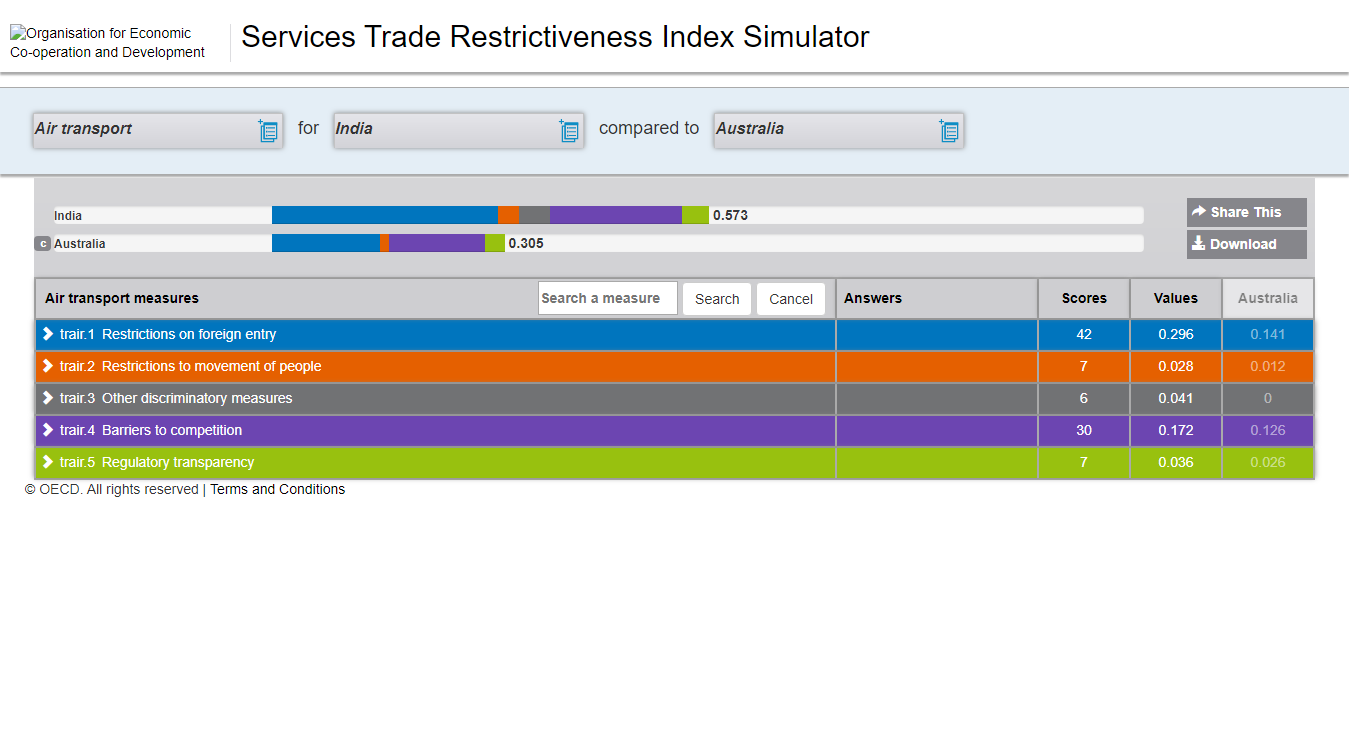
STEP 1- GO TO THIS URL AND SELECT CATEGORY AND FROM WHICH COUNTRY TO WHICH COUNTRY AND SEE THE IMAGE WHICH IS MENTION BELOW.
YOU WILL ABLE TO FIND THE RULES AND REGULATIONS

https://sim.oecd.org/Simulator.ashx?lang=En&ds=STRI&d1c=trair&d2c=ind&d2cc=au

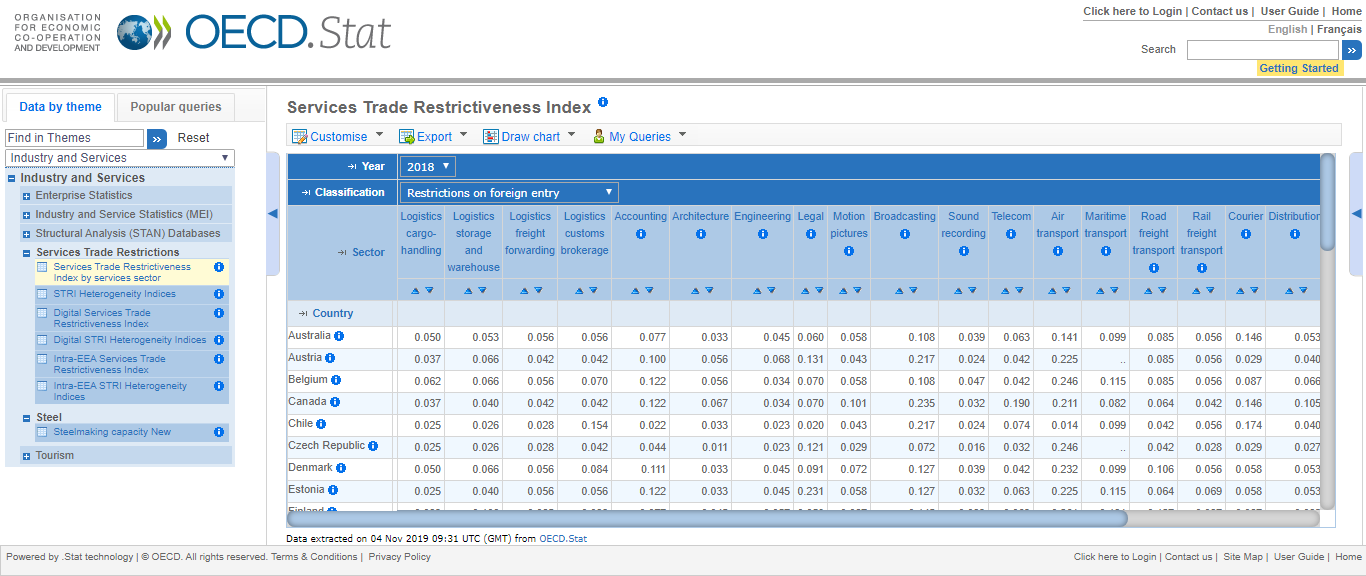
https://stats.oecd.org/Index.aspx?DataSetCode=STRI

CLCIK ON THIS AND SELECT YEAR AND CLASSIFICATION

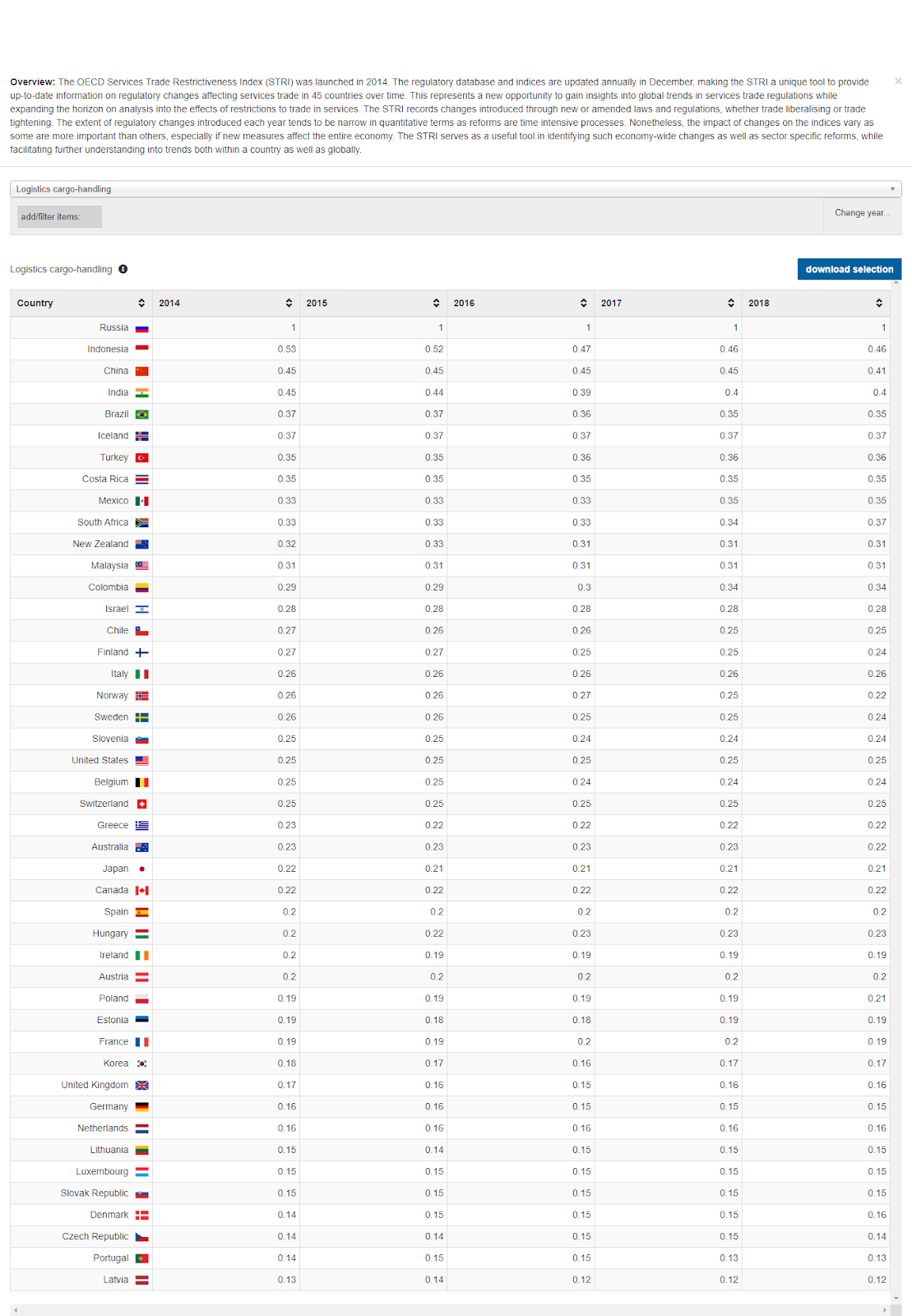
HOW WILL YOU COMPARE WHICH COUNTRY HAS LOWER TRADE RULES REGULATIONS JUST GO THIS URL AND SELECT  CATEGORY AND YOU CAN CHANGE THE VIEW FROM TOP RIGHT

https://www1.compareyourcountry.org/service-trade-restrictions/en/0//ranking/

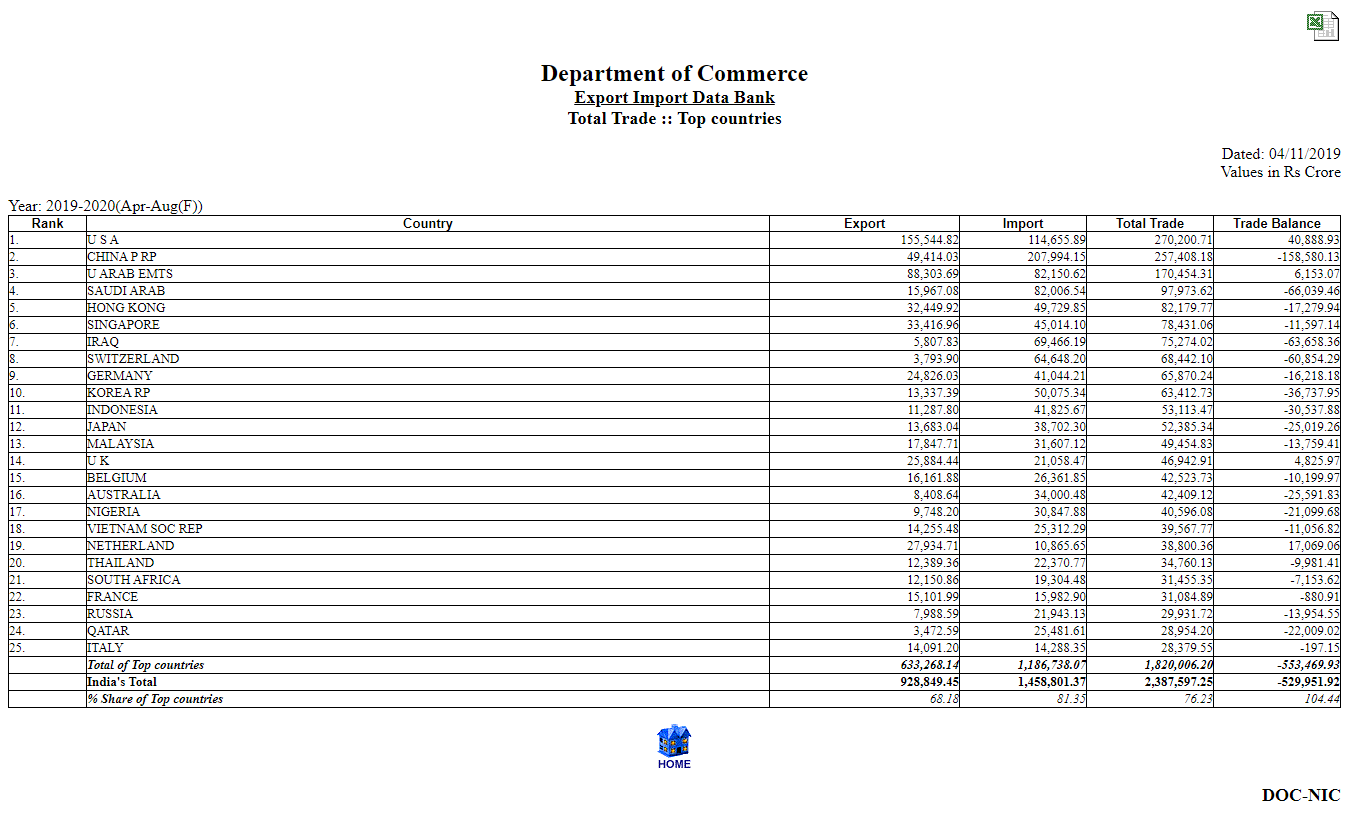
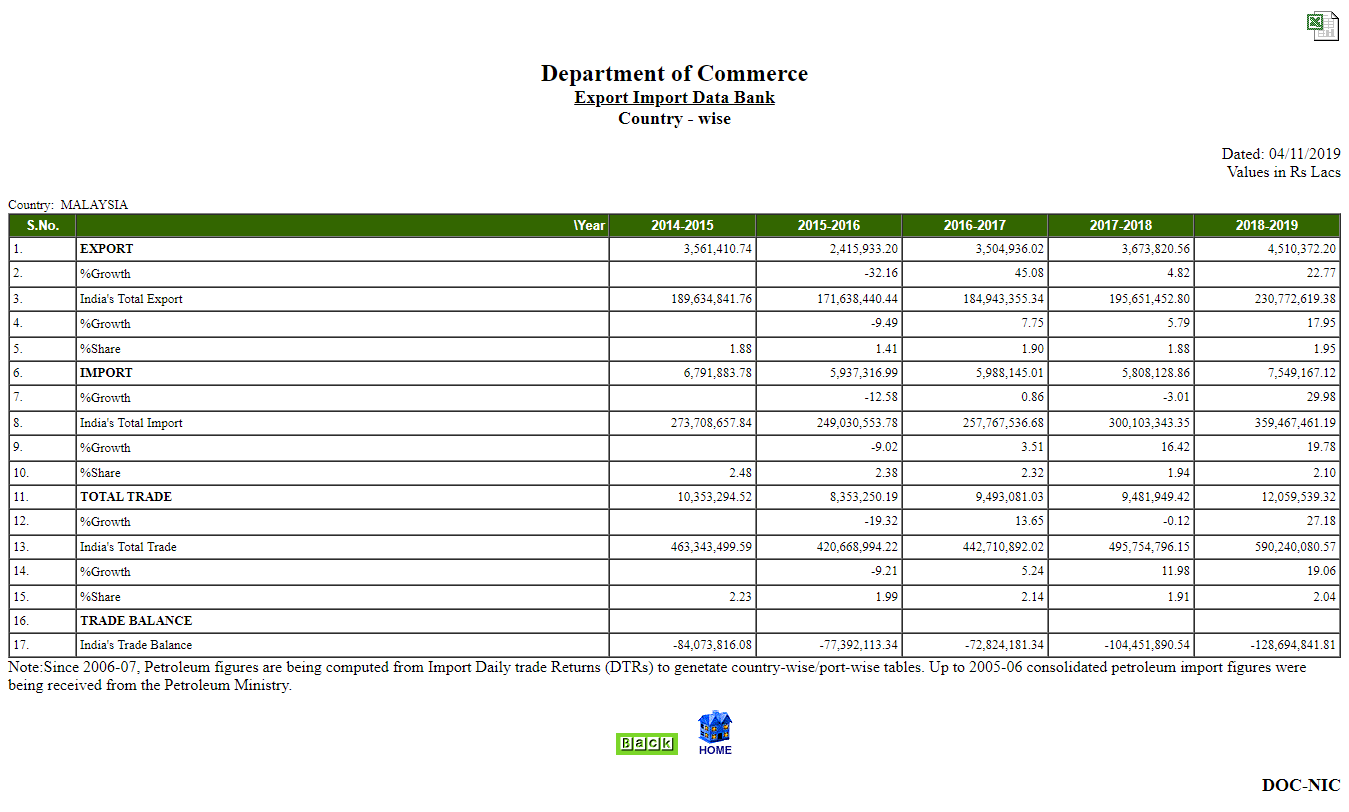
HOW TO FIND LATEST COUNTRY DATA BY GOVERNMENT OF INDIA FOR EXPORT IMPORT BUSINESS

STEP 1 GO TO THIS URL – https://commerce-app.gov.in/eidb

STEP 2 – CLCIK ON COUNTRY AND SUBMIT YOU WILL FIND DATA

STEP 3 YOU CAN FIND BY COMMODITY WISE ALSO

CLICK ON EVERY MENY YOU GET GOOD AMOUNT OF DATA

Top institute for a graduate marine engineering (GME) course in India for merchant navy

The Graduate Marine Engineering (GME) course provides mechanical engineering graduates an opportunity to take up one year course and enter merchant navy by becoming a marine engineer.
In order to become a marine engineer after doing mechanical engineering, one needs to do a compulsory 1-year Graduate marine engineering course.

As an academic discipline, Marine Engineering covers concepts and processes involved in the manufacture, designing and operation of ship machinery and engines. The discipline is about the science of nautical architecture. Marine engineers are responsible for supervising the engine crew involved in operating marine vessels and equipment. Their responsibilities also include checking for the smooth functioning of electric motors, steam engines and propulsive engines etc. Marine engineers constantly work to improve the efficiencies of gas turbines, existing shipboard conventional steam equipment, nuclear propulsion plants and diesel plants.


TOP ONLY 3 INSTITUTE IN INDIA JOIN ONLY THREE NO OTHER INSTITUTE

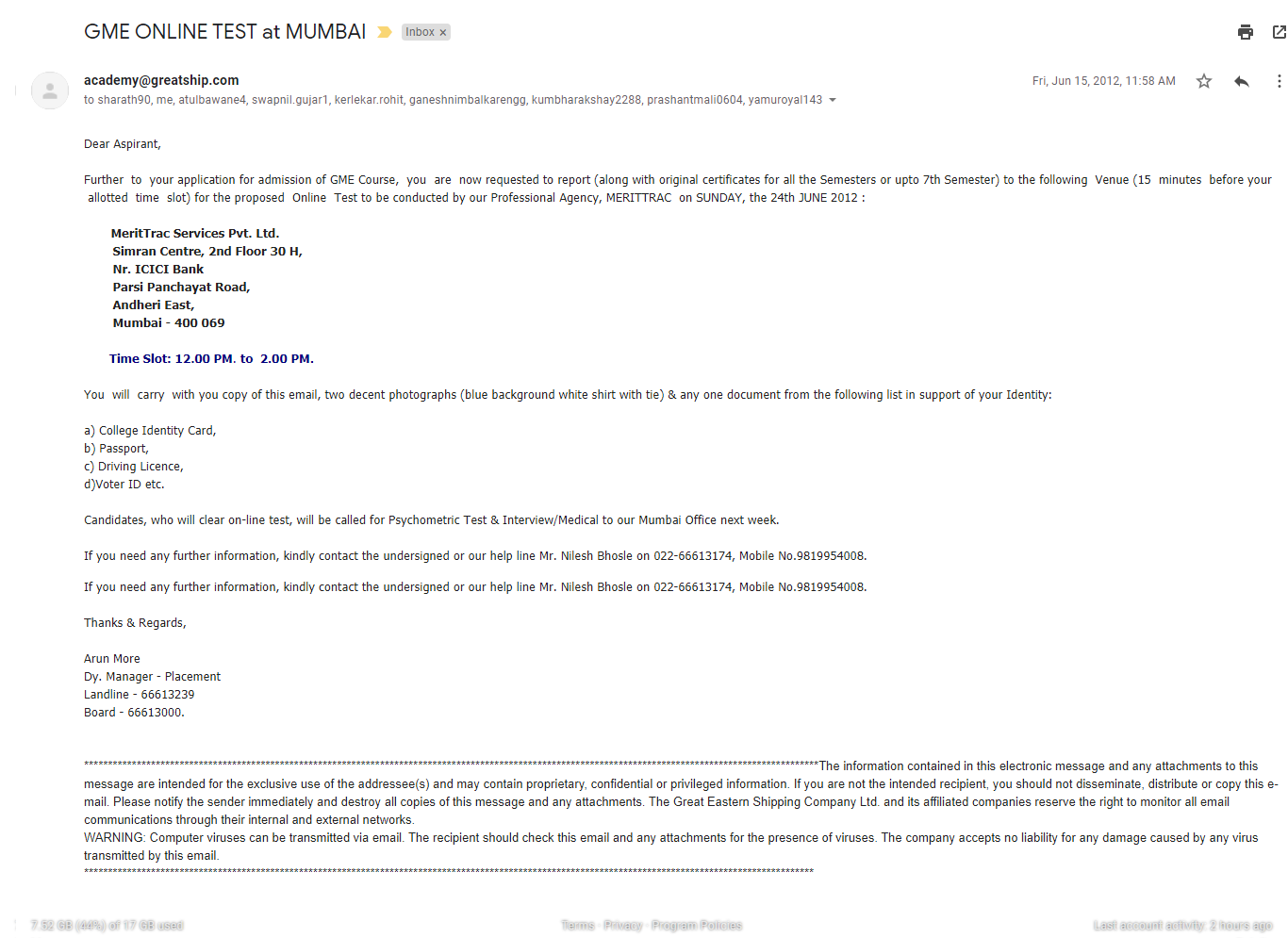
1 GREAT EASTERN ACADEMY LONVALA

http://www.geinstitute.com/


2 ANGLO EASTERN MARITIME ACADEMY

http://www.angloeasterncollege.com/

3  

Samundra Institute of Maritime Studies


REASONS OF JOINING THESE THREE INSTITUTES

THEY HAVE THIER OWN SHIPS NEAR ABOUT 50 TO 100. THEIR SHIPS   SAIL ACROSS THE WORLD


SALARY IS NEAR ABOUT 25 K TO 35 K AT THE TRAINEE MARINE ENGINEER AFTER CLEARLY 8 MONTHS AND PASS 4 TH YEAR EXAMINATION YOU GET A SALARY OF MINIMUM OF 1 LAKH PER MONTH

AFTER 3 TO5 YEAR OF EXPEREINCE YOU GET 5 LAKHS PER M ONTH

AFTER  6 TO 7 YEARS YOU GET SALARY OF ABOUT 10 LAKHS PER MONTH

YOU CAN EARN MAXIMUM 15 LAKHS PER MONTH IN MERCHANT NAVY 

ADMISISION PROCEDURE IS SIMPLE


KNOWELDGE OF SHIPS MACHINERY,

ARCHIETURE OF SHIP

HOW SHIP WORKS

WHAT ALL THE COMPANY IS THERE

WHAT IS 4  STROKE AND  2 STROKE
WHICH OIL USED IN SHIP
WHAT IS MOTOR
WHATT IS ENGINE CONTROL ROOM
WHAT IS BOLIER, VALVE, TYPES OF VALVE, WHAT IS CRANKSHAFT
WHAT IS DECK I SHIP
HOW IS CAPTAIN AND CHIEF ENGINEER ROLES AND RESPONSIBILITY
ENGLISH MUST BE GOOD BOTH IN WRITING AND SPEAKING

STUDY THIS TOPICS VERY WELL

https://www.marineinsight.com/main-engine/how-ships-engine-works/

https://www.youtube.com/watch?v=x1gHPf3G-E0

STUDY WELL ABOUT ARCHITECTURE OF SHIP
AS A 5TH ENGINNER ROLES AND RESPONSIBILITES


INDIAN MARKET CENTERS FOR SPICE PRODUCTS

INDIAN MARKET CENTERS

Spices/Spice
Products
Markets
Spices
Black Pepper Cochin, Alleppey, Calicut, Nedumangad, Konni,
Adoor, Pala, Alwaye, Thodupuzha, Chalakudy,
Badagara, Cannanore, Tellicherry, Kanjangad,
Kasaragod-(Kerala); Bombay-(Maharashtra)
Cardamom Cochin, Thodupuzha-(Kerala); Saklashpur,
Mercara, Medikeri, Mangalore-(Karnataka);
Bombay-(Maharashtra); Virudhunagar, Cumbum,
Bodinayakkanur, Thevaram, Pattiveerampatti-(Tamil
Nadu)
Chillies Virudhnagar, Tuticorin, Sankarankoil, Kovilpatti,
Theni, Ariyalur, Ramnad-(Tamil Nadu); Guntur-(Andhra
redesh)
Ginger Cochin, Alleppey, Punalur, Adoor, Pala,
Alwaye, Moovattupuzha, Thodupuzha, Calicut,
Tellicherry-(Kerala)
Turmeric Alleppey-(Kerala); Erode-(Tamil Nadu); Cudappah,
Nizamabad, Guntur-(Andhra Pradesh); Sangi-(Maharashtra)
Celery seed Amritsar-(Punjab), Nadiad-(Gujarat); Saharanpur-(Uttar
Predesh)
Coriander seed Guntur, Varavakonda, Nandyal-(Andhra Pradesh);
Ramganj (Mandi) Baran,Kotta-(Rajasthan) ;
Thiruchirappilly, Virudhunagar-(Thamil Nadu)

Davangore-(Karnataka); Varanasi, Jaunpur-(Uttar
Pradesh)

Cumin seed Unjha, Palan, Mohsana, Visnagar-(Gujarat);
Jaipur, Kisangarh Kokri-(Rajasthan)
Fennel seed Unjha, Visnagar, Nadiad, Vijapur-(Gujarat);
Patna-(Bihar);

Jodhpur-(Rjasthan); Varanasi, Hathras, Gorakhpur-(Uttar
Predesh)

Fenugreek seed Unjha, Idar, Visnagar-(Gujarat) Jaora,Indore,
Khjner (Madhya Predesh)

Molerkotla-(Punjab), Varanasi,Jampur, Hapur-(Uttar
Pradesh) Jodhpur, Jaipur, Ramganj-Mandi, Bhawani-Mandi,
Baran -(Rajasthan)

Garlic Hassan, Hubli, Gulbarga-(Karnataka); Nizamabad,
Hyderabad-(Andhra Pradesh); Poona, Nasik-(Maharashtra);
Bundi, Ramganj-Mandi Bhawani-Mandi (Rajasthan);
Patna-(Bihar); Surat, Jamnagar, Ahmedabad,
Visnagar-(Gujarath); Nimach, Pipaliya, Mandhasaud-(Madhya
Pradesh); Varanasi, Jaunpur-(Uttar pradesh)
Spice Products
Curry powder Madras-(Tamil Nadu); Bombay-(Maharashtra);
Cochin-(Kerala); Calcutta-(West Bengal); Banglore-(Karnataka)
Oils and Oleoresins Cochin, Calcutta,Alleppey-(Kerala) Bombay-(Maharashtra);
Madras

Madurai-(Tamil Nadu); Banglore-(Karnataka)

SPICES PARK – LOCATIONS

Spices Park

Design a site like this with WordPress.com
Get started