How to find Basic Ocean freight under LCL shipment?

How to find Basic Ocean freight under LCL shipment?


Chargeable Volume under LCL (Less than Container Load) Shipment?

Question 2
Find the total basic Ocean freight for the following LCL shipment:-
a)      Length              –       2.5m
b)      Width               –       1.2 m
c)       Height               –     80 cm  à .8 m
d)      Total weight    –      2 ton 
e)      Rate                   –      $ 20 /cbm
Total items        –     2 parcels with same measurements
Solution
Volume   = length * width* height
    2.5*1.2*0.8 = 2.4
                 2.4 * 2 = 4.8 cbm  
                                                                  
               2 tons means 2 cbm
Since, 2 cbm < 4.8 cbm,   (Gross volume is accounted)     
   4.8 * 20 96
So, Total ocean freight for the LCL shipment is $ 96 


Calculation of Basic Ocean freight under LCL shipment with example

hargeable Volume under LCL (Less than Container Load) Shipment?
Basic Ocean Freight under LCL cargo is calculated on the basis of per CBM (Cubic Meter) rate or per Ton (per 1000 kgs gross weight) whichever is higher.
Or we can say basic ocean freight under LCL shipment is calculated on the basis of chargeable volume of cargo. 
How to find chargeable volume of cargo?  Chargeable volume means total cubic meter volume of cargo or total gross weight in Tons whichever is higher.
XY Ltd. Company wants to send 8 parcels to New York from Chennai. Out of this 8 parcels, 3 of them got same dimensions as length 225cm, width 110cm and height 1.8m and also weights 600kg each. The other 5 parcels also have same dimensions like length is 180cm, width 145cm and height 2m. Each of the parcel weights 600kg. Find the total ocean freight that would cost to the XY Ltd. Company if freight is charged as $35/cbm.
Solution
3 parcels with same dimensions and weight,      
Length             –    225cm   (2.25m)               
Width             –    110cm   (1.1m)
Height             –        1.8m
Weight           –   600kg
Parcels, n       –       3
Volume           –    2.25*1.1*1.8         =   4.455
è               4.455*3           =    13.365cbm
è Total weight, 600*3    =   1800 kg
5 parcels with same dimension and weight
Length            –    180cm   (1.8m)  
Width             –    145cm   (1.45m)
Height             –     2m
Weight            –   600kg
Parcels, n        –    5
Volume           –     1.8*1.45*2         =   5.22
                 5.22*5                 =   26.1cbm
 Total weight, 6000*5       =  30000kg
 Total Volume of 8 parcels    =    13.365 + 26.1 
                                                                      = 39.465cbm
 Total Weight of 8 parcels    =    1800 + 30000 =   31800
                                                 =    31.8cbm (since 1000kg = 1 cbm)
Basic Ocean Freight under LCL cargo is calculated on the basis of per CBM (Cubic Meter) rate or per Ton (per 1000 kg’s gross weight) whichever is higher.
        Here,        31.8 < 39.465 (gross volume is selected since it is higher)
              39.465*35    =     1381.275
  Total ocean freight would cost to the company is $1381.275

How to calculate chargeable weight under airfreight in exports and imports.

Method of calculation of CBM under LCL shipment
In this article let us learn Calculation of CBM under LCL sea shipment. Why to measure LCL shipment? How to calculate volume of cargo under sea LCL shipment? What is the importance of calculation of volume of cargo under LCL shipment?
Calculating volume of cargo is a common subject for all exporters and other shipping related companies. If cargo is Full Container Load (FCL), the freight charge is for full container load basis. But if the cargo is a Less Container Load (LCL), normally a freight forwarder charges freight on the basis of volume of cargo. A freight forwarder charges freight on the basis of CBM.
How to calculate CBM in LCL export shipments copy
The method of calculation of volume of cargo under sea LCL shipment
CBM means Cubic Meter. However, the total weight of cargo should not exceed 1 ton. That means, if the cargo weight is above 1000kgs, the volume of cargo is treated on the basis of weight. In short, freight forwarders charges LCL rate on the basis of ‘per CBM’ or per weight of 1000kgs (1 ton) which ever is higher. CBM – cubic meter is calculated by multiplying length, width and height of packages of goods. For example, if the length, height and width of a cargo is 2.3 meters, 1.4meters and 2 meters respectively, the volume of cargo is 2.3 X 1.4 X 2.00 = 6.44 CBM. If you have the measurement in inches or centimeters, first you need to convert in meters and then calculate CBM which will be easier for you. If freight forwarder quote a rate of USD 10.00 per CBM, the rate will be 6.44 CBM X USD 10.00 per CBM = USD 64.40.
If the weight of the said package is 7 tons (7000kgs), the freight on LCL is calculated on the basis of weight. That is, 7 tons X USD 10.00 = USD 70.00. So, weight of 1 ton (1000kgs) is treated as 1cbm. In other words, the LCL freight is calculated on the volume of 1 CBM or weight of 1 ton (1000kgs) which ever is higher. 

How to calculate CBM in LCL export shipments

In this article let us learn Calculation of CBM under LCL sea shipment. Why to measure LCL shipment? How to calculate volume of cargo under sea LCL shipment? What is the importance of calculation of volume of cargo under LCL shipment?
Calculating volume of cargo is a common subject for all exporters and other shipping related companies. If cargo is Full Container Load (FCL), the freight charge is for full container load basis. But if the cargo is a Less Container Load (LCL), normally a freight forwarder charges freight on the basis of volume of cargo. A freight forwarder charges freight on the basis of CBM.
How to calculate CBM in LCL export shipments copy
The method of calculation of volume of cargo under sea LCL shipment
CBM means Cubic Meter. However, the total weight of cargo should not exceed 1 ton. That means, if the cargo weight is above 1000kgs, the volume of cargo is treated on the basis of weight. In short, freight forwarders charges LCL rate on the basis of ‘per CBM’ or per weight of 1000kgs (1 ton) which ever is higher. CBM – cubic meter is calculated by multiplying length, width and height of packages of goods. For example, if the length, height and width of a cargo is 2.3 meters, 1.4meters and 2 meters respectively, the volume of cargo is 2.3 X 1.4 X 2.00 = 6.44 CBM. If you have the measurement in inches or centimeters, first you need to convert in meters and then calculate CBM which will be easier for you. If freight forwarder quote a rate of USD 10.00 per CBM, the rate will be 6.44 CBM X USD 10.00 per CBM = USD 64.40.
If the weight of the said package is 7 tons (7000kgs), the freight on LCL is calculated on the basis of weight. That is, 7 tons X USD 10.00 = USD 70.00. So, weight of 1 ton (1000kgs) is treated as 1cbm. In other words, the LCL freight is calculated on the volume of 1 CBM or weight of 1 ton (1000kgs) which ever is higher. 

Notification no 40/2019 Customs (Anti-Dumping Duty) date on 15th October, 2019

Seeks to impose anti-dumping duty on imports of Flat rolled product of steel, plated or coated with alloy of Aluminium and Zinc originating in, or exported from China PR, Vietnam and Korea RP.   
 The extract of CUSTOMS (ADD) Notification No. 40/2019- CUSTOMS is given below: 
    Notification No. 40/2019-CUSTOMS (anti-dumping duty)
 [TO BE PUBLISHED IN THE GAZETTE OF INDIA, EXTRAORDINARY, PART II, SECTION 3, SUB-SECTION (i)] 
GOVERNMENT OF INDIA
MINISTRY OF FINANCE
(DEPARTMENT OF REVENUE) 
NOTIFICATION No. 40/2019-CUSTOMS (ADD) 
New Delhi, the 15th October, 2019
G.S.R. (E). – Whereas, in the matter of import of ‘Flat rolled product of steel, plated or coated with alloy of Aluminium and Zinc’ (hereinafter referred to as the subject goods), falling under headings 7210, 7212, 7225 and 7226 of the First Schedule to the Customs Tariff Act, 1975 (51 of 1975) (hereinafter referred to as the Customs Tariff Act), originating in, or exported from China PR, Vietnam and Korea RP (hereinafter referred to as the subject countries) and imported into India, the designated authority vide its preliminary findings No. 6/4/2019-DGTR, dated the 15th July, 2019, published in the Gazette of India, Extraordinary, Part I, Section 1, dated the 15th July, 2019, has come to the conclusion that-
(i)             there is significant increase in imports of subject goods from subject counties in absolute terms as well as in relation to production and consumption in India;
(ii)             the subject goods have been exported to India from the subject countries below their normal values.;
(iii)             the domestic industry has suffered material injury;
(iv)             material injury has been caused by the dumped imports of subject goods from subject countries,
and has recommended imposition of provisional anti-dumping duty on the subject goods, originating in or exported from the subject countries and imported into India, in order to remove injury to the domestic industry.
Now, therefore, in exercise of the powers conferred by sub-section (2) of section 9A of the said Customs Tariff Act, read with rules 13 and 20 of the Customs Tariff (Identification, Assessment and Collection of Anti-dumping Duty on Dumped Articles and for Determination of Injury) Rules, 1995, the Central Government, on the basis of the aforesaid findings of the designated authority, hereby imposes on the subject goods, the description of which is specified in column (3) of the Table below, falling under headings of the First Schedule to the said Customs Tariff Act as specified in the corresponding entry in column (2), originating in countries as specified in the corresponding entry in column (4), exported from the countries as specified in the corresponding entry in column (5), produced by the producers as specified in the corresponding entry in column (6), and imported into India, a provisional anti-dumping duty at the rate equal to
the amount specified in the corresponding entry in column (7), in the currency as specified in the corresponding entry in column (8), and as per unit of measurement as specified in the corresponding entry in column (9), of the said Table:-
Table
Sl.
No.
Heading
Descrition of Goods
Country of Origin
Country of
Export
Proucer
Duty
Amount
Currency
Unit of measurement
1.
7210,
7212,
7225 and
7226
Flat  rolled  product
of  steel,  plated or
coated with alloy of
Aluminium and Zinc
(this alloy may contain one or more
additional  elements
which in individual
or  in  combination
shall not exceed 3%
by weight)      
Korea RP
Korea RP
Dongkuk Steel
Mill Co., Ltd.
28.67
United
States
Dollar
Metric
Tonne
2
do
do
Korea RP
Korea RP
POSCO
113.49
United
States
Dollar
Metric
Tonne
3
do
do
Korea RP
Korea RP
POSCO Coated &
Color Steel Co.,
Ltd.                
113.49
United
States
Dollar
Metric
Tonne
4
do
do
Korea RP
Any
Any other
producer other
than serial number
1, 2 and 3           
122.66
United
States
Dollar
Metric
Tonne
5
do
do
Any country
other than
subject
countries
Korea RP
Any
122.66
United
States
Dollar
Metric
Tonne
6
do
do
Vietnam
Vietnam
Ton Dong A
Corporation           
45.35
United
States
Dollar
Metric
Tonne
7
do
do
Vietnam
Vietnam
Hoa Sen Group
54.07
United
States
Dollar
Metric
Tonne
8
do
do
Vietnam
Vietnam
Tay Nam Steel
Manufacturing
and  Trading Co.Ltd,           
49.05
United
States
Dollar
Metric
Tonne
9
do
do
Vietnam
Vietnam
Nam Kim Steel
Joint Stock
Company           
86.06
United
States
Dollar
Metric
Tonne
10
do
do
Vietnam
Any
Any other
producer other
than serial number
6, 7, 8 and 9           
199.53
United
States
Dollar
Metric
Tonne
11
do
do
Any country
other                than
subject
countries
Vietnam
Any
199.53
United
States
Dollar
Metric
Tonne
12
do
do
China PR
China PR
Zhejiang Huada
New Materials
Co., Ltd.           
68.08
United
States
Dollar
Metric
Tonne
13
do
do
China PR
Any
Any producer
other than
Zhejiang Huada
New Materials
Co., Ltd.           
129.59
United
States
Dollar
Metric
Tonne
14
do
do
Any country
other                than
subject
countries
China PR
Any
129.59
United
States
Dollar
Metric
Tonne
The subject goods mentioned in column (3) in the above Table does not include the following products: –
(a)    Flat rolled steel products coated with Zinc without addition of Aluminium;
(b)   Flat rolled steel products coated with Aluminium without addition of Zinc; and
(c)    Pre-painted or colour coated Aluminium Zinc alloy coated steel sheets (Pre-coated SGL sheets).
  1. The provisional anti-dumping duty imposed under this notification shall be effective for a period of six months (unless revoked, amended or superseded earlier) from the date of publication of this notification in the Official Gazette and shall be payable in Indian currency.
Explanation.- For the purposes of this notification, rate of exchange applicable for the purposes of calculation of such anti-dumping duty shall be the rate which is specified in the notification of the Government of India, in the Ministry of Finance (Department of Revenue), issued from time to time, in exercise of the powers conferred by section 14 of the Customs Act, 1962, (52 of 1962), and the relevant date for the determination of the rate of exchange shall be the date of presentation of the bill of entry under section 46 of the said Customs Act. 

Difference between FCL and LCL

If an exporter has goods to accommodate in one full container load, he books an FCL Difference between LCL and FCL copy(Full Container Load) to stuff his cargo. In an FCL cargo, the complete goods in the said container owns by one shipper. In an FCL owned by one shipper, the cargo in the container need not have fully loaded cargo in the container. Let the cargo be half loaded or quarter loaded container, if booked by one shipper under one shipment, the said shipment is called FCL shipment.
Under an LCL cargo, where in a shipper does not have enough goods to accommodate in one full container, he books cargo with a consolidator to console his goods along with goods of other shippers. This type of shipment is called LCL shipment. The said consolidator arranges a fully loaded container (FCL), and consoles the shipments of other shippers and deliver each shipment to final destination by separating each shipment at final destination

How to book empty container for factory/CFS/ICD/port stuffing

The information provided here is part of Import Export online Training
Empty container booking procedures with shipping lines
This is a simple question – What are the procedures to book an empty container with shipping line for factory/CFS/ICD/port stuffing? Can a shipper be allotted empty container for stuffing of his goods immediately up on contacting shipping carrier? Where does the empty container of shipping carrier lie?
Once the cargo packed and ready for export, shipper makes arrangements to ship the said goods to buyer’s place as per his purchase order or Letter of Credit. He enquires with shipping lines or freight forwarders to get the best ocean freight and How to book empty container for factory CFS ICD port stuffing copyservices, if the freight terms are on ‘Pre Paid’ basis. He finalizes a carrier and confirms his acceptance of freight.
If the shipment is on nomination basis, the shipper contacts shipping carrier to whom his buyer nominated.
The carrier requests the shipper to book the container either online or by e-mail by providing details required by the carrier. After completion of booking procedures, carrier provides a booking confirmation to the shipper, by issuing a ‘deliver order’ to pick up the container from their empty container yard. Means, each shipping line has their own or hired location/yard to park their empty containers. The booking confirmation/delivery order to pick up empty container is mentioned the place of yard/location where the empty container lies.
The shipper or his customs broker arrange a transport truck to move the said empty container from carrier’s yard to his factory for stuffing. A stack period is given to shipper by carrier to return back the stuffed container. ‘Stack period’ is the period allotted to ship authorities to return all stuffed containers to port terminal for loading in to a particular vessel. The empty container is moved to exporter’s factory for factory/CFS/ICD/port stuffing.  

how to find top countries for export by trade map

https://www.udemy.com/home/my-courses/learning/

login – vizpathak@gmail.com
password- sonupathak@123
go to the courses  click on
https://www.udemy.com/course/exim-a-z-a-wholesome-approach-to-exportsimports-business/learn/lecture/10587720#overview

  2 course international freight forwarding 
3  course shipping an logistics 
4 course how to find buyers by using Go4worldbusiness

5 there are many digital marketing courses you can access for export import business

if you any doubts related to digital marketing put your comments below. charge is free for any support 

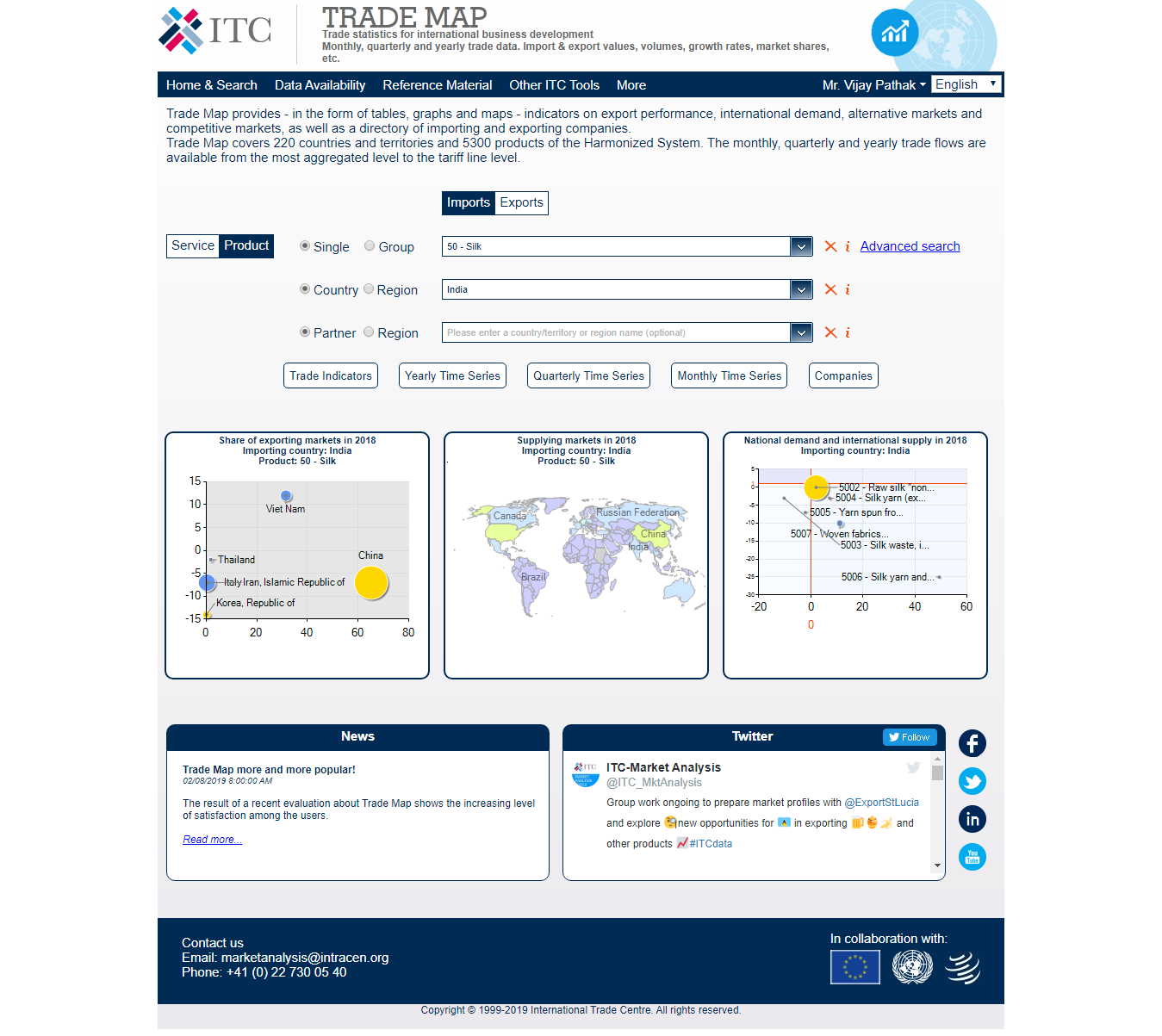
step 1 go to trade map https://www.trademap.org/

step 2  select your product and click on trade indicators . you can find top countries
, also click  on graphs .you will able to know which products is in demand .  ,less demand,  click on companies you have able to know companies in a particular country .there is a proper course for who to use trade map.
step 3 different tools are there like click on other tools in trade map . you can see market access map.export potential  map.use all map for export import data .

Technologies Changing the Freight Industry- IoT, Artificial Intelligence and Cloud Computing

Technologies Changing the Freight Industry- IoT, Artificial Intelligence and Cloud Computing

by Rishi Agarwal | 04 Jan, 2019 | Read Time: 2 minutes

Technology has revolutionized the way business is performed all around the world. With the introduction of better and more advanced technology, operating business has become much easier and efficient. Technology has affected not only one, but all types of business dealing in different products and services.
The Freight industry is one which has seen a significant change in their business operations due to the integration of advance technologies in their systems. Supply chain productivity has risen notably due to these advances and has helped in minimizing cost and error in the industry.
Technology has an impact on all operations of the logistics industry, from transportation either by air or ocean, to supply chain management and even shipment tracking.
Let’s take a look at the 3 major technological advancements that are changing the freight industry for the better:


1) Internet of Things (IoT):
In the freight industry, having access to real time data is very important. The IoT technology is an efficient way of managing supply chain and logistics and making them more organized and error free. 
Companies have started adopting this technology in order to increase their productivity and optimize their operations. From creating ‘smart warehouses’ which are operated by robots who store, arrange and retrieve inventory with efficient ease, to using IoT sensors for detecting goods, companies have transferred all their logistic operations to be handled by IoT. All IoT compatible devices can communicate, coordinate and connect with each other to perform supply chain management tasks in a synchronized manner.


2) Artificial Intelligence (AI):
AI/machine learning is a technology which is being widely adopted by supply chain companies to facilitate better management and growth. AI is the future of supply chain management market. Here’s how AI/machine learning helps the supply chain market:
  • AI helps in better negotiations to get you the lowest price for hardware and software. It also helps you analyse the supply, quality and demands as well as the services, warranties and Mean Time Failure of a product.
  • With all the useful data at your disposal, AI helps you analyse it and provides real time advice on how the inventory management can be made more effective.
  • Order management can be done in a more accurate and efficient way with the help off AI tools.


3) Cloud Computing:
Cloud computing is another technology which has improved the operations in freight industry by providing exceptional data handling solutions. Data is readily available on the internet and can be accessed from anywhere around the world.These are the ways in which cloud computing helps the supply chain market:
  • It allows real-time evaluation of prices associated with each logistics and supply chain element.
  • You have access to real-time inventory and thus inventory management becomes simple.
  • Your data gets stored in matrices and divisions which helps you find out similar shipping and procurement patterns.
  • It allows real-time monitoring and helps in creating accurate models of merge in transit.
  • Your entire team can access data regardless of the time and place they are stationed at. This gives way to faster and efficient operation.


Conclusion

Managing supply chain and logistics has become less challenging with the introduction of these technological advancements. There are limitless possibilities for the development of freight industry when it is integrated with technology.

3 Mandatory Documents that Exporters and Importers Need to Have for a Hassle-free Shipping Experience

Documents are a necessary evil in all business transactions. Be it sales, purchase, or shipping, if even a single document is missing, it creates havoc for all the parties concerned. 
In shipping, documentation is an indispensable part of transporting goods from country to another. Goods cannot enter or leave a country without relevant and complete documents accompanying the cargo. 
It is therefore necessary that the exporters and importers double check all the documents. Without the complete set of documents, they will not be able to handover or collect the cargo, and might even end up incurring a penalty.
Earlier, exporters or importers were required to submit around 7-8 mandatory documents and any other paperwork required depending on the nature of the cargo or the importing/exporting country’s rules and regulations. This had made the process quite tedious and expensive.
What’s new?
In 2015, in an effort to improve the export and import process, the Department of Commerce had set up a committee to study the procedure and recommend ways to reduce the documentation required in the export process. The committee, after due study and consultation with concerned authorities, recommended to keep three mandatory documents for exports and three mandatory documents for imports.
Based on the recommendations of the committee, the Director General of Foreign Trade (DGFT) had issued a formal notification to announce the changes in the documentation requirements. The new rule came into force from April 2015. According to the new rule, the three mandatory documents required for export and import are:
3 Mandatory Documents Required for Exports:
Bill of Lading: The bill of lading is the most important document in the shipping process for both export and import. It is a legal document which contains all the details pertaining to the cargo being shipped, the destination, the terms of sale, and the details of the recipient. It must be signed by the appointed signatory of the shipping line, the exporter, and the importer.
For smooth transportation of goods from one place to another, it is necessary that the exporter obtain a correct and complete bill of lading from the shipping line/forwarder. He must then send the bill of lading to the importer. The importer can collect the cargo only after he presents the bill of lading to the shipping line at the destination port.
Commercial Invoice-cum-Packing List: A commercial invoice, as the name suggests, is a document that provides the details of the sales transaction like name of seller and buyer, the value and quantity of the goods sold.
A packing list contains the details of the goods that are being shipped. It should mention the correct description of the goods, quantity, weight (gross and net), number and type of packages, and marks and numbers, carrier name, export date, export license number, and letter of credit number. This information is necessary for the Customs to ascertain the value of the goods and to facilitate examination at the time of clearance.
Importers in India must obtain a copy of the commercial invoice and packing list as they need to present the same to collect the cargo.
Shipping Bill/Bill of Export: A bill of export or shipping bill is a document requirement by the customs authority. It provides the details of any benefit that the shipper has availed in terms of customs duty, export schemes of the government, credit obtained under DEPB. If the goods are re-export of previously imported goods, then such details are also mentioned in the bill. The Customs do not provide clearance without a shipping bill or bill of export.
3 Mandatory Documents Required for Imports:
Like in exports, bill of lading and commercial invoice-cum-packing list are also mandatory documents for importing goods into the country. The importer needs to collect these documents from the exporter. Apart from these two documents, importers also need to present a bill of entry to be able to collect their cargo at the destination port.
Bill of Entry: A bill of entry is a declaration by an importer or his appointed agent. It provides details of the type of cargo, its value, and quantity. It is prepared in three copies. The Customs inspect and clear the goods based on the information provided in the bill of entry. To ensure that there is no malpractice regarding the value of the goods, the bill of entry is tallied with the sales invoice or insurance policy.
These are the main documents that must accompany every import or export shipment. 
*Additional documents might be required depending upon the nature of the cargo, or due to any other rules and regulations of the authorities in India or of the country with which the exporter or importer is doing business. For any specific country or product related documentation, traders must check with their agents or shipping lines.
Design a site like this with WordPress.com
Get started